The booking is confirmed. The crew is on the calendar. Most moving companies stop selling here — the estimate closed, the invoice is written, all that’s left is to show up and load the truck. That instinct leaves money on the table, because the customer at booking time is not done making decisions. They have decided they need help. They have not decided how much.
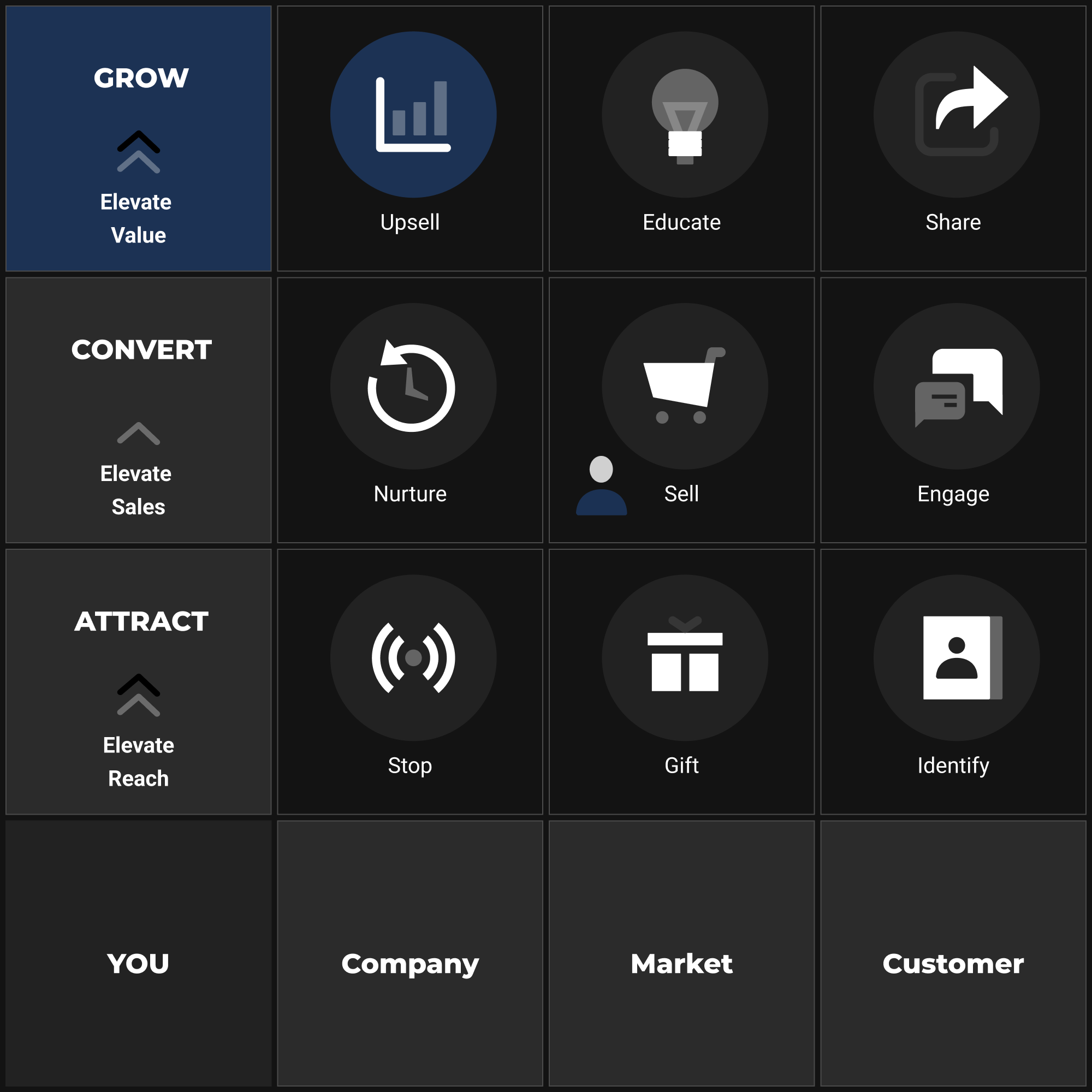
This is Stage 7 of the GROW band: Upsell. Not a hard-sell script bolted onto the end of a call — a ladder of optional services, presented at the one moment the customer is already thinking about price and effort, so saying yes to more feels like an extension of the decision they are already making, not a second ask.
The Ladder: Just Move → Full Service
The ladder has four rungs, each adding labor and removing a piece of the customer’s own effort:
- Labor-only / “Just Move.” The customer has packed everything. Your crew loads, drives, unloads. This is the entry offer — the cheapest way to get a truck and trained movers on the job — and for many customers it is exactly what they want. This rung is not the upsell target; it is the floor everything else is built above.
- Partial packing. The customer packs most of the house but hands off the room they dread — almost always the kitchen, sometimes the garage or a home office full of loose cables. This is a small, bounded line item: “pack my kitchen only,” priced as an add-on to the base labor quote, not a second estimate.
- Storage. For customers whose move-out and move-in dates do not line up — a gap of days, weeks, or longer — storage bridges the timeline. This rung has a longer sales horizon than the other two; it is not always decided at booking, but it should always be offered at booking.
- Full Service Move. You pack everything, move everything, unpack on request. This is the top rung — full labor, full materials, full peace of mind — priced accordingly. Most customers reach it only after saying yes to a smaller rung and discovering how much friction it removed.
Notice the shape: every rung is optional, every rung is a real line item with its own price, and every rung removes a specific, nameable pain rather than bundling vague “extra service.” A customer choosing between rungs should be able to say, in one sentence, what they are paying for and what it saves them from doing themselves.
Why the Estimate Call Is the Moment
Stage 5 — the estimate — is where the customer decides on price. That makes it the best moment to present the ladder.
A customer on the estimate call is already in deciding mode. Their guard is down, because they called expecting to talk about scope and price. A ladder presented here reads as a clarifying question (“do you want us to pack anything, or is everything boxed already?”) rather than an interruption. The same offer made in a follow-up call, after the price is locked in the customer’s head, reads as a bait-and-switch. Timing is the difference between an upsell that lands as helpful and one that lands as pressure.
Build the packing and storage questions into the estimate script as a two-question branch — “Is everything packed, or would you like a hand with any of it?” and “Do your move-out and move-in dates line up, or is there a gap we should plan storage around?” Both surface a real need the customer may not have thought to mention, and both give you a clean, honest reason to quote a second line item rather than a second sales call.
Packing: The Highest-Margin, Easiest Add-On
Of the three upsell rungs, design packing first. It solves a pain almost every customer feels — the fear of the fragile item, the exhaustion of boxing an entire kitchen after a full work week — and it is the smallest possible ask: a partial-packing line item, not a full-service commitment. “We’ll pack your kitchen, you handle the rest” is a sentence a customer can say yes to on the spot, because it is bounded, priced, and solves a specific dread rather than asking them to hand over the whole house.
Frame this rung around the pain it removes, not the service category. “Kitchen packing — we wrap the glassware, box the pantry, you don’t have to think about it” beats “packing services available,” for the same reason a specific hook beats a vague one in Stage 1: the customer has to picture themselves relieved of the task before the offer means anything.
Storage: The Longer-Horizon Upsell — and an Expansion Lane of Its Own
Not every customer has a gap between move-out and move-in — but the ones who do have a real, unavoidable problem, and storage is the only rung on this ladder that solves it. Present it as a question, not a pitch: does the closing date line up with the move-in date? If there is a gap of even a few days, storage is not an upsell in the pushy sense — it is the only way the move works. Customers in this situation are often relieved someone asked, because they had not yet solved the problem themselves.
This rung has a different rhythm than packing. A customer might not decide on storage at the estimate call — they might need to check a closing date or confirm a lease — but make the offer there, so the option is in their head before the timeline forces a decision under pressure. A follow-up touch closer to the move date, referencing the gap they mentioned, closes the loop without feeling like an unprompted pitch.
Everything above is storage as the move-gap bridge — the short-term rung, decided (or not) on the estimate call. But a second kind of storage hides inside the same word, and it is a different product entirely.
Short-term vs. standalone. Short-term storage is that bridge: days or weeks, decided in the context of a move you are already quoting. Standalone storage is something else — a customer who wants space with no move attached, or a move customer whose “just a few weeks” quietly becomes a year. That customer is not buying a move. They are renting a recurring service, billed month after month, and they may have found you searching for storage alone, having never once thought about hiring movers.
That distinction is why storage is the highest-headroom bet on this ladder. Every other rung is tied to a move — one job, one invoice, done. Standalone storage is recurring revenue: it bills every month whether or not anyone touches a truck, and it fills the seasonal troughs when moving demand goes quiet. A mover who stores is running two businesses on one set of assets.
Storage earns its own column in the matrix. People search “storage in [your city]” who will never type “movers” — so storage does not belong only as a question on the estimate call. It belongs in the City × Service Matrix from Stage 1 (HOOK) as its own column, beside local move, long-distance, and office move: one landing page per city for storage, tuned to the storage searcher’s specific worries — climate control, access hours, month-to-month terms, what happens to their things — rather than to someone planning a move. Movers routinely leave this demand on the table because they file storage under “add-on to a move.” The ones who build it out as its own service line capture a stream of customers their move-only competitors never see.
State your storage capability only where it is real — if you have not opened a facility, do not build the pages. But the moment the space exists, storage stops being one rung on an upsell ladder. It becomes a new column on the grid, a recurring line on the books, and the clearest place a moving company can grow without booking a single extra truck.
Full Value Protection: Risk, Not Just Price
The valuation disclosure in Stage 5 — the estimate — is where the customer first learns what basic liability coverage actually covers, and it is usually less than they assume. Full Value Protection answers the gap: instead of a small per-pound liability limit, you cover the repair, replacement, or cash value of anything damaged in the move.
Frame this rung around risk transfer, not price. The question is not “do you want to spend more” — it is “who is holding the risk on your grandmother’s dining table if something goes wrong.” Customers who just walked through a clear valuation disclosure are the easiest to sell this rung to: you are not introducing a new fear, you are offering to close one they were just told about.
Specialty & White-Glove: The Move That Can’t Be Redone
The ladder so far measures one thing — how much of the move you handle. There is a second axis it does not capture: how hard, how rare, or how irreplaceable the thing being moved is. That axis is where the highest margins on this page live, and it is a distinct service line — not a bolt-on to any rung above it.
Some items cannot be re-bought if they break. A piano. A generations-old antique. A piece of fine art. The contents of an estate. A safe, a hot tub, a rack of sensitive equipment. The customer moving one of these is not lying awake over the hourly rate — they are lying awake over the image of an untrained summer hire tilting the piano the wrong way on a staircase. The pain this rung removes is not effort. It is the fear of an irreplaceable thing destroyed by someone who moves anything for anyone.
Price it as its own line, and frame it as a profession, not a service. This is the rung that lets you refuse to compete on hourly rate at all: you charge more because handling an irreplaceable item is a trained capability — crating built to the object, the right equipment, people who have done it before — not a seasonal job filled by whoever answered the ad. A mover who can credibly say “this is what we do” here has stepped out of the same market as the cheapest truck in town.
State the capability only where it is real. If your crew has genuinely moved pianos, art, or estates, say so plainly — that specific proof is the whole offer, and it is the one claim a templated competitor cannot fake. If it hasn’t, keep it off the ladder: a botched specialty move is the review that outruns every good one. Where it is real, this rung pairs naturally with Full Value Protection — the customer transferring the risk on an irreplaceable object is exactly the customer who wants coverage that pays to make them whole, not a few dollars per pound.
AI Earns Its Place Here
Feed your business profile — your service list, your typical move size, your typical gap between move-out and move-in — into an AI assistant and ask for two things: a packing upsell script built around your most common dreaded room, and a storage upsell script built around your typical timeline pattern. Ask for both as questions the estimator can ask naturally on the call, not pitches read off a script.
Push back on anything that sounds like a universal price — a script that says “$X for packing” is copying someone else’s rate card, not yours. The right output names the pain, names the rung, and leaves the number to your own pricing sheet. What survives that edit is a ladder your estimators can actually use on the next call.
If you have opened storage or run specialty moves, ask for two more things: storage landing-page angles written for the storage searcher’s worries in your city — access hours, month-to-month terms, what happens to their things — so the page can join your City × Service Matrix as its own column; and a specialty script that names the exact one-of-a-kind items your crew has actually handled. The rule holds harder here than anywhere: strike any line that invents a capability you don’t have or borrows a price that isn’t yours. The only proof worth publishing is the move you have really done and the number off your own sheet.