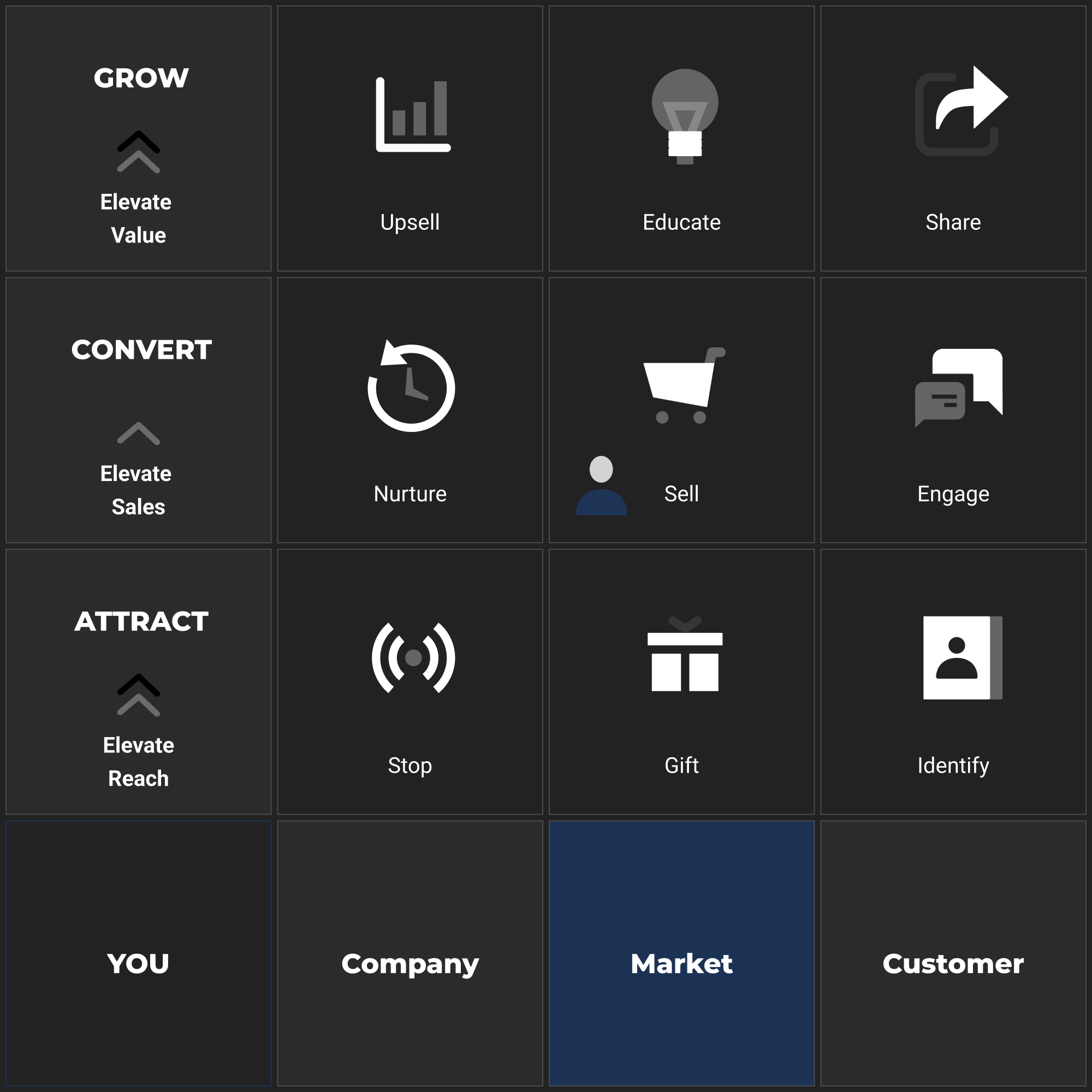
You’ve probably seen the competitor spreadsheet making the rounds — the one with a tab per rival, a column for every feature, a colour-coded grid of who-charges-what, lovingly maintained by a founder who mistakes surveillance for strategy. It is the great comfort ritual of early business: open a dozen competitor sites, screenshot their pricing, note that one of them just launched a new colourway, and feel, for an afternoon, like you have done the work. You have not done the work. You have done its cosplay. Watching what your rivals do is not a strategy; it is a way to end up doing what your rivals do, slightly later and slightly worse.
The Company pillar gave you internal clarity — your offer, your unique mechanism, your brand voice, the positioning you intend to own. That clarity is real. It matters. But a business does not compete against itself, and the moment you step outside, you are surrounded by alternatives, shoved around by forces no single rival controls, and judged by customers who have heard a hundred promises that sound exactly like yours. So the Foundation Blueprint you are building stays half-formed until it reckons with the world outside the building. This chapter completes the second pillar: Market Awareness. And it treats the field as reconnaissance, not as a shopping list of things to imitate.
By the time you finish, you will hold a completed Market Awareness profile — a structured picture of who you compete against, what forces are reshaping the ground, and where the attention battles actually take place. More than that, you will have a clear-eyed read on where your differentiation is genuinely meaningful and where it is merely assumed. That last part is the point. This pillar does not just describe the world outside; it puts the internal work you already did on trial against it.
The cost of skipping it is not abstract. A business with a beautifully articulated Company Context and a poorly understood market writes messaging that sounds magnificent in the meeting and lands like a wet leaflet in the feed. It picks channels because the founder likes them, not because the customer is on them. It calls itself “differentiated” in ways its competitors match word for word, because nobody bothered to check. And when the HOOK campaigns launch and the click rates flatline, the post-mortem will trace the wound straight back to here — to a Foundation pillar that looked finished on the page and never once touched the world it was meant to navigate.
The objective of this pillar: map the competitive landscape, the forces reshaping it, and the channels where your ideal customer’s attention concentrates — and use that map to sharpen your positioning, validate your differentiation, and make deliberate choices about where and how to show up.
In the language of the Multiplier Principle, Market Awareness is not a numbered lever in the chain. It governs the quality of every lever’s performance instead. A hook written from genuine knowledge — of how competitors message, what pains the market has not yet solved, which channel the customer actually inhabits — beats a hook written from guesswork at every stage, for the same effort. Foundation work done properly is a multiplier on the multiplier. Rushed or skipped, it is a tax the whole chain pays quietly, indefinitely, and without ever sending you the bill.
Why the Foundation multiplies everything
Worth pausing on what kind of work this is, because it is easy to file it next to the action steps and treat it the same way. It is not the same kind of thing. Market Awareness is not the tenth lever in your business; it is not a step you execute and measure like HOOK or SELL. It belongs to the Foundation, and the Foundation does something stranger and more useful than any single lever. It governs the quality of every lever’s improvement.
Recall the Multiplier Principle: your revenue is the product of your levers — traffic, click rate, opt-in rate, conversion, average order value, repeat and referral — and the gains you make at each step compound through the chain rather than merely stacking on top of one another. The Foundation sits underneath that whole equation. A hook written by someone who knows precisely where their rival is weak, and which channel that rival has neglected, outperforms a hook written from a hunch — same step, same effort, different outcome. A sales page that counters the exact objection the market has been trained to raise converts better than one arguing into an empty room. Market Awareness is the difference, repeated nine times over, between a fifty-per-cent gain at a step and a five-per-cent one. It is not a number in the chain. It is the sharpness of every number you will later move. Which is why doing it properly is the cheapest investment available to you, and rushing it the most expensive shortcut.
Why market awareness works
The whole case for looking outward rests on one unglamorous fact about how customers decide. People do not evaluate products in absolute terms. They evaluate them in comparison. “Is this good?” is a question almost nobody asks. “Is this better than the alternatives I already know about, for the thing I’m actually trying to do?” is the question everybody asks, usually without noticing they have asked it. Your entire job in positioning is to win that comparison — and you cannot win a comparison whose other side you never bothered to read.
This is why differentiation means nothing in isolation. To call yourself “higher quality” or “more personal” or “better value” is to say precisely nothing until those claims are pinned against specific rivals who are specifically weaker on those exact dimensions. Differentiation is a relative property. It exists only in the gap between what you do and what the alternatives fail to do — and that gap can only be measured by examining the alternatives. Most of this pillar is the work of finding that gap and naming it precisely enough to build a business inside it.
There is a second, quieter reason, and it reaches forward into every channel you will later pick. Attention is neither evenly distributed nor free. Your competitors have already colonised certain channels and certain messages; the ground there is trodden flat, the noise is deafening, and a newcomer shouting the same line in the same room is simply absorbed into the racket. But markets are lumpy. There is always a channel your customer frequents that the incumbents never staffed, a communication style nobody bothered to try, a conversation happening somewhere the big players consider beneath them. Market Awareness is how you find that less-crowded ground — not because being contrarian is clever, but because the economics of attention pay best to the operator fishing where the others are not.
And a third reason, which wires this pillar straight into the AI work threaded through the whole framework. To instruct a model to write copy that stands out, you have to be able to tell it what it is standing out from. Feed an AI nothing about your competitive context and it will regress, confidently, to the mean — handing you back the same generic claims your rivals already make, because the mean is exactly the soup it was trained on. Feed it a clear read of competitor messaging, market sentiment, and the tired clichés of your category, and you can aim it: counter them, occupy the gap, sound like the exception rather than the rule. Your market intelligence is the raw material that makes machine-written content distinctive instead of derivative.
The anatomy of market awareness
Before building the grid, it helps to see what a complete read of a market is actually made of. Pull apart any sound piece of market analysis and the same three layers fall out, each answering a different question — and a sound strategy needs all three. Mapping the ontology’s MarketAwareness profile, these are the Competitors, the Market Trends, and the Channel Characteristics. The discipline is to treat each as a layer in its own right rather than mushing them together into a vague feeling about “the competition”.
The first layer is the Competitive Set — the specific rivals contesting your customer’s attention and budget. This is the most concrete layer and the one most operators stop at. Stopping here is the mistake, because a list of competitors is only the observation. The analysis lives in their weaknesses — the complaints in their reviews, the feature they lack, the segment they ignore, the message that has gone limp through overuse. Your differentiation lives in those weaknesses, which is why naming them precisely matters far more than naming the competitors does.
The second layer is Market Forces and Trends — the larger currents moving under the surface of the immediate scrap. Technological shifts, cultural turns, economic pressure, regulatory tightening, changing expectations: forces no single competitor controls but that quietly rewrite what customers want and fear. Trends matter because they manufacture new pains and unmet needs faster than any individual rival can address them, and the business that reads a trend early occupies the position before it gets crowded. The art here is relevance — filtering the endless churn of “trends” down to the handful that genuinely touch your niche and your customer.
The third layer is Channel and Communication Context — the surfaces where the contest physically happens, and where your customer actually spends their attention. This is the layer that reaches forward most directly into the ATTRACT level, because it decides where your HOOK will fire and how your Brand Voice must bend to suit each surface. It asks two questions at once: where is the noise, and where is the customer? The valuable ground is wherever those two answers diverge — where the customer is present but the competition is not yet loud.
Competitors, trends, channels: the field as it stands, the currents moving it, the ground you will fight on. A market read missing any one of the three is not a read. It is a fragment.
The Market Awareness Grid
To run this scan deliberately rather than by vibe, work through the Market Awareness Grid — the signature tool of this pillar. Its structure is a three-by-three matrix: the three layers you just met form the rows, and three modes of thinking form the columns. The first column is observation — what is simply there, recorded honestly before you start drawing conclusions out of thin air. The second is analysis — the weaknesses, the gaps, the unmet needs the observation exposes. The third is strategic response — the position you will take, the differentiation you will claim, the channel and voice decisions that follow. You move left to right across each row: see clearly, then think, then decide. In that order, every time. The order is the whole discipline.
| Observe — what is there | Analyse — the gaps and weaknesses | Respond — your strategic position | |
|---|---|---|---|
| A. Competitive Set | List the 2–4 rivals contesting your customer most directly. Their main offering and stated value proposition. | Where they fall short: review complaints, missing features, generic messaging, ignored segments. | How your Unique Mechanism overcomes a named weakness or serves an ignored segment. The honest answer to why you. |
| B. Market Forces & Trends | The 2–3 technological, cultural, economic or behavioural shifts genuinely touching your niche and customer. | The systemic pains and unmet needs those trends create or expose — beyond what any competitor addresses. | Which trends to ride and which to stand against; how your narrative aligns with or counters each. |
| C. Channel & Communication Context | Where your customer and competitors actually spend attention; the tone and noise level of each surface. | Which channels are saturated by rivals; which are underused or overlooked; which styles are underserved. | Where to prioritise your HOOK; how your Brand Voice must adapt to cut through on each chosen channel. |
The grid is not a form to fill out before lunch. Each cell is a small investigation, and the value is entirely in the rigour you bring to it. What follows is a tour of each row, with the kind of concrete reasoning a seasoned operator actually brings to the work.
Row A — the Competitive Set
Begin by observing honestly. The discipline here is to resist boiling the ocean. You are not cataloguing every business in your category; you are naming the two-to-four players — direct or significant-indirect — who fight hardest for your particular customer’s attention and budget. For a maker of premium men’s performance hoodies, the relevant set is not “all clothing companies” but the handful of brands a fitness-minded buyer would genuinely weigh against you. Visit their sites. Read their copy. Note the value proposition they actually state, not the one you imagine they hold — those are rarely the same sentence.
Then analyse — and this is where most reads go shallow and self-congratulatory. Put on a sceptical customer’s hat and go hunting for weakness. Read the reviews, and dwell on the ugly ones, because the negative review is where a competitor’s failures are documented, for free, by the very people they let down. A pattern of complaints — inconsistent sizing, slow delivery, pricing only a tax lawyer could parse, support that answers in a week and a half — is a map of openings. So is a segment they ignore: the larger sizes they never stock, the beginner they talk down to, the use case they pretend does not exist. Name two or three specific weaknesses for each rival that counts. Vague impressions are dead weight here. “Their marketing is a bit generic” is a shrug; “they slap ‘premium quality’ on every product with no mechanism behind the claim” is a lever.
Finally, respond. This is the cell that justifies the whole row, and the one where Company Context and Market Awareness shake hands. Take your Unique Mechanism — the specific reason your product works — and aim it directly at a weakness you just named. The pattern is precise: they are weak here; our mechanism is strong precisely there; therefore a customer who cares about this should choose us. As an illustration of the shape, not a script to copy: where a mass-market rival’s high-volume production breeds the inconsistent sizing their reviews keep flagging, a maker whose mechanism is a controlled, small-batch finishing process can claim reliable fit as a genuine, defensible difference — one the competitor cannot match without tearing up their own business model. That is differentiation with evidence behind it. “Better quality” is not; it is a claim every rival in the category also makes, in the same font.
Row B — Market Forces and Trends
Observe the currents, not the competitors. Lift your eyes off the immediate scrap and ask what larger shifts are reshaping your customer’s world. Is automation changing what people expect from a product or a service? Has sustainability slid from a niche preference to a default expectation? Are privacy rules tightening, is economic pressure rewriting what people will pay for, is a cultural turn toward craft or minimalism or transparency quietly bending taste? The skill is filtering. The world produces an inexhaustible supply of “trends”, and most of them have nothing to do with you. Identify the two or three that genuinely touch your niche and your specific customer, and ignore the rest with a clear conscience.
Analyse by asking what each trend does to people — what new pain it creates, or what old unmet need it suddenly throws into relief. A trend is strategically useful only when you can wire it to a human need your business can serve. The relentless march of automation, for instance, can breed a low hum of overwhelm and a counter-craving for the human and the hand-made; a flood of fast, disposable goods can breed a quiet guilt and an appetite for things that last. Push past what competitors already address. The whole reason you read trends is to find the need the market has only just begun to feel, before the field has organised itself around answering it.
Respond by choosing your posture toward each trend on purpose. There are two honest moves, and both are valid. You can ride a favourable trend — if sustainability is rising and your sourcing is genuinely responsible, lean in and let the current carry your message further than your budget could. Or you can stand against one — if everything in your category is sprinting toward cheap automation, plant your flag as the human, crafted alternative and turn the dominant trend into the foil that defines you. What you must not do is pretend the forces are not there, because they shape your customer’s expectations whether you nod at them or not. The trend is the weather your message sails through. You do not control it. Ignore it and it sinks you anyway.
Row C — Channel and Communication Context
Observe where the conversation actually happens. Map the specific surfaces — the social platforms, the search engines, the forums and communities, the industry publications and the voices your customer trusts — where your ideal buyer spends real attention and where your competitors turn up. This is not a lazy gesture at “social media”; it is the named places that matter for your customer, informed by the avatar work you are about to do. Characterise each one honestly: is it loud and hype-drunk, or measured and educational, or cynical and community-policed by people who can smell a brand account from three posts away? A claim that lands warmly in a professional network reads as try-hard in a meme-literate feed. The surface has a culture, and the culture sets the rules whether you read them or not.
Analyse the openings. Not all channels are equal for you. Some are so clogged with competitor spend and competitor noise that a newcomer cannot be heard without a budget that would make an accountant weep. Others are quieter — places your customer genuinely frequents but the incumbents have written off as too small, too unfashionable, too slow to pay back. Hunt, too, for underserved styles: a category drowning in polished short-form video may have left long-form depth wide open, and a field of wall-to-wall promotion may have left room for the one brand that simply teaches. The gap between where the customer is and where the competition is loud is the single most valuable piece of real estate in your whole market read.
Respond by deciding where your HOOK will fire first and how your Brand Voice must bend to suit it. This is the cell that hands straight to the ATTRACT level. You are not choosing every channel; you are prioritising the one or two where the customer is present, the competition is beatable, and your voice can be itself without putting on a costume. And you note, concretely, how the voice must modulate — the same brand sounding appropriately direct and authoritative in one room, looser and more visual in another, without ever stopping being recognisably you. The voice is constant. Its dress changes by surface. Get this cell right and your later attention work starts from high ground instead of a fair fight in the most crowded room in the building.
Mapping your customer’s awareness
There is a lens that sits across the whole grid and sharpens it considerably, and it is worth meeting now because it will return, in full, in the HOOK step. The copywriter Eugene Schwartz observed that the people in any market sit at different stages of awareness — and that the stage your market mostly occupies should shape your competitive read, your trend posture, and your channel choice alike.
| Awareness stage | What the prospect knows | What it means for your market reading |
|---|---|---|
| Unaware | Doesn’t yet feel the problem | The field is uncrowded but the work is heavy — you must create recognition before you can compete |
| Problem-aware | Feels the pain, not the solution | Rivals compete on naming the pain; the opening is to name it more precisely |
| Solution-aware | Knows solutions exist, not yours | The crowded middle; differentiation against named competitors matters most here |
| Product-aware | Knows the players, including you | Competition is fierce and direct; reassurance and proof decide it |
| Most aware | Ready to act, needs a reason now | A small, valuable, late-stage segment; the contest is on offer and urgency |
This matters for your grid because the stage your market occupies changes what “the competition” even is. In an unaware or problem-aware market, your real rival is usually inertia and the status quo, not another brand — and the channel strategy that follows leans toward education and story. In a solution-aware or product-aware market, you are in a direct, named knife-fight, and the weakness analysis of Row A becomes the beating heart of your whole strategy. Read where your market mostly sits, and the rest of the grid snaps into focus. Your customer avatar — the next pillar — will tell you this with precision; for now, hold the question open as you scan.
Reading the competitive field
Worth dwelling a moment longer on the competitor comparison itself, because a list of rivals is still not an analysis — it is a list. The move that turns observation into strategy is laying competitors side by side against the dimensions your customer actually cares about, so the pattern of strength and weakness becomes visible, and the gap you can own with it.
The principle is to compare on the dimensions that decide the purchase, not the ones that are merely easy to put in a column. Price is easy to compare and almost never the dimension you want to win on, because a price contest has exactly one winner — whoever can afford to bleed money longest — and it is rarely you. The more useful comparison runs across the things your Unique Mechanism lets you do that rivals cannot — the dimensions where their reviews leak weakness and your mechanism shows strength. Set several competitors against several such dimensions and two things tend to surface. First, a column or two where every competitor is weak — a need the whole field has left unmet, which is the most valuable finding in all of market analysis. Second, the honest reckoning with dimensions where a rival genuinely beats you, which you need to know so your positioning leads with your strengths and steers the comparison, gently, off their ground. The point is not to crown yourself winner on every row — nobody believes that grid, and a grid nobody believes is worse than no grid. The point is to find the one or two rows where you win decisively and make those the terms on which the customer judges the whole category.
The channel-fit question
The other piece of judgement worth isolating before you build is channel fit — because where you fire your first HOOK is among the most consequential calls in the entire Foundation, and it gets made by default or by fashion far more often than by analysis. The question is not “which channel is biggest?” It is “which channel best fits the intersection of my customer, my competition, and my voice?”
Three forces decide channel fit, and a good choice satisfies all three. The first is customer presence: a channel is worthless to you, however vast, if your specific customer is not meaningfully on it. The second is competitive density: a channel where rivals already spend heavily is a channel where attention is expensive and hard-won, while a smaller, quieter one where the customer genuinely lives can return far more per unit of effort. The third is voice fit: a channel whose native culture clashes with your brand forces you either to misrepresent yourself or to underperform, and neither is a deal worth taking. A premium, considered, authoritative brand and a fast, irreverent, meme-driven feed are a poor marriage no matter how many people are at the party. The strongest channel choice is the one where the customer is present, the competition is thin, and your voice can be fully itself — and that intersection is exactly what Row C of your grid is built to find. Hold the analysis here; the procedure for scoring and choosing belongs in the SOP that closes this chapter.
Bringing the grid together
Work the grid row by row, observation before analysis before response, and resist the gravitational pull toward the strategic conclusions. The honesty of the third column depends entirely on the rigour of the first two; a differentiation claim built on a guessed-at weakness is a guess in a suit, and customers can see the seams. The order matters, and so does the discipline of writing things down plainly. The moment you reach for “better quality” or “more premium”, stop — those are not findings. They are placeholders for findings you have not yet done the work to earn.
What finished work looks like is concrete and specific all the way through. The competitor weaknesses are named and, ideally, evidenced by the customers who reported them. The trends are the two or three that genuinely touch your niche, each tied to a human need rather than left hovering as an abstraction. The channels are named surfaces with a characterised tone, scored against your customer and your competition rather than chosen out of habit or because the founder enjoys them. And every cell in the third column traces back, visibly, to a named observation in the first — the chain from what is there to what we will do about it unbroken at every link. Capture all of it in the Market Awareness Worksheet, which holds the grid in a form you can revisit and refresh, because markets move and a read that is true today drifts toward fiction the longer it sits.
The quiet failure of the inward-looking founder
There is a cross-cutting failure mode worth naming, because it never announces itself and it quietly rots everything downstream. It is the founder who completes this pillar entirely from the comfort of their own desk — describing competitors from memory, trends from the headlines, channels from a half-remembered article — never once visiting a rival’s site, reading a single review, or watching how the conversation truly runs in the places the customer gathers. The grid gets filled. The cells contain words. And every one of those words is a projection of the founder’s assumptions wearing the costume of a finding.
This failure is invisible precisely because the deliverable looks complete. The damage surfaces two or three steps later — in a HOOK that attacks a weakness the competitor patched last year, in a campaign launched on a channel the customer quietly abandoned, in messaging that counters a trend that turned out to matter to nobody. The antidote is uncomfortable and embarrassingly simple: go and look. Read the actual reviews, not your memory of them. Visit the actual channels, not your idea of them. Market Awareness is a research discipline before it is a thinking one, and the thinking is only ever as good as the looking that fed it. A grid built on real observation is a foundation. A grid built on assumption is a liability that compounds, silently, at every later step.
Accelerating with AI
This is a pillar where AI earns its keep — not by inventing your market read, but by synthesising the research you gathered into structured strategic insight far faster than you could by hand. Open prompts/Market.md. The prompt is built deliberately around your own input: you do the looking — visiting competitor sites, reading reviews, noting trends, characterising channels — paste those raw findings in, and the model organises them into the three layers of the grid, surfaces the differentiation angles implied by the gap between your Unique Mechanism and the competitor weaknesses you observed, and suggests channel and voice responses.
The framing matters, and the prompt enforces it. The model is told to work solely from the research you provide, not from its own training — precisely because a market read generated from a model’s general knowledge is the regression to the mean we warned about three sections ago: confident, plausible, and generic as own-brand cereal. You supply the field intelligence; the AI supplies the synthesis and the pattern-finding. Feed it your real observations alongside the Company Context you have already built, and you accelerate the analysis without surrendering the looking that makes it true. Generate broadly, then refine every output against your own judgement and the rigour standard this chapter has set. The model multiplies your thinking. It does not get to do your seeing.
What good looks like
The deliverable of this pillar is a completed Market Awareness Grid — all nine cells filled with specific, evidenced findings, captured in the worksheet and ready to inform every step that follows. Unlike the action steps later in the framework, the payoff here is not a live metric you can read off a dashboard. The payoff is clarity: a true, honest, externally-grounded picture of the field you are about to play on. You judge this work not by a click-through rate but by whether it would survive contact with reality.
Three tests tell you whether your grid is sound. The first is specificity: could a stranger read your competitor analysis and recognise the actual companies, or could it describe any business in any category? Generic findings are unfinished findings. The second is evidence: does each named weakness trace back to something you actually observed — a review, a missing feature, a stale message — rather than to an assumption you happen to find convenient? The third is traceability: does every cell in your strategic-response column connect, visibly, to an observation in your first column, so your positioning rests on what is there rather than on what you wish were there? A grid that passes all three is a foundation the rest of the framework can safely stand on. A grid that fails any of them is a comfortable fiction — and the bill arrives, quietly, at every later step.
The mechanics of running the scan — the order to research in, where to look, how to score the channels — are procedure, and procedure belongs in the SOP that follows.
The Market SOP
THE MARKET SOP — “Read the field honestly”
When to run it — once when building the Foundation Blueprint, and again whenever you enter a new market, face a new competitor, sense a market shift, or at a regular cadence (quarterly is sensible) to keep the reading current. Inputs — your completed Company Context (Unique Mechanism, Brand Voice, intended positioning); and the raw research you will gather: competitor sites and reviews, trend sources, channel observations. Owner — founder or strategist (agent:
research-intelligence). Procedure
- From Company Context, restate who your customer is and where you intend to sit — this scopes the whole scan.
- Identify the 2–4 competitors who contest that customer most directly; record each one’s stated value proposition (Grid A, Observe).
- Read each competitor’s reviews and site critically; name 2–3 specific, evidenced weaknesses each (Grid A, Analyse).
- Write a differentiation statement per competitor, aiming your Unique Mechanism at a named weakness (Grid A, Respond).
- Identify the 2–3 trends genuinely touching your niche; tie each to a human pain or unmet need (Grid B, Observe and Analyse).
- Decide your posture toward each trend — ride it or stand against it (Grid B, Respond).
- Map the named channels where your customer and competitors are; characterise the tone and noise of each (Grid C, Observe).
- Score each channel on customer presence, competitive density, and voice fit; identify the under-served ground (Grid C, Analyse).
- Prioritise the 1–2 channels for your first HOOK, and note the required Brand Voice adaptation for each (Grid C, Respond).
- Run
prompts/Market.mdover your gathered research to synthesise the grid and surface differentiation angles; refine every output against the rigour standard below.Tools — Market Awareness Worksheet,
prompts/Market.md. Best practices — observe before you analyse, analyse before you respond; evidence every weakness from a real review or a real gap, never an assumption; compare on dimensions that decide the purchase, not on price alone; choose channels by the intersection of customer, competition and voice, not by size or fashion; tie every trend to a human need; date the reading and refresh it, because markets move. Common pitfalls — filling the grid from memory without visiting a single rival or review (the inward-looking failure); “better quality” and “more premium” as findings rather than placeholders; cataloguing too many competitors instead of the few that matter; chasing every trend rather than the few that touch your niche; choosing the biggest channel rather than the best-fitting one; letting AI invent the reading instead of synthesising your research. Definition of done — a completed nine-cell Market Awareness Grid in which every weakness is evidenced, every trend is tied to a need, every channel is characterised and scored, and every strategic-response cell traces back to a named observation — passing the tests of specificity, evidence, and traceability. Hand-off — produces the external half of strategic clarity → feeds the Customer Avatar, the next Foundation pillar, which turns this reading of the field into a precise portrait of the person you are playing it for.
What’s next
You now know the field — who else is on it, which way the wind is blowing, where the ground is least crowded. But a field is only ever played for a person, and so far that person has been a useful abstraction: “the customer”, weighed against competitors, drifting through trends, gathering on channels. Time to make them specific. Everything you just mapped — the rival’s weakness you can exploit, the trend you can ride, the channel where you will be heard — only becomes a strategy when it is aimed at a real, profiled human being whose pains, dreams, beliefs and behaviour you understand as well as you now understand the market around them. That portrait is the work of the next pillar, and the one that turns all this clarity into something you can act on: the Customer Avatar.