Ask a business to describe its customer and you tend to get the same sentence, lightly reworded: “Our target demographic is women 25–45 who value quality and convenience.” It sounds like an answer. It has an age range, a gender, two whole adjectives. Someone, somewhere, was paid to arrive at it.
It is a description of nobody. Read it back and try to picture the person — you can’t, because there isn’t one. “Women 25–45” is roughly half the adults you will ever meet. “Values quality” describes every human who has bought anything since the invention of money; no one walks into a shop seeking the shoddy and the inconvenient. What you are looking at is not a customer. It is a slide. It was written to survive a pitch deck, to fill the box on the strategy template marked Target Audience, to be nodded at once and never opened again. It tells you who to bill, not who to write for.
The gap between that sentence and a real human being is the whole subject of this pillar.
The Market Awareness pillar gave you the external landscape: the competitors crowding the field, the trends shifting underneath it, the channels your prospects move through. You know the territory. What you do not yet have — and what every one of the nine steps quietly depends on — is a precise picture of the person standing in the middle of it. Market Awareness tells you where the battle is fought. The Customer pillar tells you who you are fighting for, and why they need you to win. Without it your hooks are aimed at a crowd, your gifts are guesses, and your SELL pages answer objections you inferred rather than ones you actually heard.
The two pillars are deliberately sequenced. Your market research already surfaced the categories of pain in your space — the frustrations reviewers mention, the gaps competitors leave, the trends manufacturing new needs. This pillar goes beneath the category to the textured, specific reality of the person who lives inside it. It is the difference between “time scarcity is a common pain point in this sector” and knowing that your ideal customer lies awake on a Sunday evening because the coming week already feels unmanageable and it hasn’t started yet.
The objective of this pillar: to build a detailed, research-grounded Customer Avatar — a structured picture of your ideal customer’s observable reality, underlying drives, and future aspirations — that every later step in the framework can draw on as a primary source of truth.
Why depth matters here
Most businesses build the slide and stop. Age range, job title, maybe an income bracket. It lives in a deck and gets consulted roughly never, because it has nothing to offer. It cannot tell you which hook will stop them mid-scroll, because it has no idea what they are scrolling away from. It cannot tell you which objection is quietly strangling your conversion rate, because it does not know what they privately believe about products like yours. A thin avatar produces generic marketing, and generic marketing is the expensive kind — it has to shout, because it failed to resonate.
The Customer Avatar you build here works at three layers at once: what is observable about your customer, what drives them beneath the surface, and where they are trying to go. Each layer is load-bearing, and each feeds a different decision. Observable reality hands you the targeting and the vocabulary. Underlying drives hand you the emotional truth — the tension your marketing has to meet and move. Future state hands you the transformation they are after, which is the only ground a lasting relationship can be built on.
This is not indulgence. It is the highest-leverage hour in the whole Foundation, because — as the Multiplier Principle insists — the Foundation does not add to the nine levers. It multiplies the quality of each one. A HOOK written from a shallow avatar and a HOOK written from a deep one cost exactly the same to place. The difference in what they return is not budget and not platform. It is how precisely the writer understood the human they were writing for. The Foundation is the quality multiplier on every lever’s improvement. That is why we don’t rush it.
The anatomy of a deep avatar
A useful Customer Avatar is a composite portrait, not a census entry. It is built from three layers, each answering a different question about the person you serve.
Observable reality is the surface — the facts that are, in principle, verifiable. Demographics: approximate age, location, income. Role: sole trader, mid-level manager, the parent making the household’s buying decisions. The platforms and tools they use. The sources they trust. And the problems they talk about openly — the frustrations they voice in forums, the complaints they leave in reviews, the questions they ask in groups. Observable reality is where you begin, because it anchors everything that follows in evidence rather than invention. It is also where most avatars stop, which is precisely why most avatars are useless.
Underlying drives are the layer beneath — the motivations, fears, beliefs, and needs that explain why the observable reality looks the way it does. Your customer does not simply want more website traffic; they want it because they are frightened this year will be worse than last, and because they believe more visibility buys back a sense of control. Your customer does not simply complain that marketing tools are complicated; they resent them, because every tool that failed was money spent on hope that didn’t pay out, and that resentment sits next to a quiet doubt about whether they are even capable of building the business they pictured. None of this gets stated outright in a review. It has to be inferred — carefully — from the language people use when they are willing to be honest, which is usually when they think nobody important is watching: forum threads at midnight, the comment sections under a competitor’s post.
Future state is the aspirational layer — where your customer is trying to get to, practically and emotionally. The practical destination is what they say they want: a leaner operation, a growing customer base, a product range they’re proud of. The emotional destination is the feeling they’re chasing: the calm of a business that runs without constant crisis management; the pride of having built something people recognise; the freedom to stop firefighting long enough to think about what’s next. Future state also takes in their watering holes — the specific communities, channels, and figures they return to for guidance or company. These are not just channel-targeting fodder; they are a window into aspiration, because the rooms people choose to stand in reveal the version of themselves they are trying to become.
Hold all three layers at once and your marketing can move a person rather than merely inform one. Information tells someone your product exists. The emotional truth — meeting them where they actually are, naming what they actually feel, pointing at where they actually want to go — is what makes them lean in.
Why the six needs map onto every avatar
The psychologist Abraham Maslow gave us a map of human motivation arranged as a hierarchy: physiological needs at the base, climbing through safety, belonging, esteem, and self-actualisation at the summit. The model has lasted because it describes something real — higher needs aren’t seriously pursued until the lower ones feel stable, and the same product can serve entirely different levels of the hierarchy for different customers. A business management system sold to a founder who is terrified of failure is selling safety. The identical system sold to a founder who wants to build something scalable they can one day exit is selling self-actualisation. Same product. The marketing that reaches each person has to be a different animal.
Tony Robbins’ Six Core Needs work at a finer grain, and earn their keep especially in consumer and small-business markets. The six: Certainty (the need for safety, stability, and predictability); Variety (the need for novelty, challenge, and change); Significance (the need to feel important, recognised, and unique); Love and Connection (the need to belong and to matter to others); Growth (the need to develop and expand); and Contribution (the need to give beyond oneself and make a difference). Robbins’ claim is that all six are universal — every human chases all of them — but each person ranks them, and the needs sitting highest in that ranking are the ones that drive their decisions hardest.
The reason this lands so cleanly on your avatar is that one product category can satisfy different needs for different slices of your audience, and the message that resonates with one need is irrelevant — sometimes actively off-putting — to someone whose primary driver is another. Picture three people buying the same premium productivity tool. The first is driven by Certainty: they are worried about things slipping through the cracks, and they want the reassurance of a reliable system. They respond to language about consistency, dependability, having everything under control. The second is driven by Growth: they want to move faster and scale bigger, and they are infuriated by anything that slows the expansion they’re chasing. They respond to possibility, momentum, what suddenly becomes achievable. The third is driven by Significance: the tool is partly a statement about the kind of operator they are, and they respond to language about doing it properly, being taken seriously, owning the infrastructure of a real business. Three buyers. One product. Three completely different emotional conversations.
When you fill the B3 cell of your Customer Avatar Grid — the cell for Core Human Needs and Desired Feelings — this is the work you are doing. You are not describing what your customer wants to have or to do. You are describing what they want to feel. Get that right and you have the emotional register your entire marketing operation has to speak in.
The discipline is to interrogate which of the six shows up most often, and most urgently, in your research. It is rarely one alone. A small business owner in a crowded market might lead with Certainty — anxious about whether the thing survives — with Growth a close, stubborn second, because they haven’t surrendered the vision that started the whole thing. That pairing produces a very specific emotional landscape: someone who wants the reassurance of stability and the possibility of expansion at the same time, and who will be moved most by marketing that soothes the anxiety without insulting the ambition. Maslow tells you which level of the hierarchy to pitch at. Robbins tells you which specific emotional register within that level to operate in.
Apply both, and you stop guessing at tone.
The Customer Avatar Grid
The Customer Avatar Grid is the signature tool of this pillar — a 3×3 matrix that structures your understanding across the three layers (Observable Reality, Underlying Drives, Future State) and three orientations within each (Identity and Context, Pains and Fears, Goals and Aspirations). The nine cells together produce a portrait complete enough to write from, test against, and hand to every step that follows as a briefing document.
| 1. Identity & Context | 2. Pain Points & Fears | 3. Goals & Aspirations | |
|---|---|---|---|
| A. Observable Reality | Demographics, role, environment, platforms used, information sources trusted | Stated frustrations, openly discussed challenges, language they actually use | Explicit goals, desired efficiencies, results they are actively pursuing |
| B. Underlying Drives | Self-perception, values, current emotional state | Core emotions, underlying fears, what keeps them awake | Dominant core needs (Certainty, Growth, Significance), desired feeling state |
| C. Future State | Watering holes, channel behaviour, previous purchases, where to place the HOOK | Cost of inaction, the negative trajectory if pains go unsolved | Vision of success, ultimate aspiration, how your solution bridges the gap |
Work the grid in order: Row A, then Row B, then Row C. The sequence is not decorative. Observable reality is the evidence base — you should be able to point at a review, a forum post, or an interview for most of what you write in Row A. Underlying drives are inferred from that evidence, which is why they come second: you are moving from what you can see to what it implies. Future state is the projection forward, into consequences and aspirations. Each row stands on the one before it.
The nine cells each deserve a moment, because each asks a different question and feeds a different downstream decision.
A1 — Identity and Context. The factual profile: the age range of your core segment, their likely location and income, the role they occupy (buying as a business owner, a household decision-maker, a professional in a specific function?). Note the platforms they live on, the tools they already run, their rough level of technical fluency. Capture their information sources too — the publications, podcasts, and figures they treat as authoritative. These matter not just for targeting but for vocabulary: a customer who follows specialist industry voices expects the language of a practitioner; a customer newer to the category needs concepts explained, not assumed.
A2 — Pain Points and Fears (Observable). The frustrations they state openly — the problems they’d describe to a peer without embarrassment. The complaints in reviews, the questions in forums, the recurring themes in support tickets. Write them in your customer’s words, not yours. If your customer says their ROAS is in freefall, that is the phrase that belongs here — not “declining return on advertising spend.” The specific language of pain is one of the most valuable things research returns, because it is the raw material for hooks that feel written for me.
A3 — Goals and Aspirations (Observable). The stated goals: more sales, higher average order value, fewer hours lost to operational firefighting. The desired efficiencies: a system that doesn’t need constant babysitting, a marketing approach that compounds instead of sprinting. Like the pains in A2, these are what your customer would say if you asked them directly — not what you’ve inferred. They are the surface expression of the deeper needs you’ll map in B3.
B1 — Self-Perception, Values, and Current State. How does your customer see themselves? This matters because people buy in ways consistent with their self-image, and marketing that flatters a self-perception or confirms a value earns trust in a way a benefit claim never can. A customer who sees themselves as a careful, systems-minded operator responds differently to the same message than one who sees themselves as an instinct-driven builder. Note their likely current emotional state too — not their feelings about life in general, but the mood the specific situation your product addresses puts them in. If your research says they typically arrive feeling overwhelmed and behind, that colour should bleed into every opening line you write for them.
B2 — Core Emotions and Underlying Fears. Where the avatar deepens. Beneath the stated frustrations of A2 sit emotional realities that are almost never said out loud: the fear that this year’s thinning margins are a trajectory, not a blip; the dread that competitors who look more digitally sophisticated are quietly pulling away; the resentment of having paid for tools and courses that promised transformation and shipped complexity. These are not melodrama — they are the real stakes behind the surface pains, and they are what your marketing reaches when it stops informing and starts connecting. Name them precisely. A fear named precisely in a hook produces a flash of recognition; named clumsily, the same attempt reads as manipulation.
B3 — Core Needs and Desired Feelings. The Robbins cell — where you commit to a reading of your customer’s dominant needs and the emotional state they’re after. Is Certainty the primary driver, meaning your messaging leads with stability and confidence? Is Growth the dominant register, meaning you lead with possibility and momentum? Is Significance in the mix, meaning there’s a component of identity in this purchase — they want to be, and to be seen as, the kind of person who does this properly? The desired feeling is the practical output: not “they want more sales” but “they want to feel the business is working, that growth is predictable, and that they can stop firefighting long enough to think.” That sentence is a brief for every NURTURE sequence you’ll ever write.
C1 — Watering Holes and Behaviour. Where does your customer go for guidance, community, or validation around the problem you solve? Specific Facebook groups, subreddits, Slack communities, LinkedIn networks, Masterminds, industry newsletters, particular podcasters or influencers. The specific matters far more than the category. “They use social media” is useless. “They’re active in three mid-sized Facebook groups for independent store owners, where they ask operational questions and share their failures as readily as their wins” is a targeting brief. This cell feeds straight into the channel strategy you’ll build in the ATTRACT level — and it tells you where to place your HOOK.
C2 — Cost of Inaction. If your customer solves nothing — if the pains in A2 and the fears in B2 just carry on — what does the trajectory look like? This isn’t catastrophising. It’s understanding the genuine stakes. Stagnant revenue in an inflationary year is a real and worsening problem. Falling behind on platform changes while competitors adapt is a compounding disadvantage. Burnout from operational chaos that never resolves has personal and professional consequences. Understanding the cost of inaction is what lets you write urgency that is honest — the urgency of a real problem on a real trajectory, rather than the artificial urgency of a countdown timer you invented on a Tuesday.
C3 — Vision of Success. The positive complement to C2: the transformed state your customer is moving toward. Not just the practical outcomes — the KPIs that climb, the systems that run themselves — but the felt experience of having arrived. Stepping away from the business for a week without dread. The pride of showing the numbers to someone whose opinion matters. The freedom to chase the project or the expansion that has been waiting until “things settle down.” This is the transformation your product takes part in, and it is the only honest ground a long-term relationship is built on. When NURTURE and EDUCATE and SHARE are working, they are working because they are walking someone toward this vision, one interaction at a time.
How to gather the intelligence
A Customer Avatar Grid is only as good as the research underneath it. A grid filled from assumption is an elaborate guess, and the marketing that flows out of it will perform like one. The discipline is to draw a hard line between what you know and what you believe, and to chase the first category with more rigour than feels strictly comfortable.
The most reliable primary source is a direct conversation. Customer interviews — ten to twenty, run as genuine conversations and not surveys — return the language, the nuance, and the emotional texture no analytics dashboard will ever hand you. The questions are not “what do you want?” but “tell me about the last time this was hard” and “what did you try before, and why did it not stick?” The stories people tell in answer are where the real avatar material lives. You are listening for the words they reach for when they’re being honest instead of optimistic; for the fears they drop in passing, as if they were obvious; for the moment their voice changes because you just named something they feel but rarely say.
Reviews and forum activity are the second-most-valuable source, and they have one great advantage — they are free, and honest in a particular way. Someone writing a one-star review or begging for help in a community group is not performing for an audience. They are saying something real. Your competitors’ reviews are especially rich, because they tell you not just what your competitors’ customers want but what they are not getting — which is the gap your positioning is supposed to occupy. The language in those reviews, read carefully, holds the specificity that drags a hook from generic to precise.
Your own sales data and support history, if you have them, tell a different story: the behaviour of people who already bought. Which customers come back? What did they say in their post-purchase correspondence? Which questions dominate the support queue, and what do those questions reveal about where the promise met reality? This data refines an avatar built from research into one calibrated by experience, which is the most useful version of the document.
The one source to handle with tongs is your own intuition. You know your product; you know your market; you have opinions about your customer. Those opinions are a fine starting point for a first draft and a poor substitute for primary evidence. The businesses that struggle hardest with their marketing are usually the ones whose founder-assumed avatar was never once checked against the customers who actually turned up.
Researching well: the method beneath the methods
Before you sit down with the grid, set your aim deliberately: you are hunting for tension, not just information. The most useful avatar insights are always the ones that expose a gap — between what your customer hopes and what they fear, between the self-image they’re trying to hold and the situation they’re actually in, between the outcome they want and the solutions they’ve tried and found wanting. That tension is where your marketing lives. A product that resolves a real tension for a specific person doesn’t have to fight for attention; it gets welcomed.
This aim changes how you listen. You are not cataloguing preferences; you are tracing the emotional fault lines. When a customer tells you they’ve tried three different tools and none of them stuck, you are not hearing a product review — you are hearing something about their relationship to the entire category, a relationship most likely shaped by accumulated disappointment and a well-earned scepticism about claims. That scepticism has to be met head-on in your SELL messaging. It is not an objection to bulldoze; it is a reasonable position that deserves to be acknowledged.
Here’s the part nobody building an avatar wants to say out loud: a good chunk of it is inference, and inference is just a confident word for guessing carefully. Rows B and C are not facts you collected; they are conclusions you reached. You did not interview anyone’s subconscious. You read between the lines of what they said and bet on what sits underneath. That is legitimate — it is the whole job — but it is only honest if you keep the seam visible. So when you populate the grid, work with what you know before you reach for what you assume, and label the cells you’re less sure of, so you can come back as the evidence grows. An honest avatar with acknowledged gaps beats a confident one built on thin air, because the gaps tell you exactly where to look next.
Accelerating with AI
Once you’ve gathered your primary research — interview notes, review extracts, forum observations, survey summaries — the prompt in prompts/Customer.md can compress the synthesis considerably. The prompt acts as an expert Customer Insights Analyst: you feed it your raw material and it returns a structured Customer Avatar Profile mapped directly to the grid’s nine cells.
The critical input discipline is specificity. The prompt can only return intelligence proportionate to what you hand it. Paste verbatim quotes from your interviews alongside the demographic notes, because the actual words your customers use are irreplaceable — they are the one thing the model cannot invent for you. Include the specific forum threads and review patterns you observed, not a tidy summary of them but the texture. The more granular the input, the more precisely the model can infer the drives and the future-state projections the research points toward.
The constraint the prompt enforces — that it synthesises only what you provided, rather than reaching for general knowledge about “business owners” or “ecommerce customers” — is deliberate, and it is the point. You are not building a plausible avatar for a market segment. You are building a precise avatar for your customer. The model’s general sense of what small business owners typically worry about is not the brief. Your specific research is. Use the prompt to organise and deepen your own evidence, then come back to the grid with the synthesis in hand and make the final editorial calls yourself. The model accelerates. You decide.
What the completed avatar enables
The Customer Avatar is not a marketing document in the usual sense. It is not a persona you present to a client or slot into a pitch deck — we have already established what those are worth. It is a working instrument: the reference you open when you’re writing a HOOK and need to know which exact frustration to name; when you’re designing a GIFT and need to know what kind of value will feel genuinely useful rather than broadly relevant; when you’re building a SELL page and need to know which objection is the one doing the real damage.
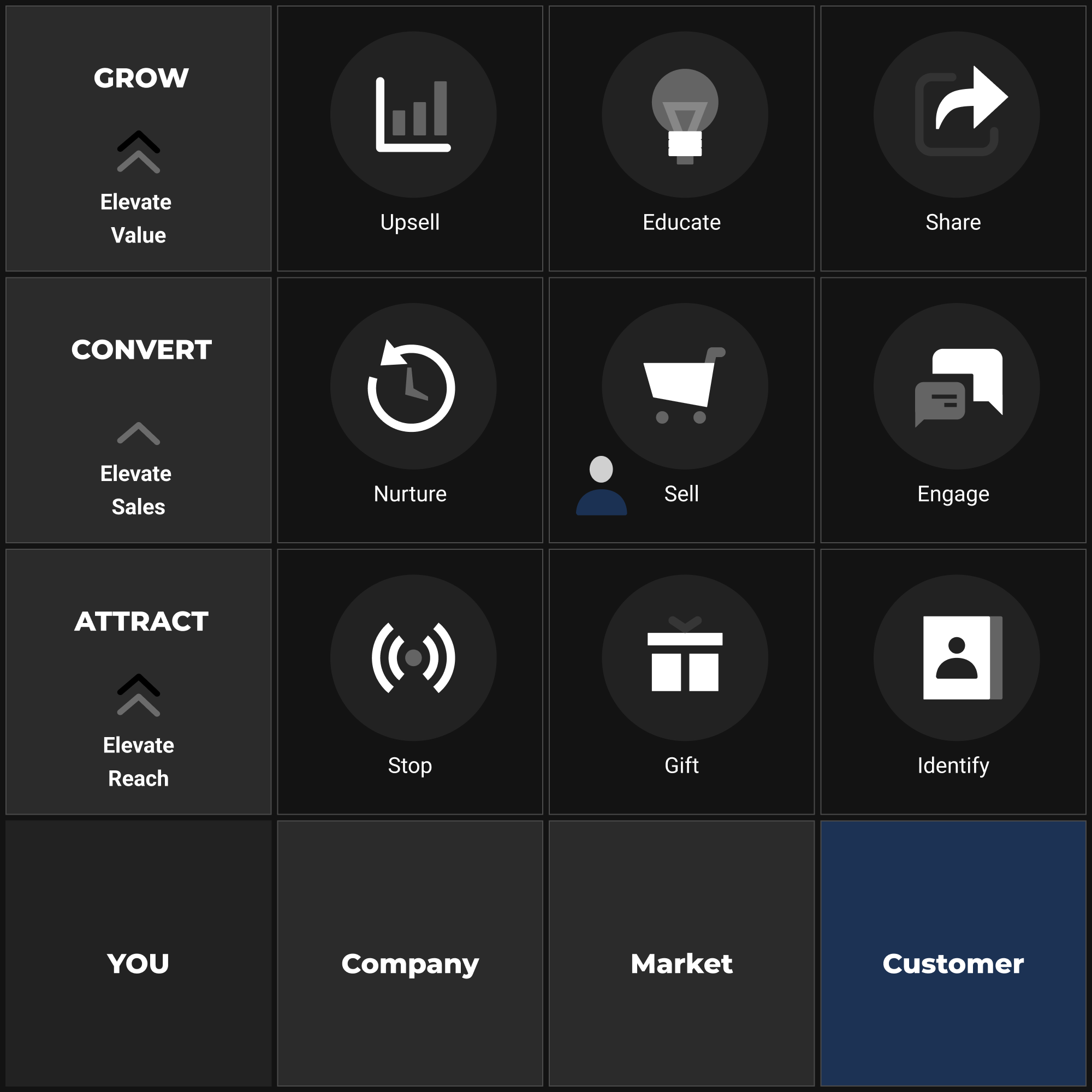
Every step in the nine-step chain draws on the avatar. The HOOK uses A2 and B2 to name pain and trigger recognition. The GIFT uses A3 and B3 to design something that meets a real need in the register of the dominant core need. NURTURE uses B2 and C2 to stay relevant between encounters. SELL uses B2 and C3 to address the fear and point at the transformation. EDUCATE uses C3 to frame ongoing communication around the customer’s vision of success. SHARE is built on the relationship that forms when all of this has been done with consistent care.
None of those steps can be done well without the avatar. And because the Multiplier Principle means quality at each step compounds with quality at every other step, the avatar’s influence on the business is not additive — it is multiplicative. A precise avatar does not merely improve your hooks; it improves the quality of every leverage point in the chain, at once, every time you use it. This is why the Foundation never shows up as a lever in the revenue equation and yet governs every lever in it.
What good looks like
The deliverable from this pillar is a completed Customer Avatar — your grid, fully populated, with Row A grounded in primary research and Rows B and C built from inference close enough to the evidence that you could defend each cell with a quote or an observation. That is the bar. Not a document that feels complete, but one that would survive scrutiny from someone who knows your customers as well as you do.
The benchmark for a Foundation chapter is not a metric — it is clarity. You should be able to read any cell of the avatar and immediately feel its implication for a downstream step. Reading B2 should fire off a specific hook idea. Reading B3 should call up the emotional register your NURTURE sequences need to live in. Reading C1 should hand you a channel list. If the cells are populated but inert — if reading them produces no immediate downstream consequence — they are too vague, and the cure is more specificity, not more words.
There’s a consistency test too. An avatar whose B2 fears don’t connect to its A2 pains, or whose C3 vision doesn’t build on its B3 needs, is a grid filled in independently rather than a portrait built coherently. The logic should flow: the observable pain points to an underlying fear; the underlying need explains the aspiration; the aspiration sits comfortably alongside the self-perception. When the cells are talking to each other, the avatar is finished. When they sit in isolation, there is more work to do.
THE CUSTOMER SOP — “Build the avatar that briefs everything else”
When to run it — once, when building the initial Foundation Blueprint; revisited when you add a new product category, expand to a meaningfully different customer segment, or when downstream marketing performance suggests the avatar has drifted from reality.
Inputs — Market Awareness output (competitor analysis, trend observations, channel landscape); any existing customer data (purchase history, support tickets, post-purchase surveys); primary research gathered in this round (interview notes, review extracts, forum observations).
Owner — Founder or marketing lead (agent: foundation-builder).
Procedure
- Gather primary research: conduct at minimum five customer conversations using open-ended, story-inviting questions; collect fifty or more recent reviews from your own store and two to three competitors; observe three or more active customer communities for a minimum of one week before drawing conclusions.
- Identify the segment you are building for first. If you serve multiple distinct customer types, build a separate avatar for each; do not merge them into a single composite that accurately describes no one.
- Populate Row A of the grid using only evidence you can cite. Label any cell where you are relying primarily on assumption.
- Open
prompts/Customer.mdand paste your raw research into the input section. Feed it demographic notes, verbatim quotes, forum observations, and review language. Review the returned synthesis and use it to populate Rows B and C, adjusting where your own judgement diverges from the model’s inference. - Check internal consistency: does B2 follow from A2? Does C3 build on B3? If the cells are not in conversation, revisit the weakest one.
- Write a one-paragraph avatar summary — a human portrait, not a grid — that you can read aloud before writing any piece of marketing. This is the working reference you will reach for daily.
- Mark any cell that remains thin or uncertain. Schedule the research needed to fill it within the next thirty days.
Tools — Customer Avatar Grid (worksheet), prompts/Customer.md.
Best practices — ground Row A in evidence before inferring Rows B and C; use your customer’s language, not your own; build one avatar per distinct segment; distinguish what you know from what you believe; return to the avatar when downstream metrics underperform rather than adjusting the step in isolation.
Common pitfalls — building from assumption and calling it research; creating a composite avatar that merges two distinct segments and describes neither accurately; completing the grid without a consistency check; treating the avatar as a one-time exercise rather than a living document; leaving B2 vague because the emotional territory feels speculative.
Definition of done — a fully populated Customer Avatar Grid with Row A grounded in primary evidence, Rows B and C in calibrated inference, internal consistency confirmed, and a one-paragraph written summary that can serve as a daily marketing brief.
Hand-off — the completed Customer Avatar feeds directly into the Alignment pillar, where your Company Context, Market Awareness, and Customer Avatar are brought together into the unified Foundation Blueprint that every ATTRACT step will draw from.
What’s next
You have now built three of the four Foundation pillars: you understand your company, your market, and your ideal customer at the depth the framework requires. Each of those three has produced intelligence that is useful on its own, but the real value of the Foundation isn’t in the pillars individually — it is in the synthesis. The question the Alignment pillar asks is whether what you offer, what the market needs, and what your customer wants are all pointing the same way. When they are, every step in the chain inherits an internal coherence that is hard to manufacture and harder to fake. When they are not, even strong tactics underperform, because the business is pulling against itself. That synthesis — and the decisions it forces — is the work of Alignment.