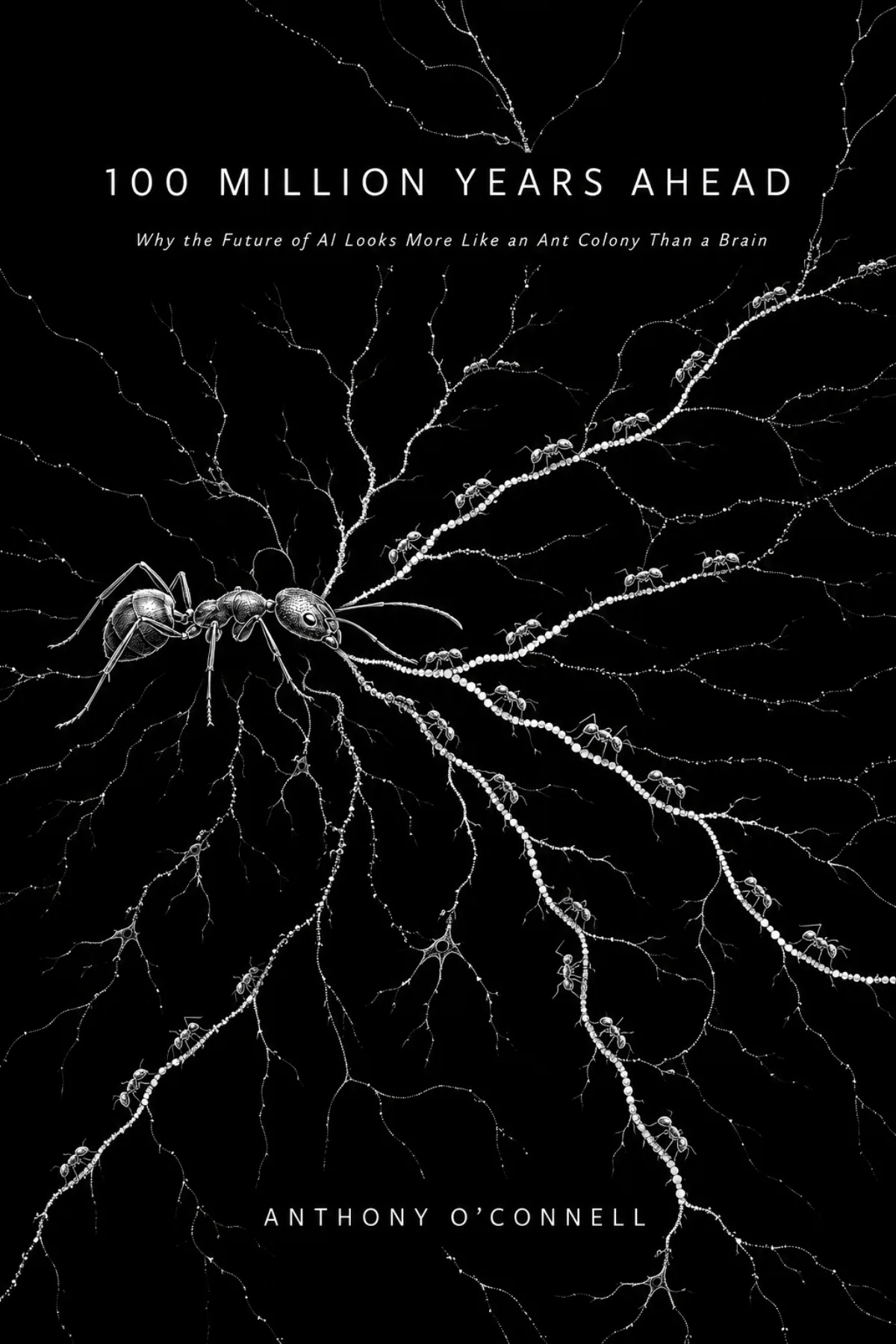
The temperature on the New Mexico dirt was above fifty degrees Celsius. Deborah Gordon was lying flat on her stomach with her face inches from the entrance of a harvester ant colony she had been tracking since 1985. By that August afternoon, she had been watching this particular colony for eight years. She would keep returning to this ground for thirty more.
The ant she was looking at had returned from a foraging trip with a seed clamped in its mandibles, roughly twice its body weight. It paused at the nest entrance for a moment, and then descended into the dark. A few seconds later, a new ant emerged from the same hole and headed out into the desert.
That was the decision.
There was no plan. There was no planner. There was a rate, a threshold, and a departure. Multiplied by thousands of ants, several thousand times per day, across decades.
By any working definition of the word, it was intelligent.
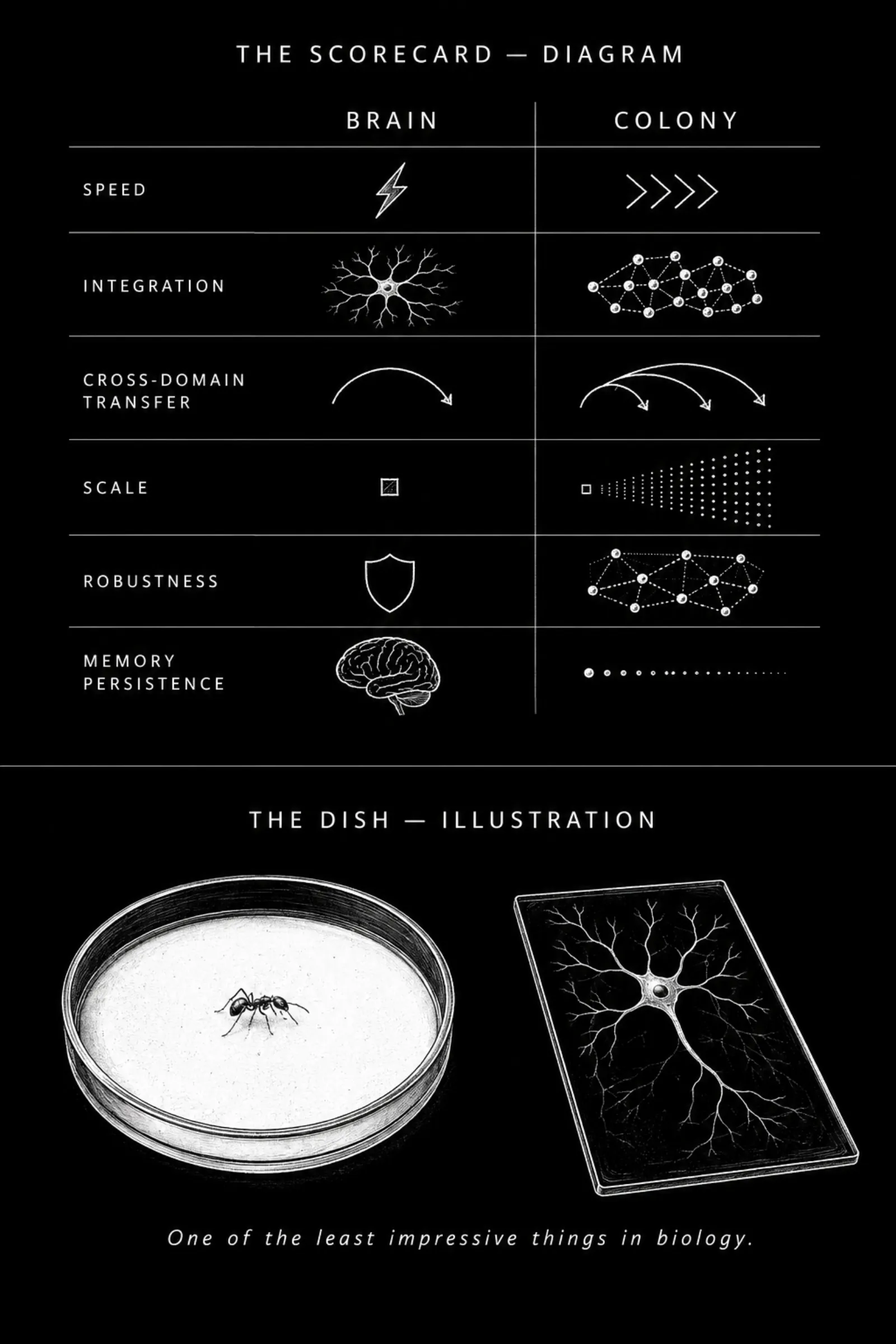
Pouring capital into a single ever-larger agent, while the substrate around it violates every one of the four conditions, is building a magnificent ant for an empty dish.
The agent gets more capable. The substrate stays dead. The model still cannot remember between conversations, cannot accumulate across instances, cannot survive the failure of a component, cannot leave a mark that persists and shapes what other agents do next.
Twenty-two chapters in three movements, with a prologue and an epilogue. Each one builds on the last.
Movement One
The Colony
Chapters 1 to 7
A harvester ant colony in the Arizona desert, told through biology alone. No ant knows the plan, and no ant makes the decisions. The colony still finds food, defends its borders and lives for decades. The queen is not in charge.
Movement Two
The Architecture
Chapters 8 to 16
The same pattern again in a city, a market, a scientific community, a body, a brain, a language and a ledger. Six things appear every time. Once you can name them, you can see them everywhere.
Movement Three
The Implications
Chapters 17 to 22
A short hinge on carbon and silicon, then AI. What general intelligence is, why one bigger model hits a ceiling, and why alignment is a property of the system a model lives in, not a property of the model.
Two kinds of intelligence, scored on the same six lines.
The brain and the colony win and lose on matched axes, speed against scale and a deep mortal memory against a shallow immortal one. The book concludes they are one architecture tuned to two settings, and asks what that architecture is.
In 1950 Alan Turing replaced the question "can a machine think" with a game: put one machine behind a curtain and talk to it. That test looks at one agent. It assumes the intelligence is inside the agent.
The book offers a second test, named for the biologist Deborah Gordon, who has watched one ant colony since 1985.
1FreezeNothing inside any agent is allowed to change.
2Let it runLet the shared space between the agents keep running.
3WaitReturn after time has passed.
4AskGive the system a problem it has never faced.
If the system solves today what it could not solve before, while every agent is exactly the agent it was, then the new skill did not come from the agents. It built up between them.
Lines you will hear again
Not in the ant
“The intelligence is in the substrate, not in the ants.”
The book hands you the key. The course watches you open locks. Each lesson takes one idea from the book and has you apply it to a system you work inside.
Anthony O'Connell has built websites for thirty years and AI systems for eight. He builds ONE, a platform where people and agents work in the same shared space.