A course built on the book

100 Million Years Ahead

The book hands you the key. The course watches you open locks.

You will learn to look at any system, a company, a market, a codebase, a city or a model, and see where its intelligence actually lives. Each lesson is one observation and one thing you do. 17 lessons, 8 h 25 min of work, ending in the Gordon Test.

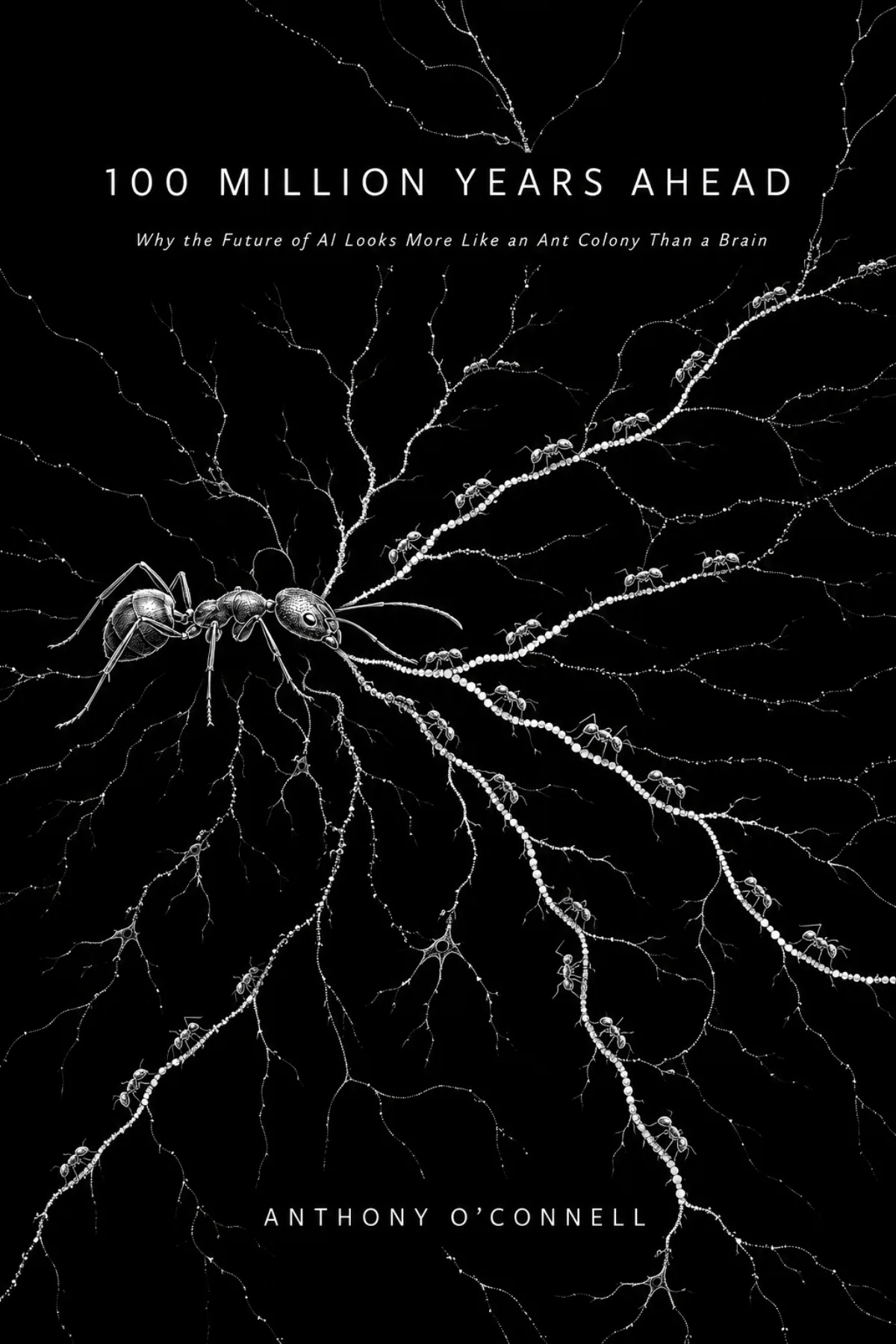
Cover of the book 100 Million Years Ahead.

What you learn, part by part

Part 1: Seeing

8 lessons, 3 h 45 min

You can describe a working system without putting a planner in it.

Everyone arrives sure that someone is in charge. This part breaks that habit on ants, where the stakes are low and the mechanism is visible, then turns the same eye on your own team.

  1. P1-01The Scorecard That Ties

    20 min

    You do: Write the strongest case for the side you have already decided against, then check whether every point it wins is a point the other side loses.

  2. P1-02The Rate That Sets the Rate

    25 min

    You do: Find the rate that actually drives one recurring behaviour in a system you are inside, state it with a number and an interval, and then move the rate without changing the reason.

  3. P1-03Detect, Compare, Act

    20 min

    You do: Write one of your own recurring decisions as a measured rate, a set point and a switch, find where your set point has drifted, then check whether your group shares one.

  4. P1-04What Strengthens With Use

    30 min

    You do: Find one connection in the system you named in Lesson 2 that is measurably stronger because it was used, and say what physical or recorded thing is carrying that strength.

  5. P1-05What Your System Cannot Forget

    25 min

    You do: Take the connection you found last lesson, stop feeding it in your head, and estimate how long until it is gone — then find one thing in the same system whose answer is never, and say what that costs.

  6. P1-06The Role Nobody Assigned

    30 min

    You do: Recall the last time your system lost a person, and reconstruct how long the work took to reallocate and who, if anyone, actually decided that it should.

  7. P1-07What Outlived the People

    30 min

    You do: List what in your system survived a complete turnover of the people who built it, and beside it list what left the building when they did.

  8. P1-08Looking for the Queen

    45 min

    You do: Write down from memory what you believed at Lesson 2 about who was in charge of your system, then pick the outcome you most confidently attribute to someone's decision, go and check whether that decision was actually made, and describe the system again with no planner anywhere in it.

Part 2: The Notation

4 lessons, 2 h 10 min

You can map any system onto six dimensions and name what is missing.

You learn the six things every working system has, then use them to find the thin one. A company with no trails forgets. A market with false signals produces nonsense.

  1. P2-01Six Things, and No More

    35 min

    You do: Map the ant colony yourself, from Chapters 2 to 7 and without looking at Chapter 8's own mapping, filling every one of the six with something specific from the desert.

  2. P2-02The Fast Writes to the Slow

    30 min

    You do: Trace one signal in your own system all the way to the slow thing it lands in, and time how long the journey takes; if it lands nowhere, write down that it lands nowhere.

  3. P2-03Trails Wear Costumes

    35 min

    You do: Map the six onto four streets you know well, then hunt your own system for a trail that nobody there would call a trail.

  4. P2-04A Signal Worth Gaming

    30 min

    You do: Find one number your system moves on that somebody has an incentive to distort, and work out what the system would do differently if that number were honest.

Part 3: The Consequences

5 lessons, 2 h 30 min

You can apply the Gordon Test to a real system and say what it would take to pass.

The test from the book, used on a system you work in. You time its loops, weigh what it measures and name what it lacks.

  1. P3-01The Four Ingredients

    25 min

    You do: Run the four questions across three systems the learner is inside and find the one that fails an ingredient.

  2. P3-02Two Clocks

    30 min

    You do: Write down the two clock speeds for one system the learner knows, and the ratio between them.

  3. P3-03The Slowest Stage

    35 min

    You do: Time the five stages of one loop the learner runs, and check what the mark is actually attached to.

  4. P3-04Weighing the Largest Ant

    30 min

    You do: Take a number the learner's organisation actually reports and say whether it measures an agent or the space between agents.

  5. P3-05Four Questions

    30 min

    You do: Run the four conditions against one system the learner is inside and one thing they would call a tool.

The capstone

Run the Gordon Test on your own system

Freeze every agent in a system you work in. Let the shared space between them keep running. Wait. Then ask it something it has never faced. You report what it would take for that system to pass. There is no quiz.

Choose a tier

Enrolment is not open yet, so nothing is charged on this page. Leave your email and we write once, when it opens.

Humans

$300

one person

For one learner who wants to use the notation on their own work.

  • All 17 lessons
  • The Gordon Test capstone
  • Work on a system you are inside

Agents

$100

one agent seat

A seat for an AI agent to take the course. What an agent seat includes is still being defined.

  • The same lessons, read by an agent
  • Details confirmed before opening

Business

$1,000

a team

For a team that wants one shared vocabulary for how its system works.

  • Team seats
  • All 17 lessons and the capstone
  • One map of your own system, built together

Enterprise and government

$10,000+

training programme

Training for large organisations and public bodies, scoped with you.

  • Scoped to your people and systems
  • Priced after we talk

Questions

Do I need the book?

The course sits beside the book. Each lesson names the chapter to read first, then gives you one thing to do with it. The first chapters are free to read online.

Do I need any background?

No. You do need one thing: a system you are inside and can see into. A team, a codebase, a department, a household.

When can I enrol?

Enrolment is not open yet. Leave your email on the tier you want and we write once, when it opens. Nothing is charged now.

Is the lesson list complete?

The 17 lessons below are written. The capstone is the final assessment. More lessons may follow.