100 Million Years Ahead · all the pictures
70 pictures, best first
Every cover, plate and format board made for the book, in one place. The number on each is its rank: 1 is the picture we would show first. Open any picture for the full size.
Looking for one story? The journey walks the plates chapter by chapter, and all the covers sets the chosen cover beside its candidates.
-
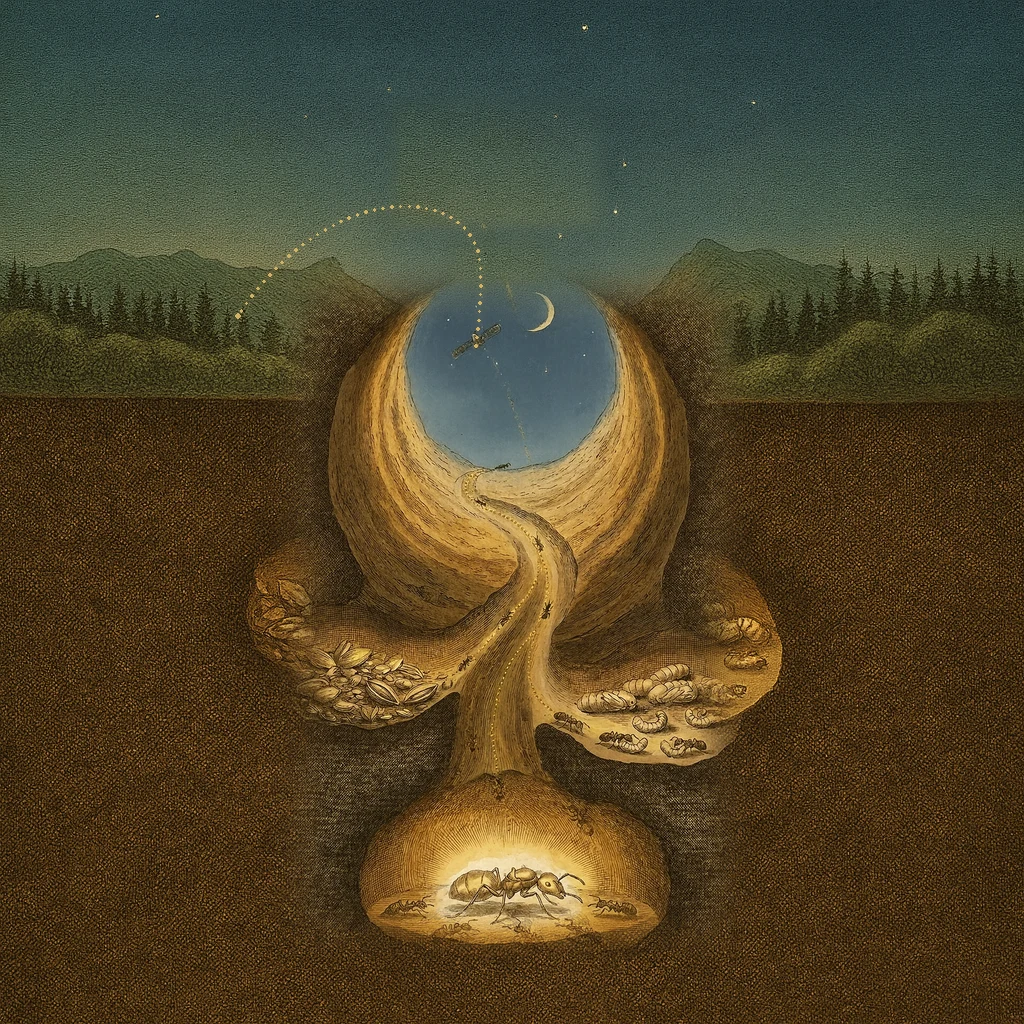
#1Full bleed, square
The chosen cover grown into a whole world. The square master the other two grow from.
-
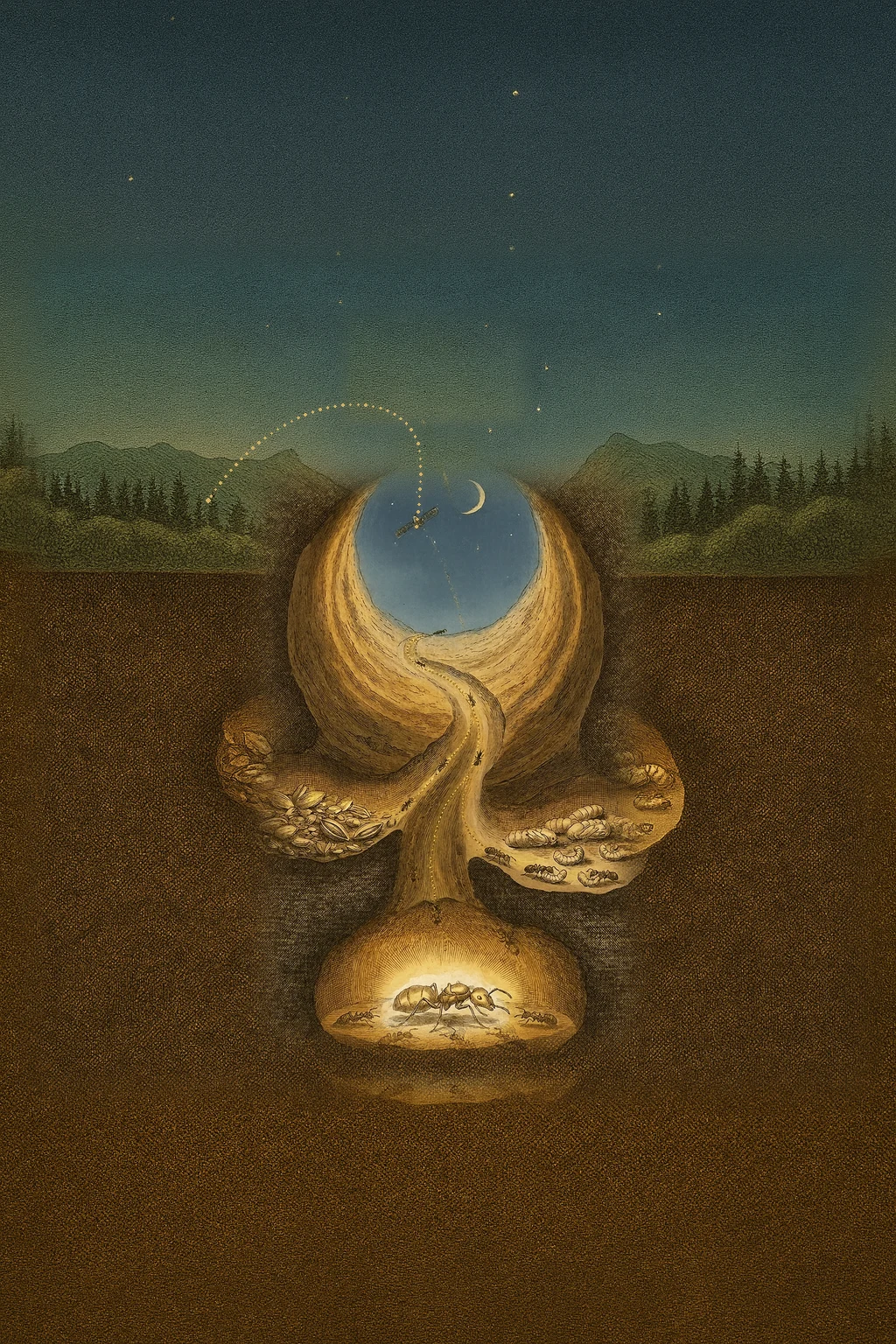
#2Full bleed, portrait
More sky above and more earth below. The master for the ebook, paperback, posters and stories.
-
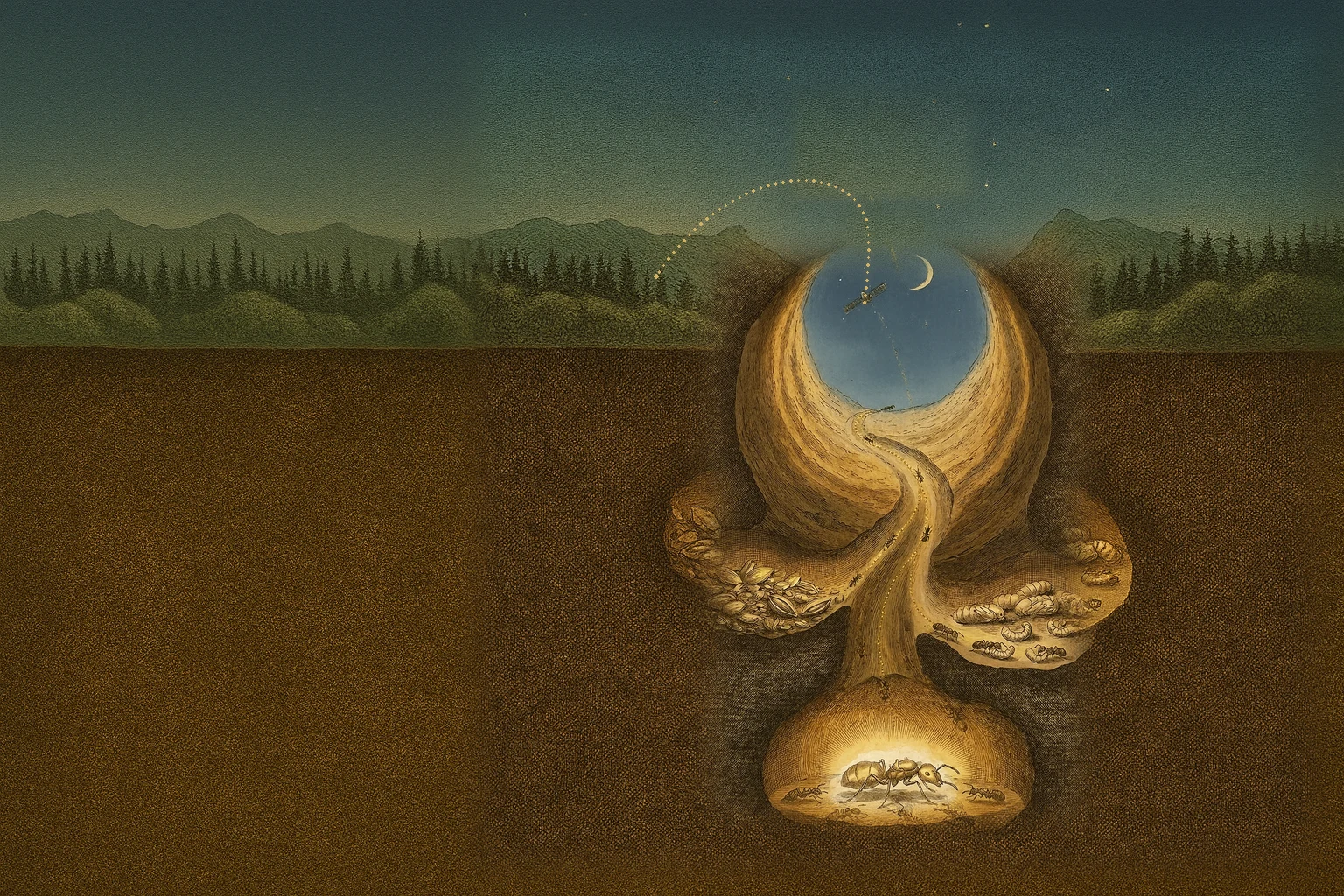
#3Full bleed, landscape
More valley to the left. The master for the ads and the banners.
-
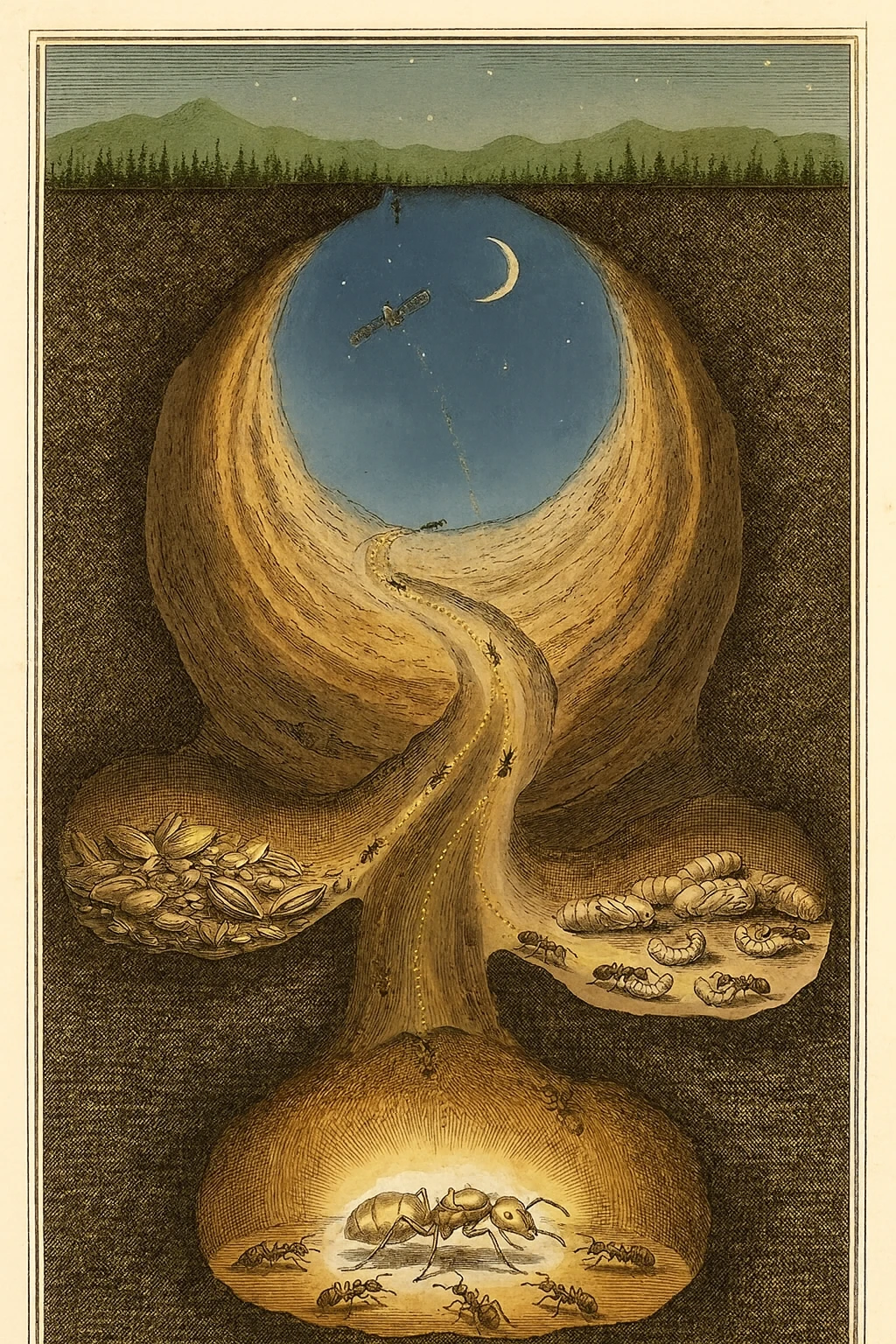
#4Dusk, with the green horizon
The chosen cover. One satellite over the nest at dusk, its beam reaching a green horizon; the successor to "One satellite".
-
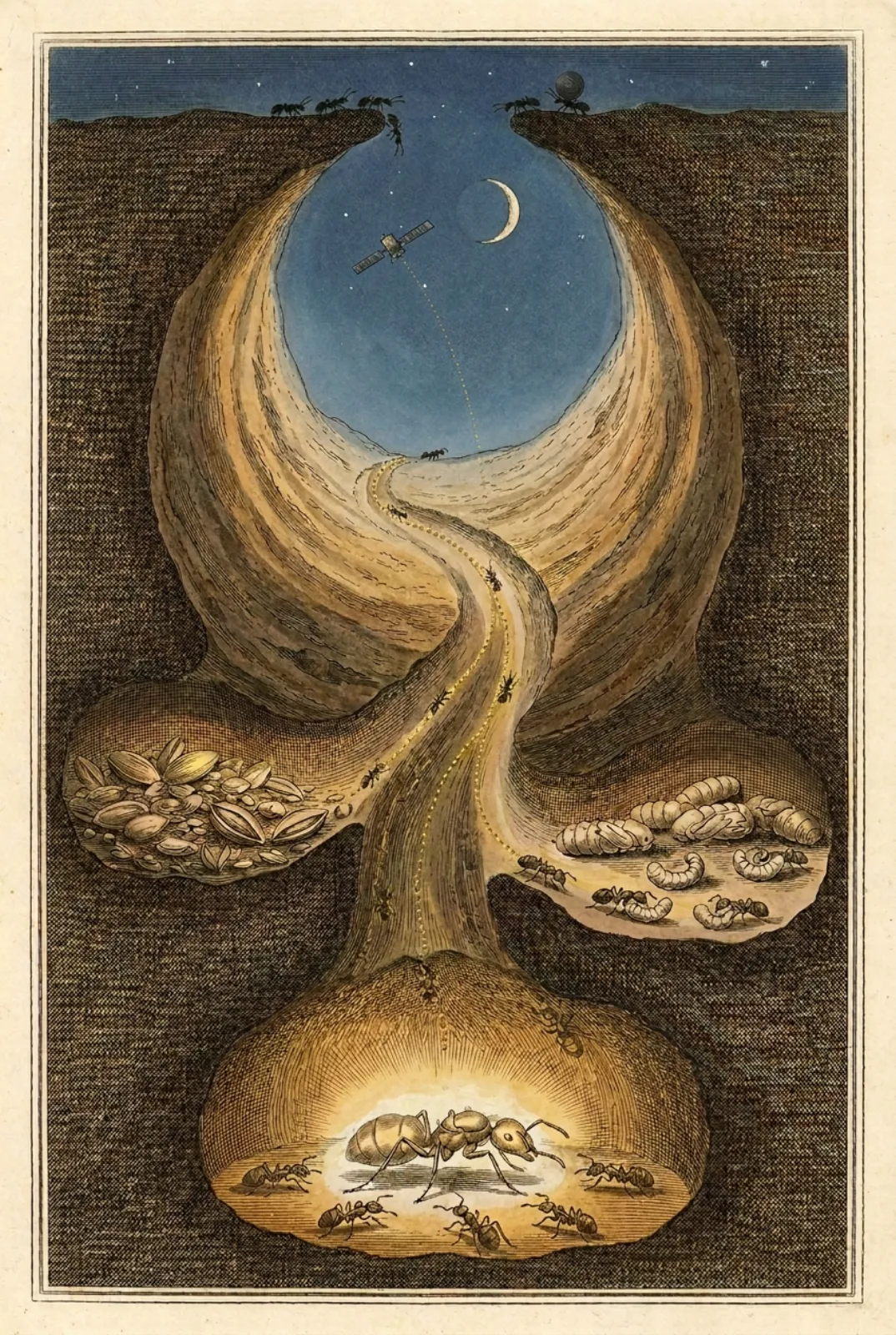
#5One satellite
A single small engraved satellite among the stars; its dotted gold signal falls down the shaft and becomes the ants' trail.
The prompt
[reference: from-below/fb-dusk-stars.webp] Edit this engraving. Among the stars in the disc of sky, add one tiny satellite drawn like an engraved astronomical instrument — a small body with two thin solar panels — and from it a faint fine dotted line of gold descends through the sky and down the shaft, joining the ants' gold pheromone trail, as if the sky's signal and the colony's trail were the same kind of mark. Keep everything else exactly as in this engraving — the winding shaft, the indigo dusk disc with stars and crescent moon, the granary, the nursery, the glowing wingless queen, the gold-dotted pheromone trail, the hand-coloured 18th-century copperplate style on cream paper and the double-rule border. The addition must be very subtle: engraved in the same fine burin line, small, discovered only on a second look, never glowing or digital, no circuitry. The image contains absolutely no text: no letters, no words, no numbers, no title, no captions, no labels, no typography, no logos, no watermark and no signature.
-
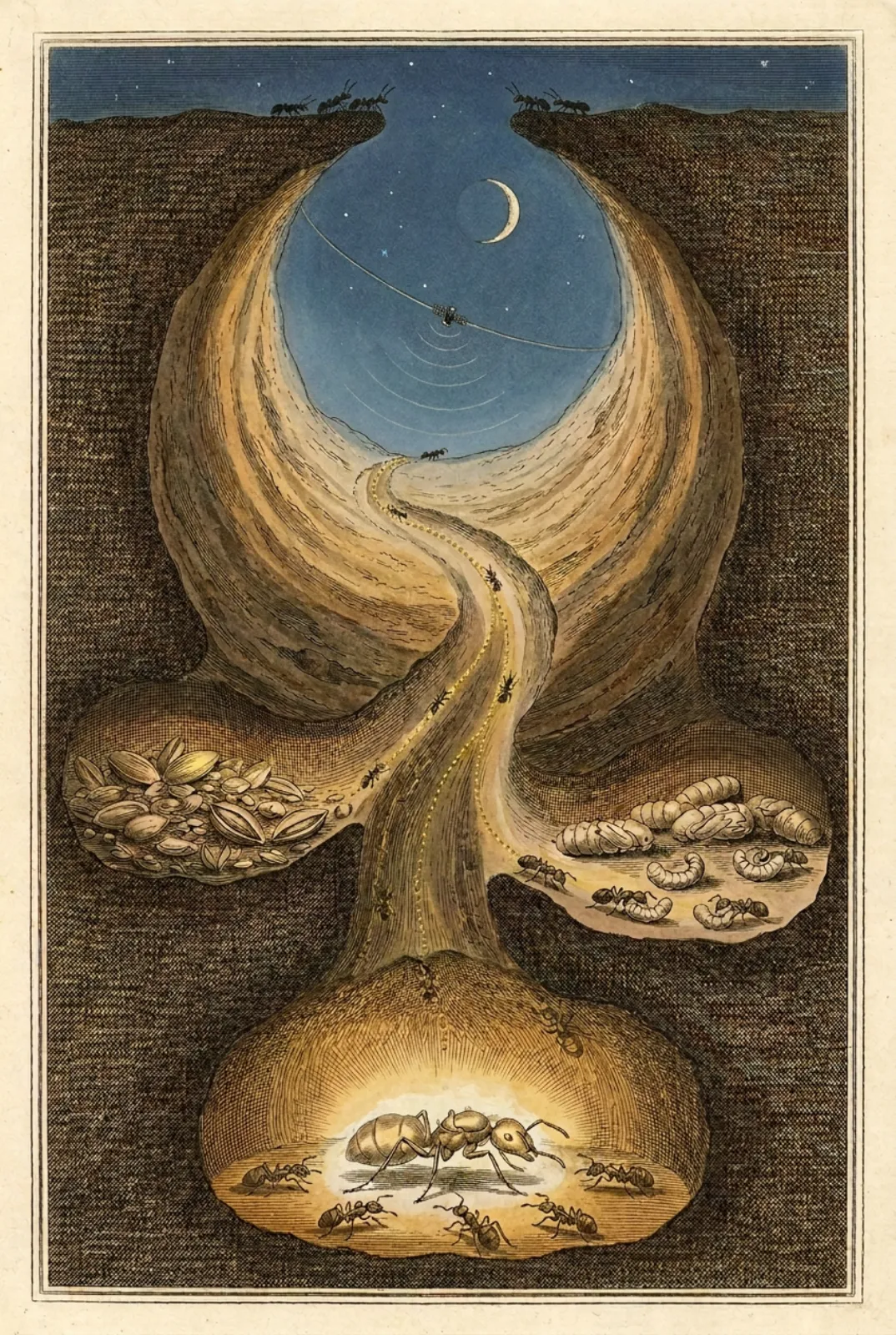
#6The orbit
A satellite rides a thin engraved orbit across the disc, sending faint rings of signal down toward the door.
The prompt
[reference: from-below/fb-dusk-stars.webp] Edit this engraving. Across the disc of sky add one thin engraved orbit arc, like the curve on an antique celestial chart, with a tiny satellite riding on it; from the satellite, three faint concentric engraved arcs of signal ripple downward toward the hole, and at the rim of the hole the ants raise their antennae as if listening. Very quiet, very small. Keep everything else exactly as in this engraving — the winding shaft, the indigo dusk disc with stars and crescent moon, the granary, the nursery, the glowing wingless queen, the gold-dotted pheromone trail, the hand-coloured 18th-century copperplate style on cream paper and the double-rule border. The addition must be very subtle: engraved in the same fine burin line, small, discovered only on a second look, never glowing or digital, no circuitry. The image contains absolutely no text: no letters, no words, no numbers, no title, no captions, no labels, no typography, no logos, no watermark and no signature.
-
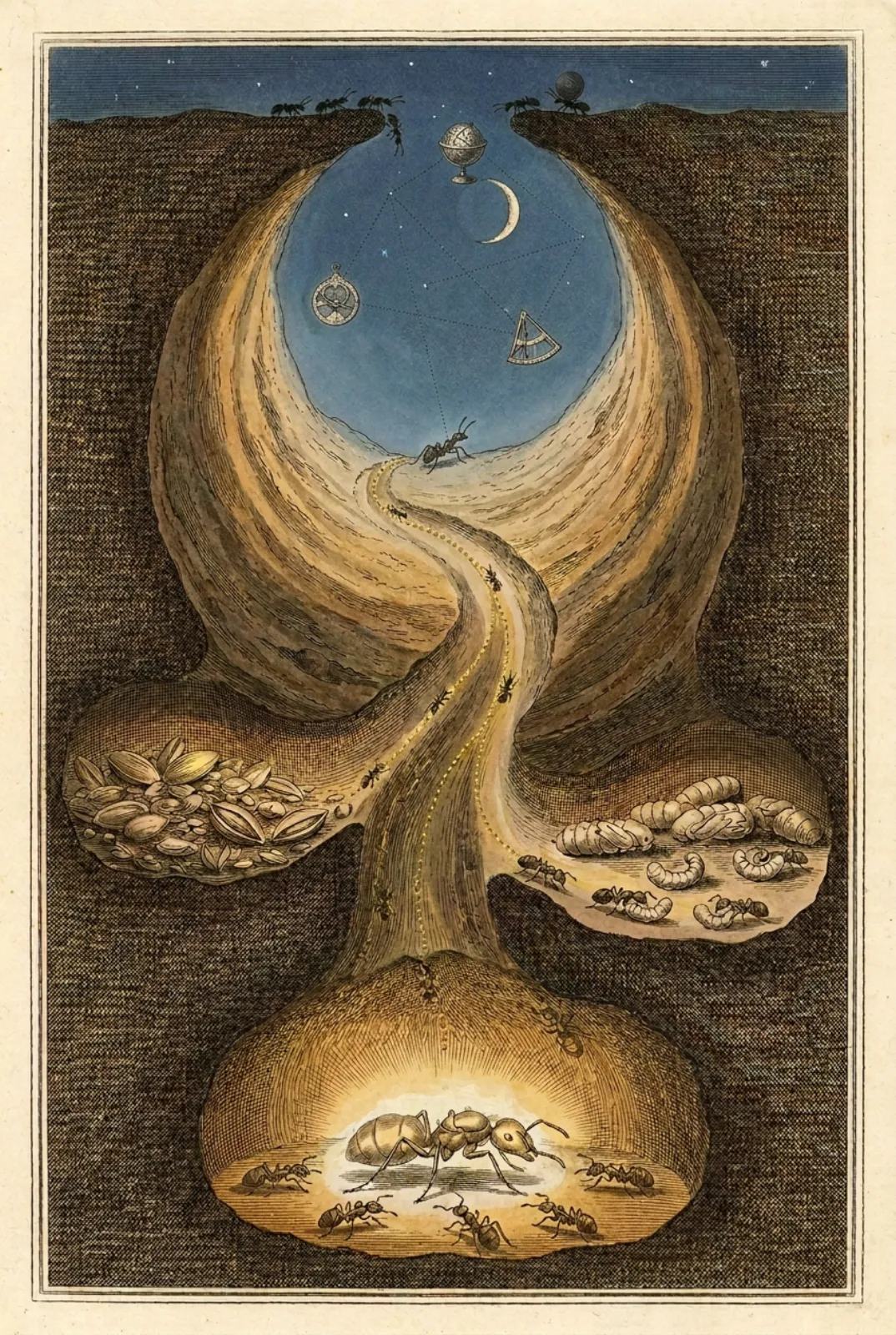
#7The instruments
The model drew antique instruments (armillary sphere, astrolabe, sextant) joined like a star chart, with one thread to a listening ant.
The prompt
[reference: from-below/fb-dusk-stars.webp] Edit this engraving. In the disc of sky, among the stars, add three or four tiny satellites, engraved like small astronomical instruments, linked to each other by faint dotted lines like constellation lines on an antique star chart — a network in the sky that mirrors the network of trails below. One faint dotted thread reaches down from them to the rim of the hole, where an ant raises its antennae toward it. Keep everything else exactly as in this engraving — the winding shaft, the indigo dusk disc with stars and crescent moon, the granary, the nursery, the glowing wingless queen, the gold-dotted pheromone trail, the hand-coloured 18th-century copperplate style on cream paper and the double-rule border. The addition must be very subtle: engraved in the same fine burin line, small, discovered only on a second look, never glowing or digital, no circuitry. The image contains absolutely no text: no letters, no words, no numbers, no title, no captions, no labels, no typography, no logos, no watermark and no signature.
-
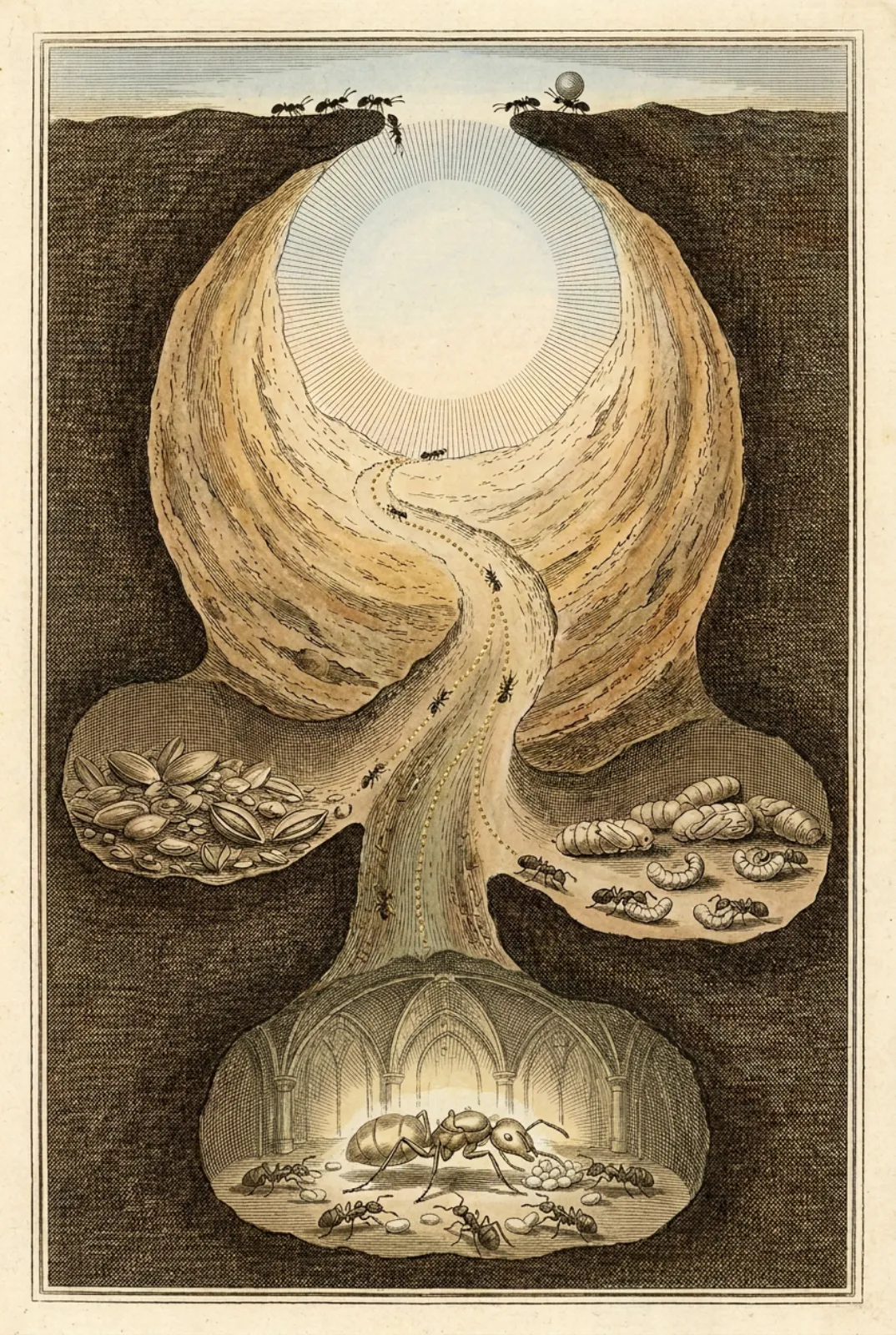
#8The queen's chapel
Her vault becomes a small vaulted chapel; she lays eggs while workers carry them up the trail.
The prompt
[reference: copperplate/copper-from-below.webp] Edit this engraving. Make the queen's vault the jewel of the plate: larger and vaulted like a small chapel, the wingless queen laying a little pile of eggs, a ring of tiny workers carrying eggs away, the vault glowing softly. Gold pheromone trails run from her chamber up the shaft to the light. Keep this exact composition — the winding shaft rising to the bright disc of dawn at the top, the granary on the left, the nursery on the right, the queen's vault at the bottom — and the same hand-coloured 18th-century copperplate engraving style, aged cream laid paper, sepia, umber and ochre palette, the gold-leaf dotted pheromone trail and the thin engraved double-rule border. The queen is wingless (she shed her wings after her mating flight). The image contains absolutely no text: no letters, no words, no numbers, no title, no captions, no labels, no typography, no logos, no watermark and no signature.
-
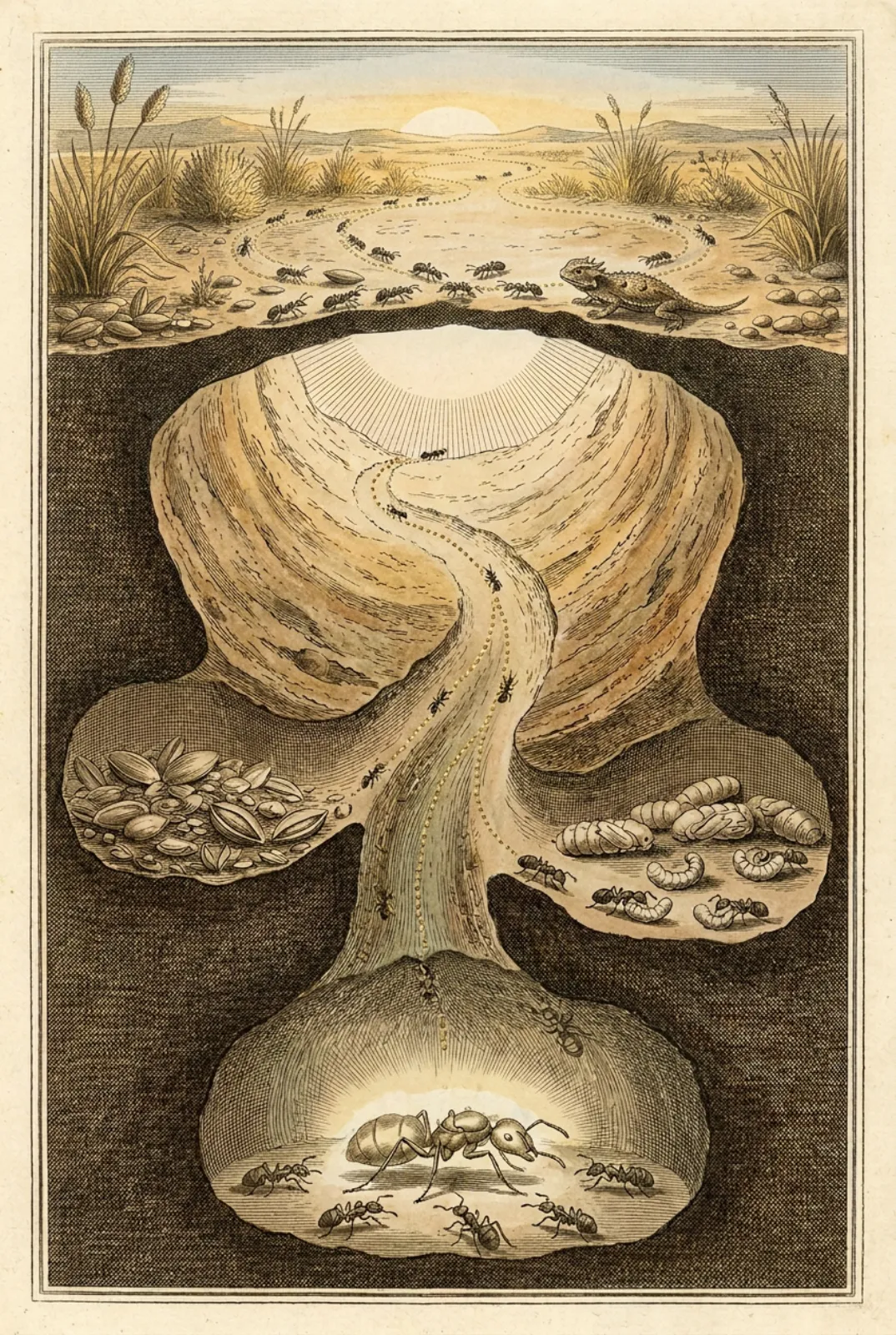
#9The world above
The surface opens at the top: grasses, seed heads, foragers on gold trails, a horned lizard, the dawn sun.
The prompt
[reference: copperplate/copper-from-below.webp] Edit this engraving. Open the top of the plate to show more of the world above ground around the rim of the hole: desert grasses and seed heads, pebbles, the cleared disc, foragers fanning out along gold pheromone trails toward seeds, the low dawn sun, and a small horned lizard at the edge. Keep this exact composition — the winding shaft rising to the bright disc of dawn at the top, the granary on the left, the nursery on the right, the queen's vault at the bottom — and the same hand-coloured 18th-century copperplate engraving style, aged cream laid paper, sepia, umber and ochre palette, the gold-leaf dotted pheromone trail and the thin engraved double-rule border. The queen is wingless (she shed her wings after her mating flight). The image contains absolutely no text: no letters, no words, no numbers, no title, no captions, no labels, no typography, no logos, no watermark and no signature.
-
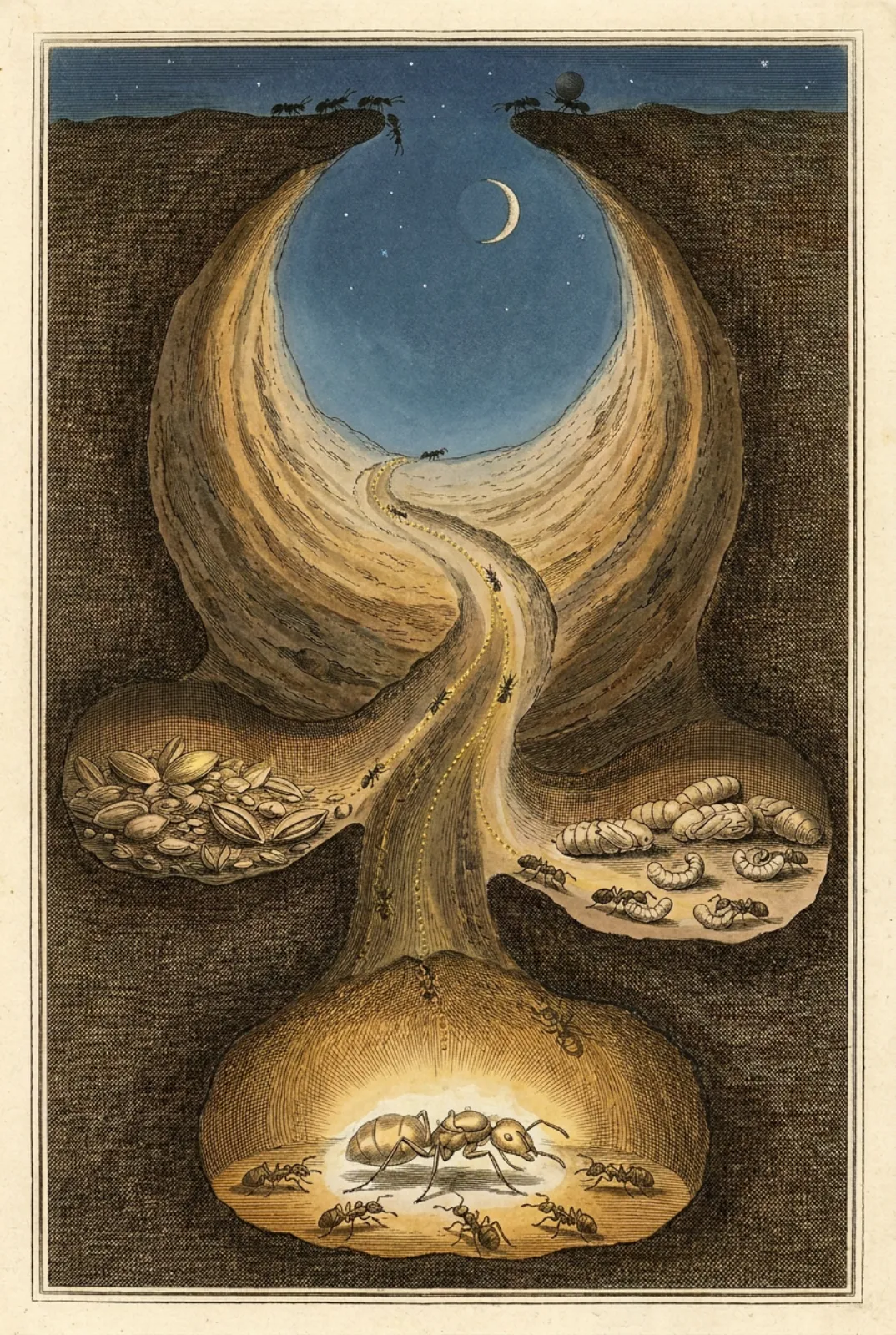
#10Dusk
The disc turns indigo with stars and a crescent moon; the chambers glow from within as the last foragers come home.
The prompt
[reference: copperplate/copper-from-below.webp] Edit this engraving. Change the time to dusk: the disc of sky at the top is deep indigo with the first stars and a thin crescent moon, the last foragers coming home down the shaft with seeds, the chambers lit warm and golden from within. Keep this exact composition — the winding shaft rising to the bright disc of dawn at the top, the granary on the left, the nursery on the right, the queen's vault at the bottom — and the same hand-coloured 18th-century copperplate engraving style, aged cream laid paper, sepia, umber and ochre palette, the gold-leaf dotted pheromone trail and the thin engraved double-rule border. The queen is wingless (she shed her wings after her mating flight). The image contains absolutely no text: no letters, no words, no numbers, no title, no captions, no labels, no typography, no logos, no watermark and no signature.
-
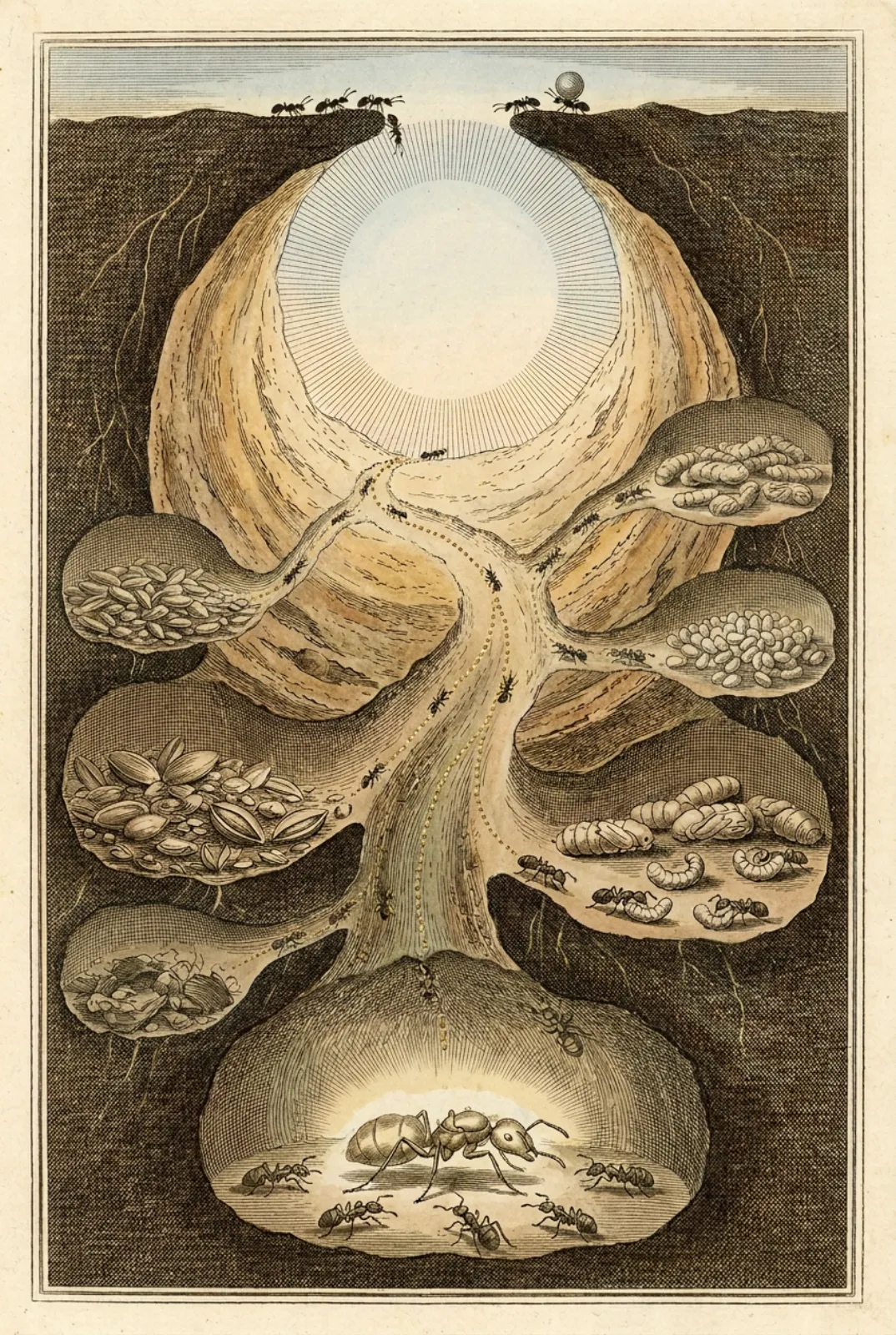
#11More chambers
The same plate grown richer: two more granaries, more brood, a refuse chamber, more trails branching off the shaft.
The prompt
[reference: copperplate/copper-from-below.webp] Edit this engraving. Make it far more intricate: add more cut-away chambers branching off the shaft at different depths — more granaries, eggs, larvae and pupae, nurses grooming brood, a refuse chamber — joined by fine tunnels; many more ants climbing and descending; several gold pheromone trails weaving between chambers; denser cross-hatching, finer burin work, more root hairs. Keep this exact composition — the winding shaft rising to the bright disc of dawn at the top, the granary on the left, the nursery on the right, the queen's vault at the bottom — and the same hand-coloured 18th-century copperplate engraving style, aged cream laid paper, sepia, umber and ochre palette, the gold-leaf dotted pheromone trail and the thin engraved double-rule border. The queen is wingless (she shed her wings after her mating flight). The image contains absolutely no text: no letters, no words, no numbers, no title, no captions, no labels, no typography, no logos, no watermark and no signature.
-
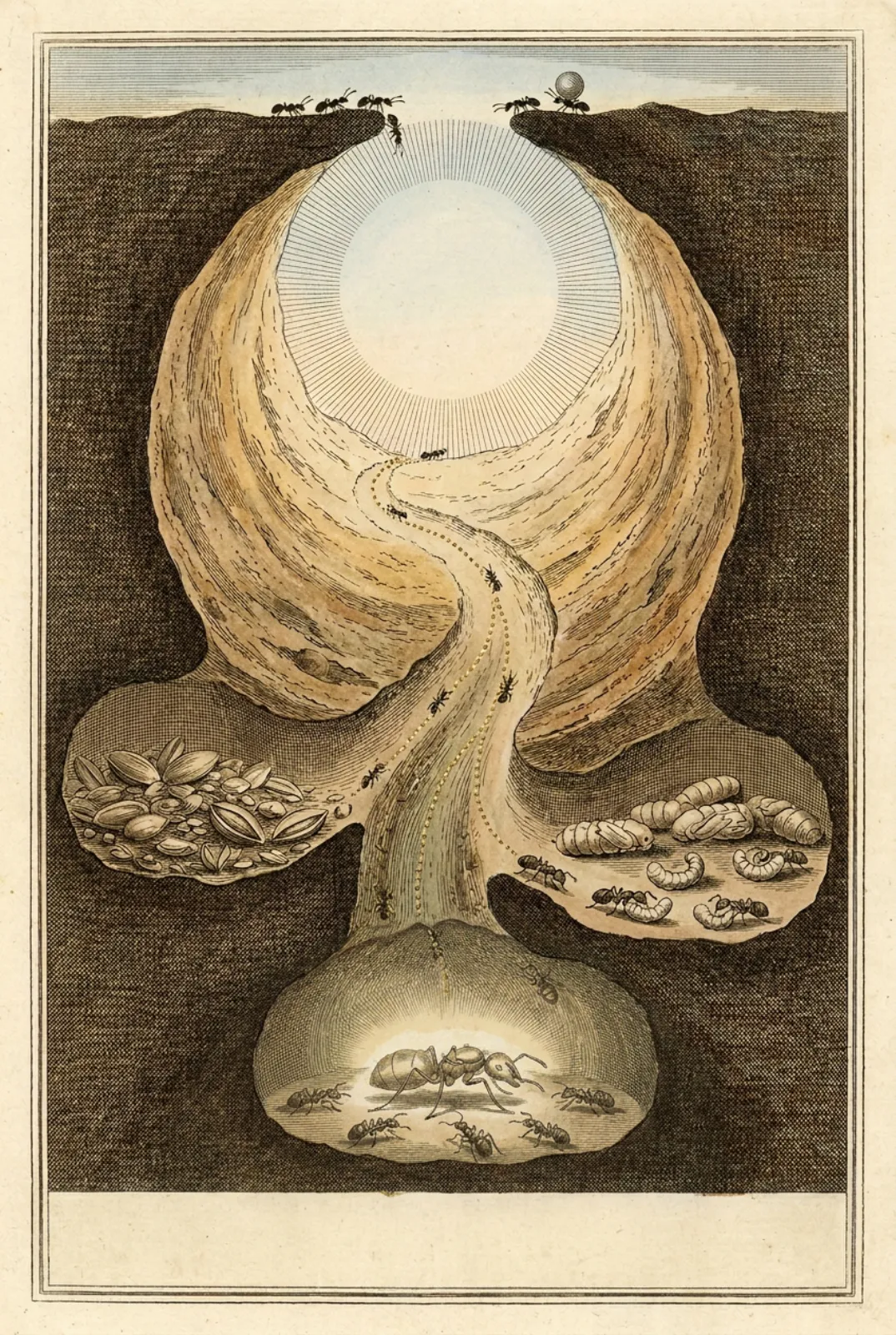
#12With a title margin
The scene lifted slightly, leaving a plain antique-plate margin at the foot for the title.
The prompt
[reference: copperplate/copper-from-below.webp] Edit this engraving. Recompose for a book cover: shrink the scene slightly upward and leave a generous plain band of cream paper inside the border across the lower fifth, empty and quiet, like the margin of an antique plate. Keep this exact composition — the winding shaft rising to the bright disc of dawn at the top, the granary on the left, the nursery on the right, the queen's vault at the bottom — and the same hand-coloured 18th-century copperplate engraving style, aged cream laid paper, sepia, umber and ochre palette, the gold-leaf dotted pheromone trail and the thin engraved double-rule border. The queen is wingless (she shed her wings after her mating flight). The image contains absolutely no text: no letters, no words, no numbers, no title, no captions, no labels, no typography, no logos, no watermark and no signature.
-
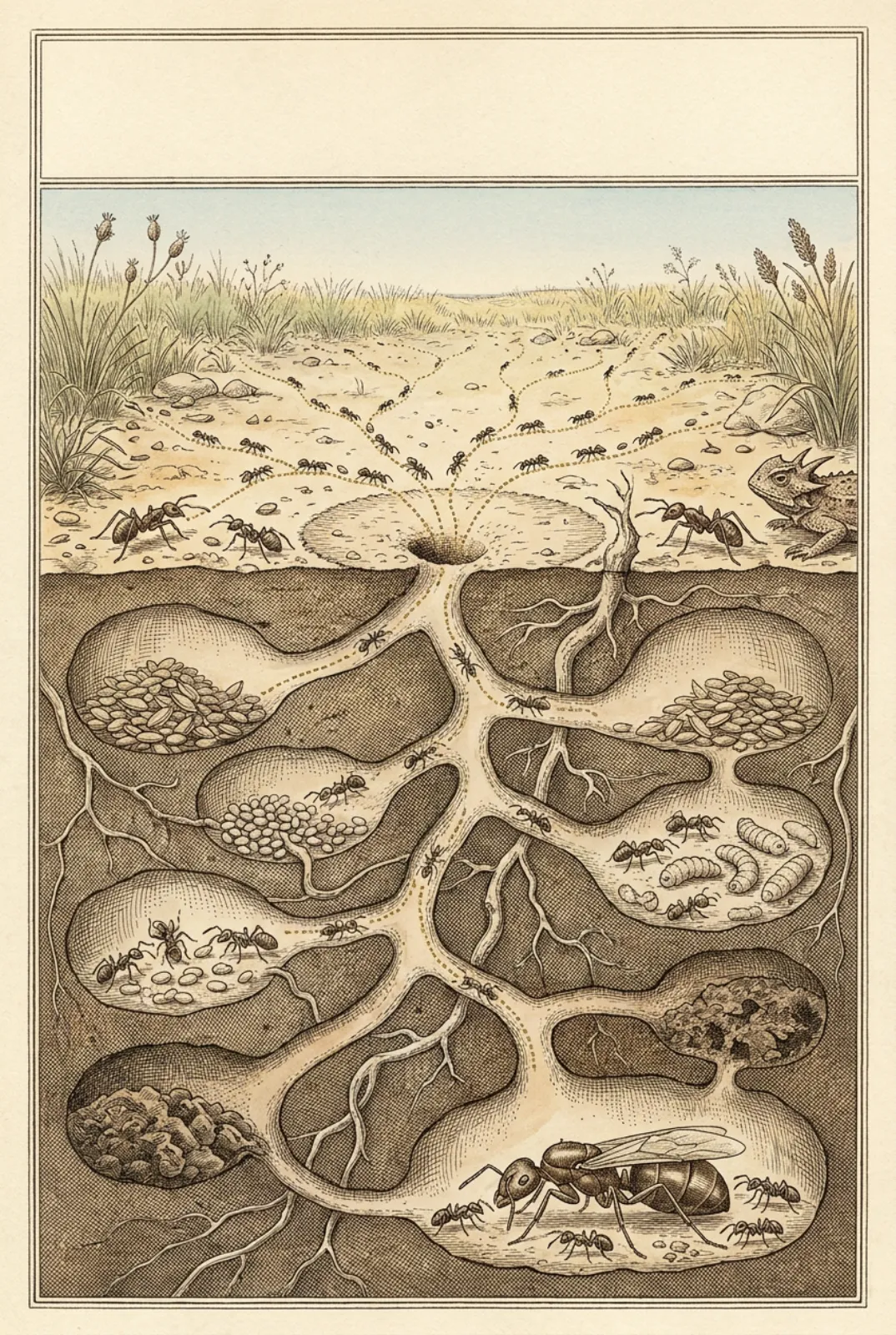
#13Copperplate: the whole world
Above ground and below in one plate: foragers on gold pheromone trails, granaries, nurseries, and the queen in her chamber at the bottom.
The prompt
Artwork for a book cover. A full cut-away cross-section of a harvester ant world, above and below ground. Top third: the sunlit desert surface — seed heads, grasses, pebbles, a cleared disc around the nest entrance, foragers streaming out along branching trails carrying seeds, patrollers at the border, a horned lizard watching at the edge. Below the soil line, the vast nest descends in a beautiful branching architecture of chambers and galleries: granaries heaped with seeds, nurseries of eggs, larvae and pupae tended by nurses, refuse chambers, and at the very bottom the great queen in her royal chamber, large and calm, attended by workers. Roots thread down between the chambers. Leave the top eighth plain paper sky for type. Style: an extraordinarily intricate 18th-century hand-coloured copperplate engraving, natural-history plate quality — fine cross-hatching, stippling and burin lines, sepia and iron-gall ink on aged cream laid paper, delicate faded watercolour washes of ochre, umber, sage and soft blue, every grain of soil and root hair engraved. The pheromone trails are drawn as fine dotted lines of burnished gold leaf that follow the ants' paths — the only metallic colour on the plate. Museum specimen-plate composition with a thin engraved double-rule border. The image contains absolutely no text: no letters, no words, no numbers, no title, no captions, no labels, no typography, no logos, no watermark and no signature.
-
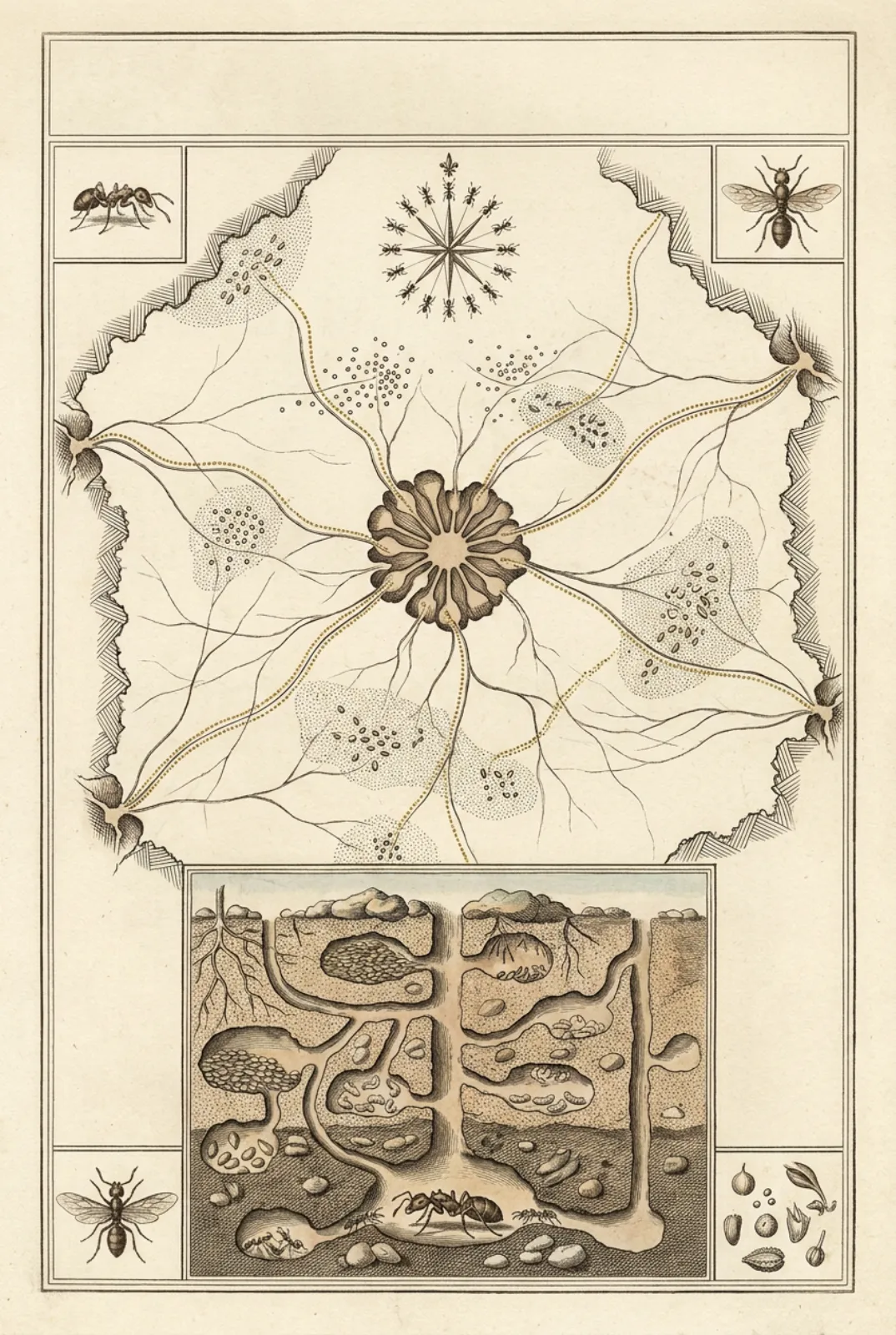
#14Copperplate: the colony map
An engraved cartographic plate: the territory from above with trails by weight, the nest in section below, specimens in the corners.
The prompt
Artwork for a book cover. A magnificent colony map engraved like an 18th-century cartographic plate: the upper two-thirds is a top-down plan of a harvester ant territory — the nest at the centre, the foraging trails radiating out as engraved lines of varying weight from bold highways to fading hairlines, seed patches stippled, neighbouring colonies at the borders, a compass rose of tiny ants. The lower third is an inset cross-section of the nest below: chambers, tunnels, granaries and the queen's chamber at the bottom. Small vignettes in the corners: a worker, a winged queen, a male, a seed, drawn as specimens. Leave a plain band of paper at the top for type. Style: an extraordinarily intricate 18th-century hand-coloured copperplate engraving, natural-history plate quality — fine cross-hatching, stippling and burin lines, sepia and iron-gall ink on aged cream laid paper, delicate faded watercolour washes of ochre, umber, sage and soft blue, every grain of soil and root hair engraved. The pheromone trails are drawn as fine dotted lines of burnished gold leaf that follow the ants' paths — the only metallic colour on the plate. Museum specimen-plate composition with a thin engraved double-rule border. The image contains absolutely no text: no letters, no words, no numbers, no title, no captions, no labels, no typography, no logos, no watermark and no signature.
-
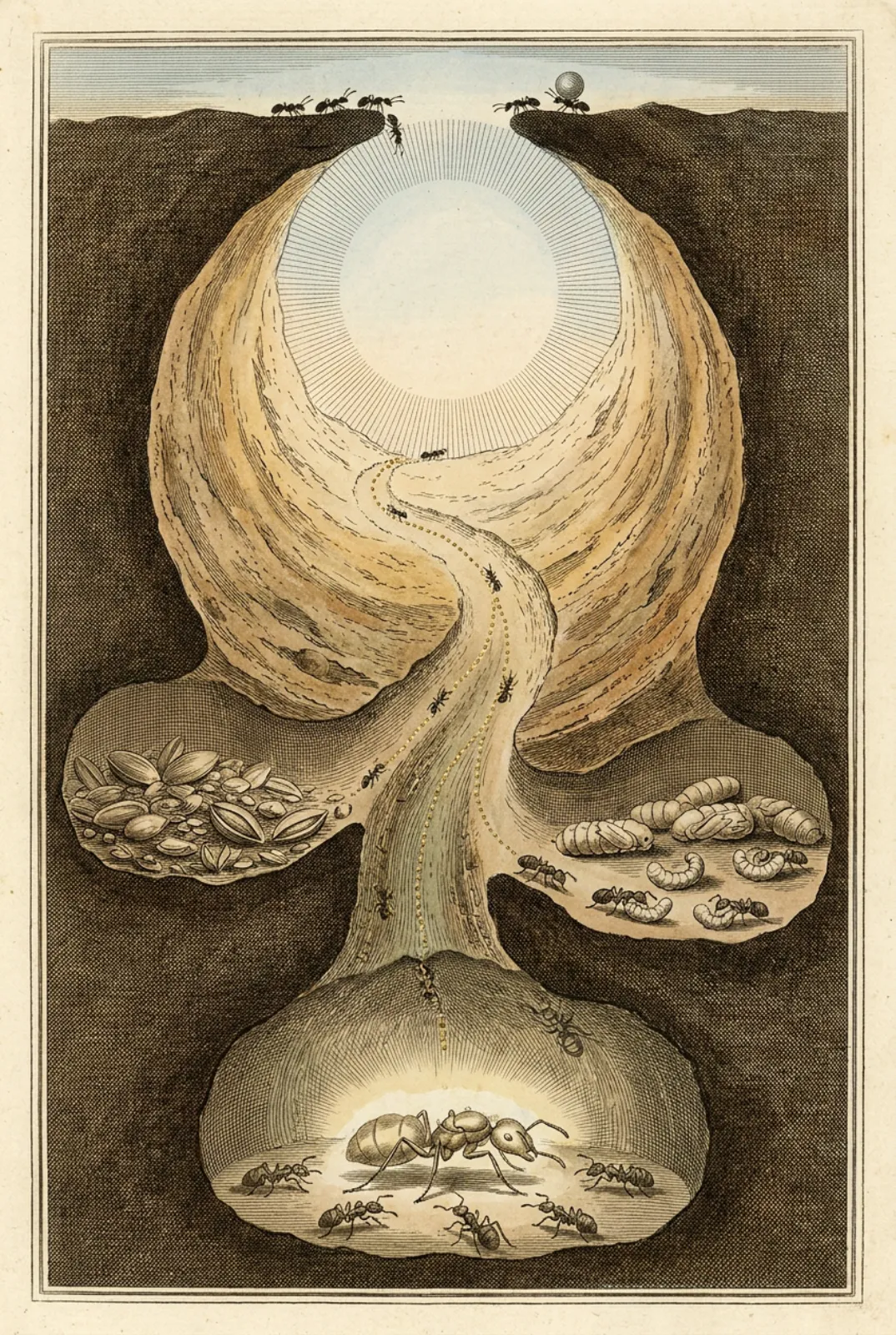
#15Copperplate: from inside the nest
The from-below view, engraved: up the entrance shaft to a disc of dawn, chambers cut away around it, the queen glowing low in the frame.
The prompt
Artwork for a book cover. The view from deep inside an ant nest looking straight up the entrance shaft toward a bright disc of pale dawn sky at the top, rendered as a copperplate engraving. The curving earth walls of the shaft are cut away like an architectural section so we see the chambers around it: a granary of seeds, a nursery of pupae, nurses carrying larvae, and low in the frame, glowing softly, the queen in her royal chamber. Ants climb the shaft toward the light along gold-dotted pheromone trails; at the rim of the hole tiny silhouettes come and go, one carrying a seed. Intimate, reverent, the reader is inside the colony. Style: an extraordinarily intricate 18th-century hand-coloured copperplate engraving, natural-history plate quality — fine cross-hatching, stippling and burin lines, sepia and iron-gall ink on aged cream laid paper, delicate faded watercolour washes of ochre, umber, sage and soft blue, every grain of soil and root hair engraved. The pheromone trails are drawn as fine dotted lines of burnished gold leaf that follow the ants' paths — the only metallic colour on the plate. Museum specimen-plate composition with a thin engraved double-rule border. The image contains absolutely no text: no letters, no words, no numbers, no title, no captions, no labels, no typography, no logos, no watermark and no signature.
-
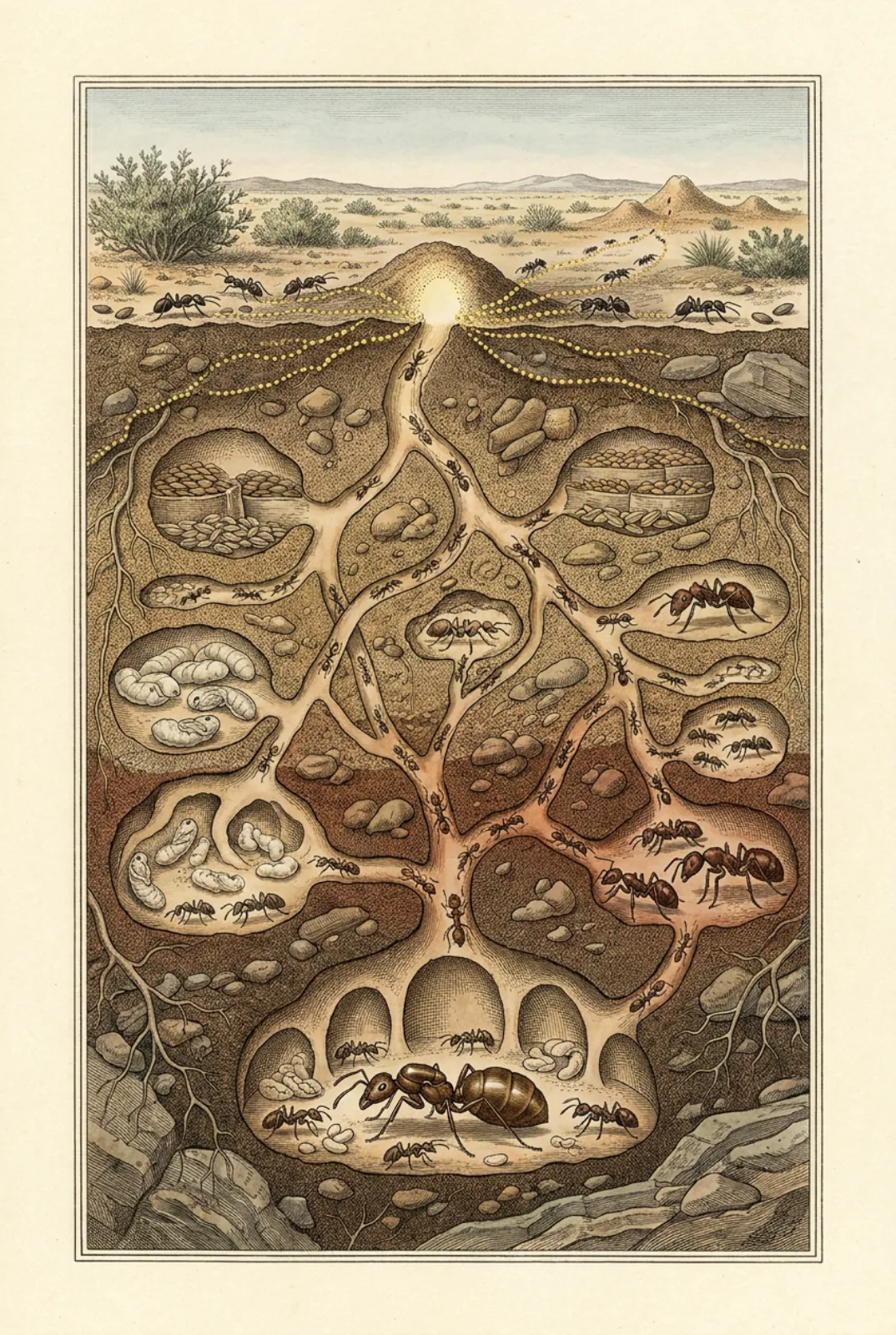
#16Copperplate: the ascent
From the queen at the bottom, the nest rises like the roots of one great plant to a single bright door and the world above.
The prompt
Artwork for a book cover. A tall vertical section through a harvester ant colony seen as one living organism. At the very bottom, the queen in her vaulted chamber; from her, the nest rises in a branching tree of galleries and chambers like the roots of a great plant — brood, granaries, workers of every age shaded from pale callow to dark worn forager — all climbing toward a single bright entrance hole near the top. Above the soil line, a thin band of desert world: foragers fanning out along branching gold pheromone trails toward seeds. Rich, ornate, deeply detailed. Style: an extraordinarily intricate 18th-century hand-coloured copperplate engraving, natural-history plate quality — fine cross-hatching, stippling and burin lines, sepia and iron-gall ink on aged cream laid paper, delicate faded watercolour washes of ochre, umber, sage and soft blue, every grain of soil and root hair engraved. The pheromone trails are drawn as fine dotted lines of burnished gold leaf that follow the ants' paths — the only metallic colour on the plate. Museum specimen-plate composition with a thin engraved double-rule border. The image contains absolutely no text: no letters, no words, no numbers, no title, no captions, no labels, no typography, no logos, no watermark and no signature.
-
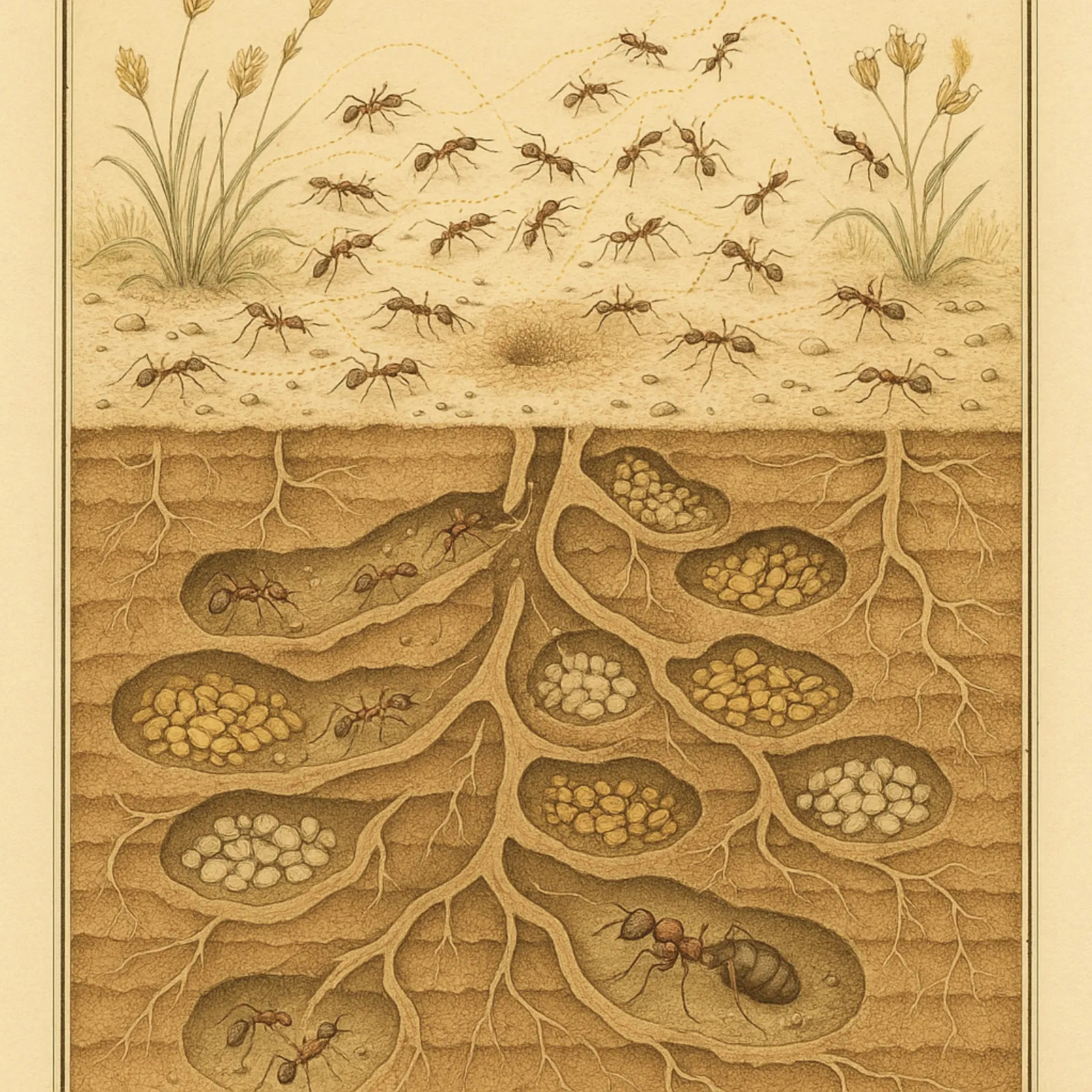
#17Copperplate: the whole world (GPT)
The same whole-world brief on a second model, for comparison.
The prompt
Artwork for a book cover. A full cut-away cross-section of a harvester ant world, above and below ground. Top third: the sunlit desert surface — seed heads, grasses, pebbles, a cleared disc around the nest entrance, foragers streaming out along branching trails carrying seeds. Below the soil line, the nest descends in a beautiful branching architecture of chambers and galleries: granaries heaped with seeds, nurseries of eggs, larvae and pupae, and at the very bottom the great queen in her royal chamber attended by workers. Roots thread between the chambers. Leave the top eighth plain paper for type. Style: an extraordinarily intricate 18th-century hand-coloured copperplate engraving, natural-history plate quality — fine cross-hatching, stippling and burin lines, sepia and iron-gall ink on aged cream laid paper, delicate faded watercolour washes of ochre, umber, sage and soft blue, every grain of soil and root hair engraved. The pheromone trails are drawn as fine dotted lines of burnished gold leaf that follow the ants' paths — the only metallic colour on the plate. Museum specimen-plate composition with a thin engraved double-rule border. The image contains absolutely no text: no letters, no words, no numbers, no title, no captions, no labels, no typography, no logos, no watermark and no signature.
-
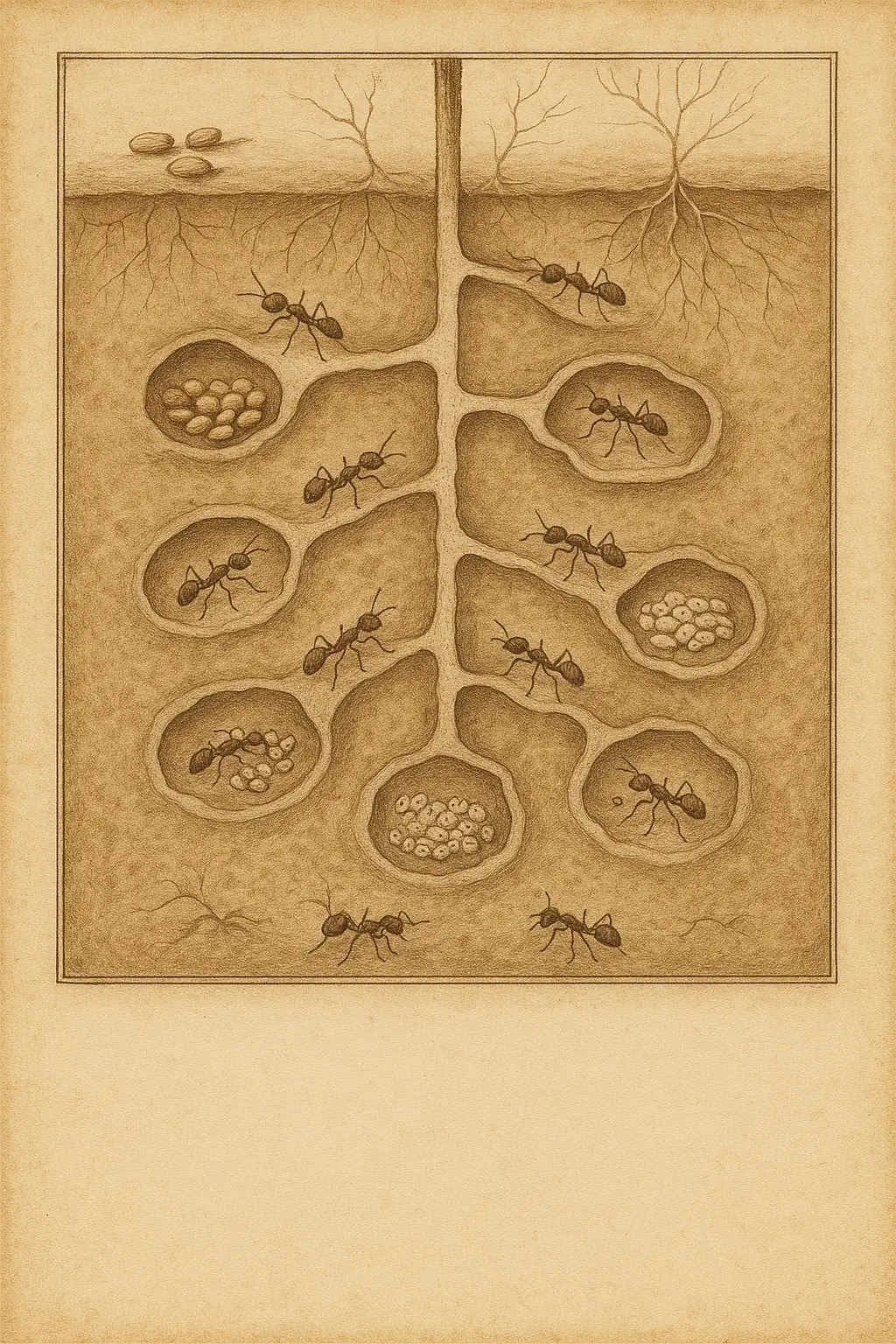
#18Antique copperplate plate
A natural-history engraving of the nest cut away: chambers and tunnels joined like a city, the ants only the traffic.
The prompt
Antique hand-coloured copperplate natural-history engraving on aged cream paper, sepia line and faded watercolour. A cut-away cross-section of an underground harvester ant nest: a vertical shaft with many chambers joined by branching tunnels, seed granaries and a brood chamber, little worker ants walking the tunnels, a few seeds on the surface above, fine roots and soil strata. Composed like a museum specimen plate with a thin ruled border, entirely unlabelled. One idea: intelligence lives in the colony and in the trails the ants lay down, not in any one brain. Leave a wide plain cream margin along the bottom 22 percent of the sheet. No circuits, no glowing brains, no robots, no gears, no human faces. The image contains absolutely no text: no letters, no words, no numbers, no title, no captions, no labels, no typography, no logos, no watermark and no signature.
-
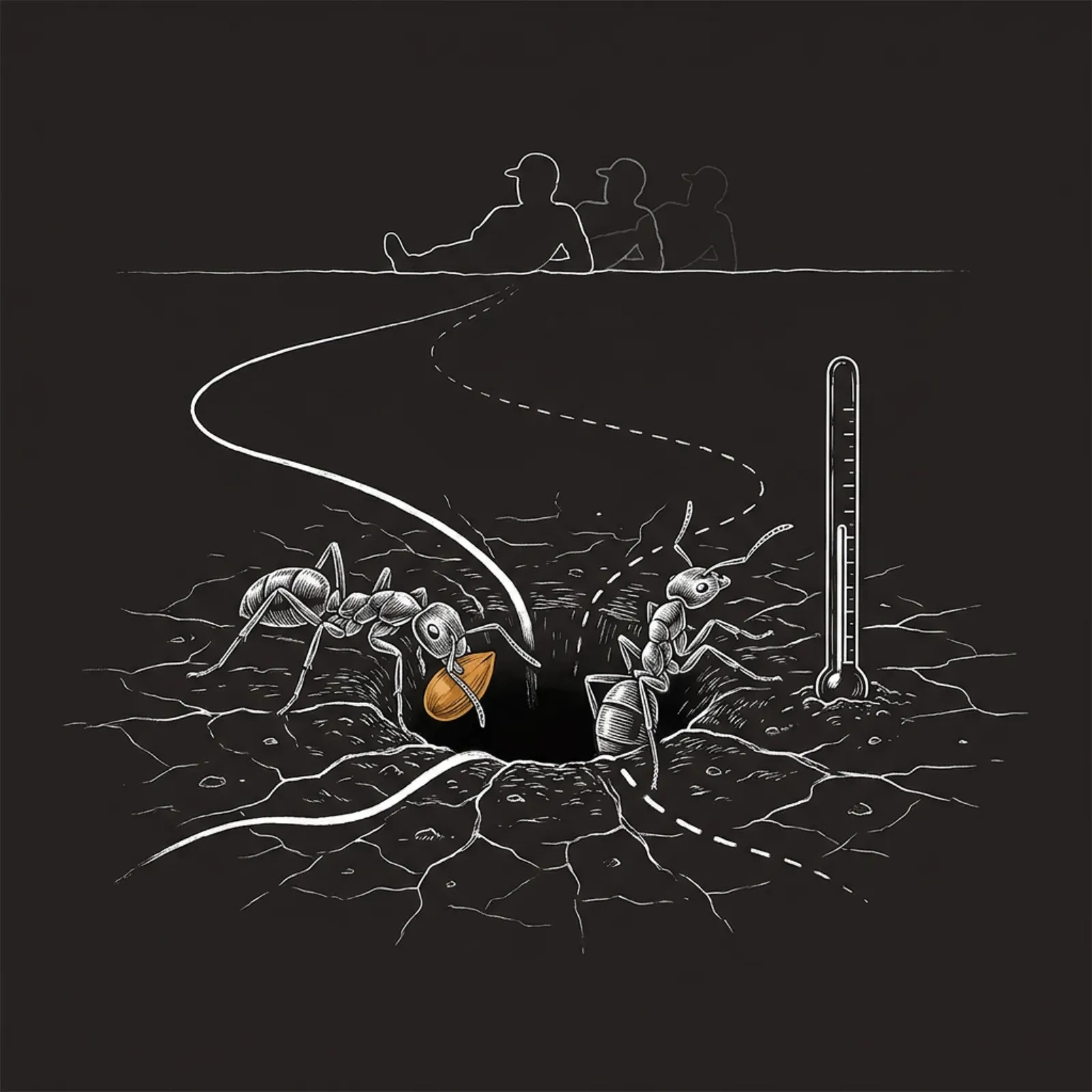
#19One ant at the door
Prologue. Nothing at the door decided anything: one ant went down with a seed and another came up. The rate of arrivals, not a plan, sent the next ant out.
The prompt
STYLE: a precise scientific ink illustration in the manner of a nineteenth-century naturalist's engraved plate: fine white ink linework and delicate cross-hatching on a flat, matte near-black ground, no gradients, no glow, no photographic rendering, no 3D shading. Trails and paths are drawn purely by stroke weight: a thick white stroke is a strong trail, a thin broken stroke is a fading one. Every ant is drawn in the same precise side-view engraving style, with exact insect anatomy. One calm centered composition with generous empty black margin, a square picture-book spread. The only colour in the whole image is a single warm ochre-amber, used for the one key element of the scene; everything else is white ink on near-black. SCENE: The doorway. Low ground-level view of a harvester ant nest entrance, a dark thumb-wide hole in the centre of a swept, cracked disc of bare desert ground, filling the lower half of the picture. Two large ants at the rim of the hole, entirely separate from each other: the left one carrying a single exact seed in its mandibles is descending into the dark, the right one is climbing out. A thin thermometer stands upright in the dirt to the right, with only blank tick marks. Far away in the upper background, tiny and clearly separate from the ants, a distant anonymous human silhouette in a cap lies flat on the ground seen from behind with no face, head toward the hole, and two fainter ghost outlines of the same prone figure sit beside it. The seed is the ONLY ochre-amber element. The image contains absolutely no text: no letters, no words, no numbers, no title, no captions, no labels, no typography, no logos, no watermark and no signature.
-
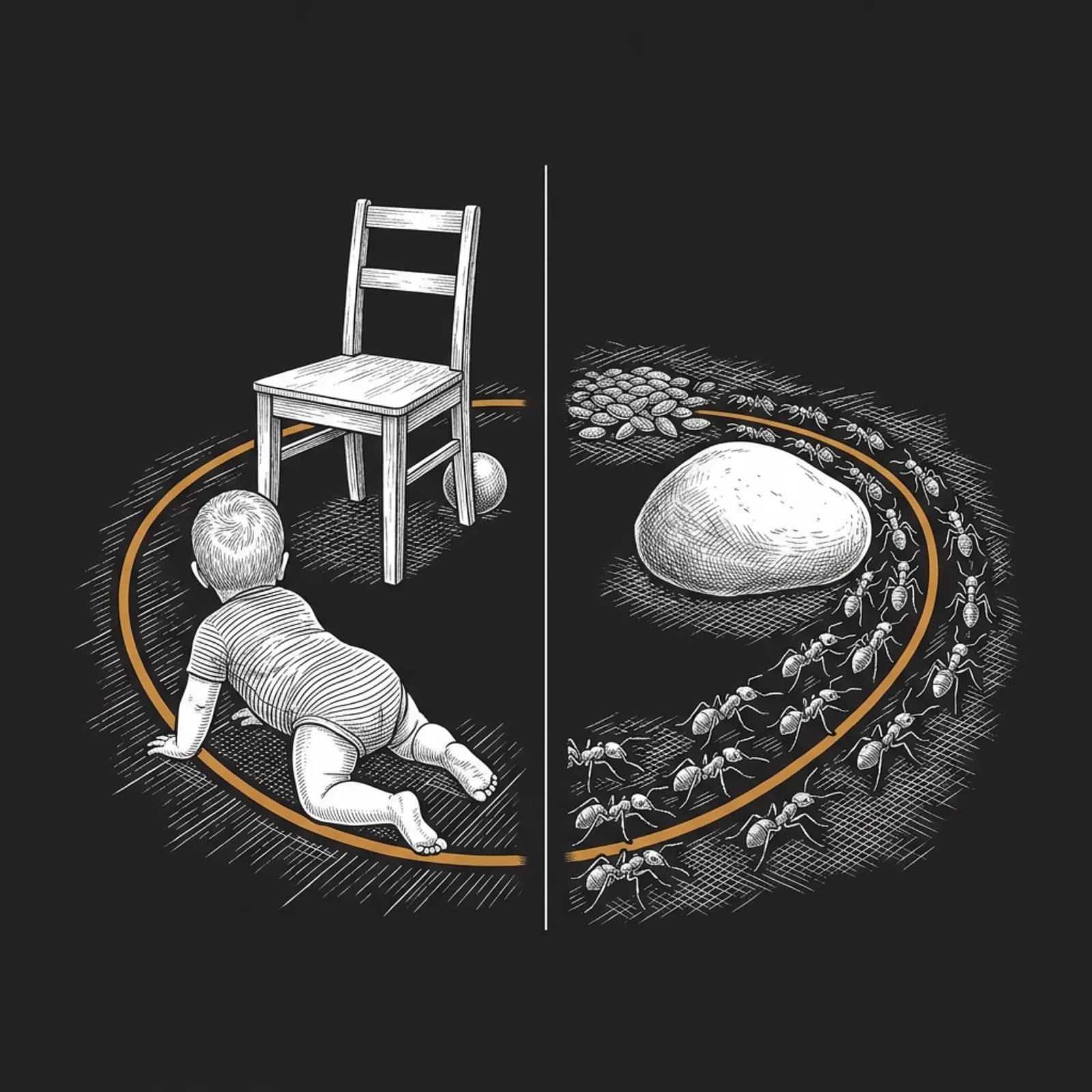
#20The same answer, written twice
Chapter 1. An infant going round a chair and foragers going round a stone trace the same detour. One architecture, spent two ways, finds the hidden thing.
The prompt
STYLE: a precise scientific ink illustration in the manner of a nineteenth-century naturalist's engraved plate: fine white ink linework and delicate cross-hatching on a flat, matte near-black ground, no gradients, no glow, no photographic rendering, no 3D shading. Trails and paths are drawn purely by stroke weight: a thick white stroke is a strong trail, a thin broken stroke is a fading one. Every ant is drawn in the same precise side-view engraving style, with exact insect anatomy. One calm centered composition with generous empty black margin, a square picture-book spread. The only colour in the whole image is a single warm ochre-amber, used for the one key element of the scene; everything else is white ink on near-black. SCENE: The same answer, written twice. A mirrored two-part composition, left half and right half joined at a thin vertical line. Left: a nine-month-old infant seen from behind, crawling on a floor around a simple wooden chair toward a ball hidden behind it. Right, matched line for line: a stream of foraging ants flowing round a rounded stone toward a hidden patch of seeds. The curved detour route around the chair and around the stone is the same shape on both sides, and is drawn in ochre-amber as a single line; everything else is white ink. The image contains absolutely no text: no letters, no words, no numbers, no title, no captions, no labels, no typography, no logos, no watermark and no signature.
-
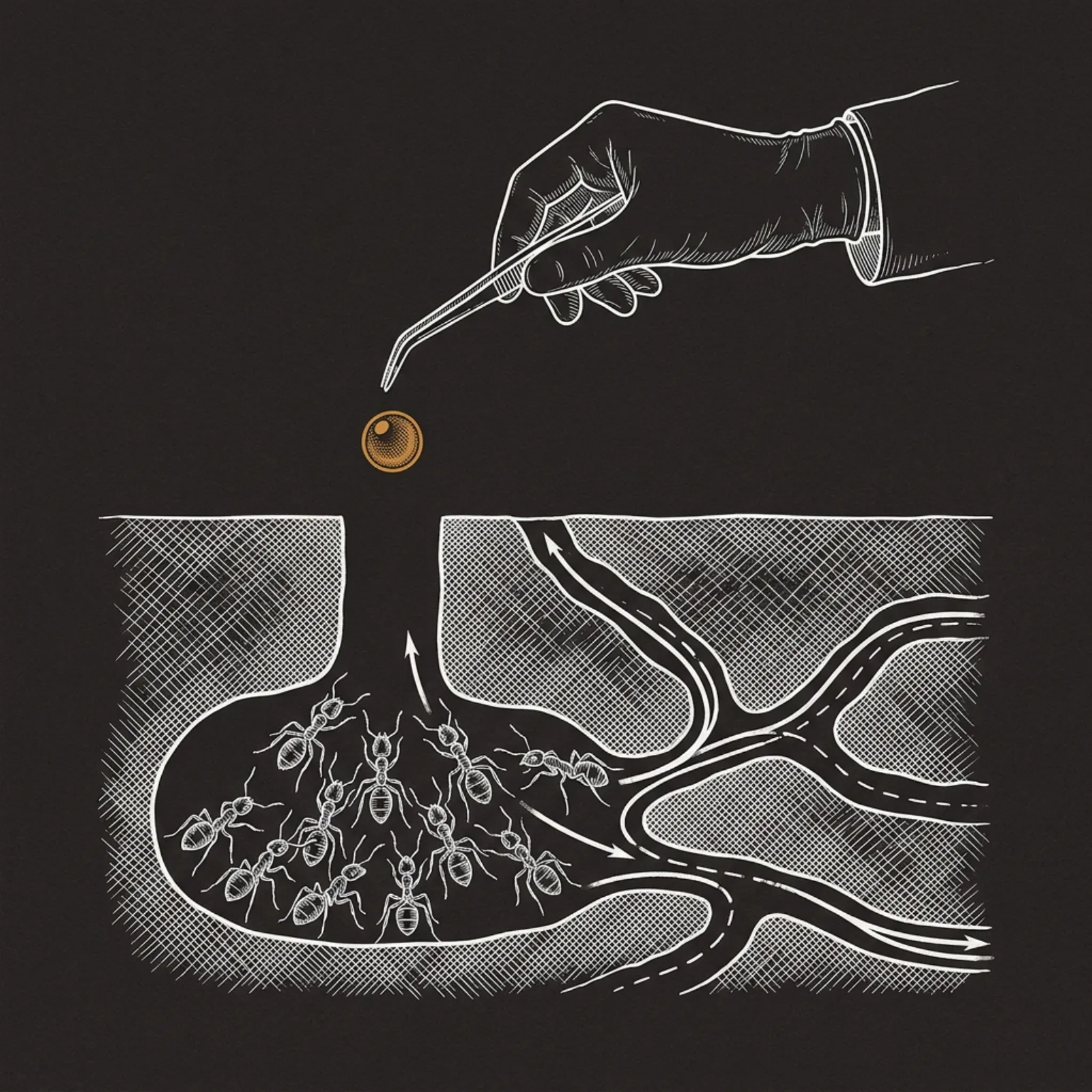
#21Glass beads at the entrance
Chapter 2. Drop a scented bead into the entrance and the waiting foragers turn as if a sister had come home. The colony reads the rate of contact, not the content.
The prompt
STYLE: a precise scientific ink illustration in the manner of a nineteenth-century naturalist's engraved plate: fine white ink linework and delicate cross-hatching on a flat, matte near-black ground, no gradients, no glow, no photographic rendering, no 3D shading. Trails and paths are drawn purely by stroke weight: a thick white stroke is a strong trail, a thin broken stroke is a fading one. Every ant is drawn in the same precise side-view engraving style, with exact insect anatomy. One calm centered composition with generous empty black margin, a square picture-book spread. The only colour in the whole image is a single warm ochre-amber, used for the one key element of the scene; everything else is white ink on near-black. SCENE: Glass beads dropped into the entrance. A cutaway section through desert ground. Above the surface line a hand in a smooth dark laboratory glove and a plain sleeve, no face and no body, holds fine forceps releasing one small round glass bead into a nest entrance. Below the surface line, in a corridor and chamber, a crowd of waiting forager ants all turn their heads and antennae upward toward the shaft as if a sister had come home. The single falling bead is the ONLY ochre-amber element. The image contains absolutely no text: no letters, no words, no numbers, no title, no captions, no labels, no typography, no logos, no watermark and no signature.
-
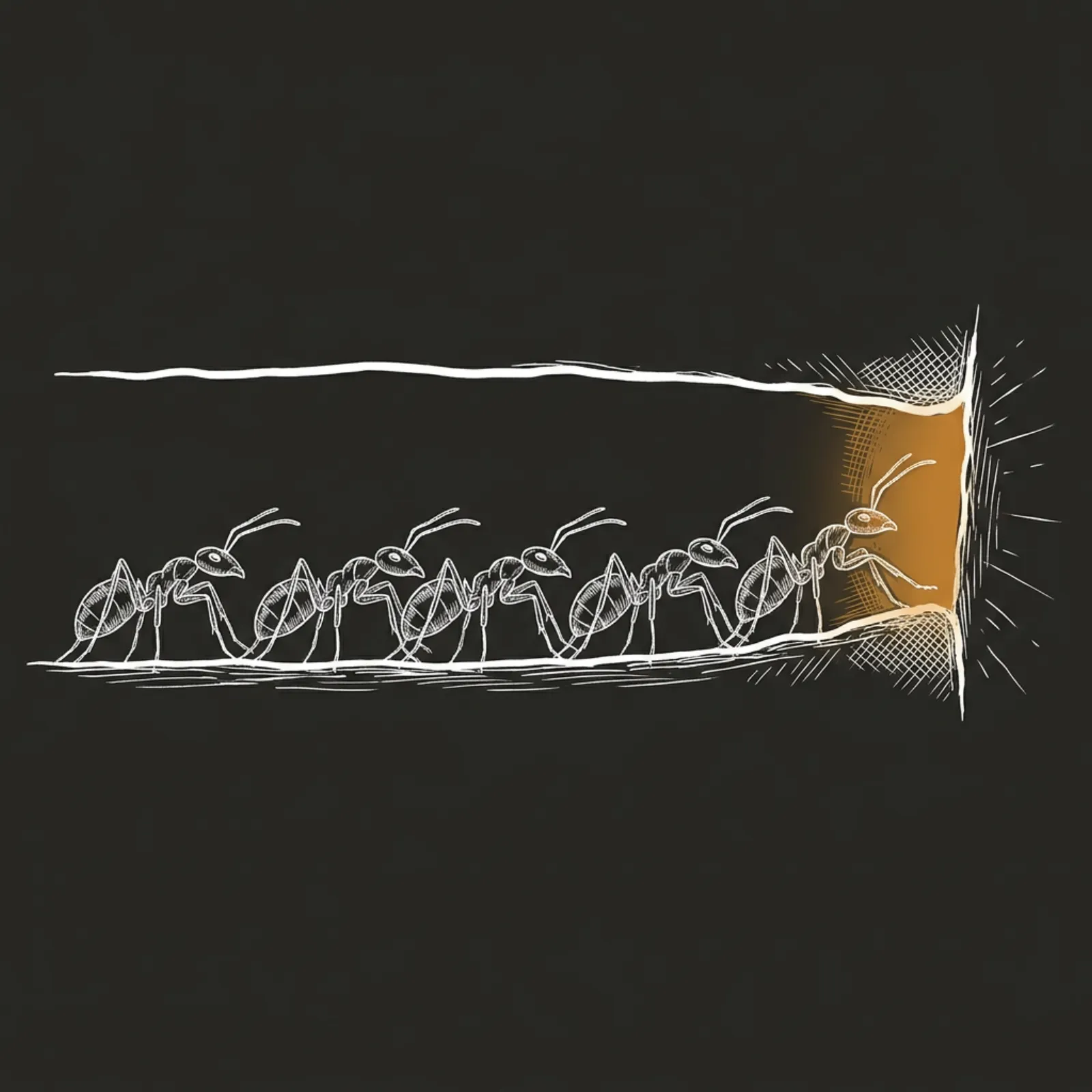
#22The eager go first
Chapter 3. Identical ants wait in the same corridor, but each has its own threshold, so only the most eager step out first. Spread thresholds turn a switch into a dial.
The prompt
STYLE: a precise scientific ink illustration in the manner of a nineteenth-century naturalist's engraved plate: fine white ink linework and delicate cross-hatching on a flat, matte near-black ground, no gradients, no glow, no photographic rendering, no 3D shading. Trails and paths are drawn purely by stroke weight: a thick white stroke is a strong trail, a thin broken stroke is a fading one. Every ant is drawn in the same precise side-view engraving style, with exact insect anatomy. One calm centered composition with generous empty black margin, a square picture-book spread. The only colour in the whole image is a single warm ochre-amber, used for the one key element of the scene; everything else is white ink on near-black. SCENE: The eager go first. A dark underground corridor drawn in section, filling the width of the picture from left to right. A queue of exactly eight identical ants waits in a line inside it, all facing right, antennae sweeping, packed close together. At the far right the corridor opens onto a small bright patch of outside desert light. Only the two ants at the front of the queue lean forward and step out into the light; the six behind them hold back. Only a small ochre-amber glow at the corridor mouth, a narrow slice of light, is the ONLY ochre-amber element. The image contains absolutely no text: no letters, no words, no numbers, no title, no captions, no labels, no typography, no logos, no watermark and no signature.
-
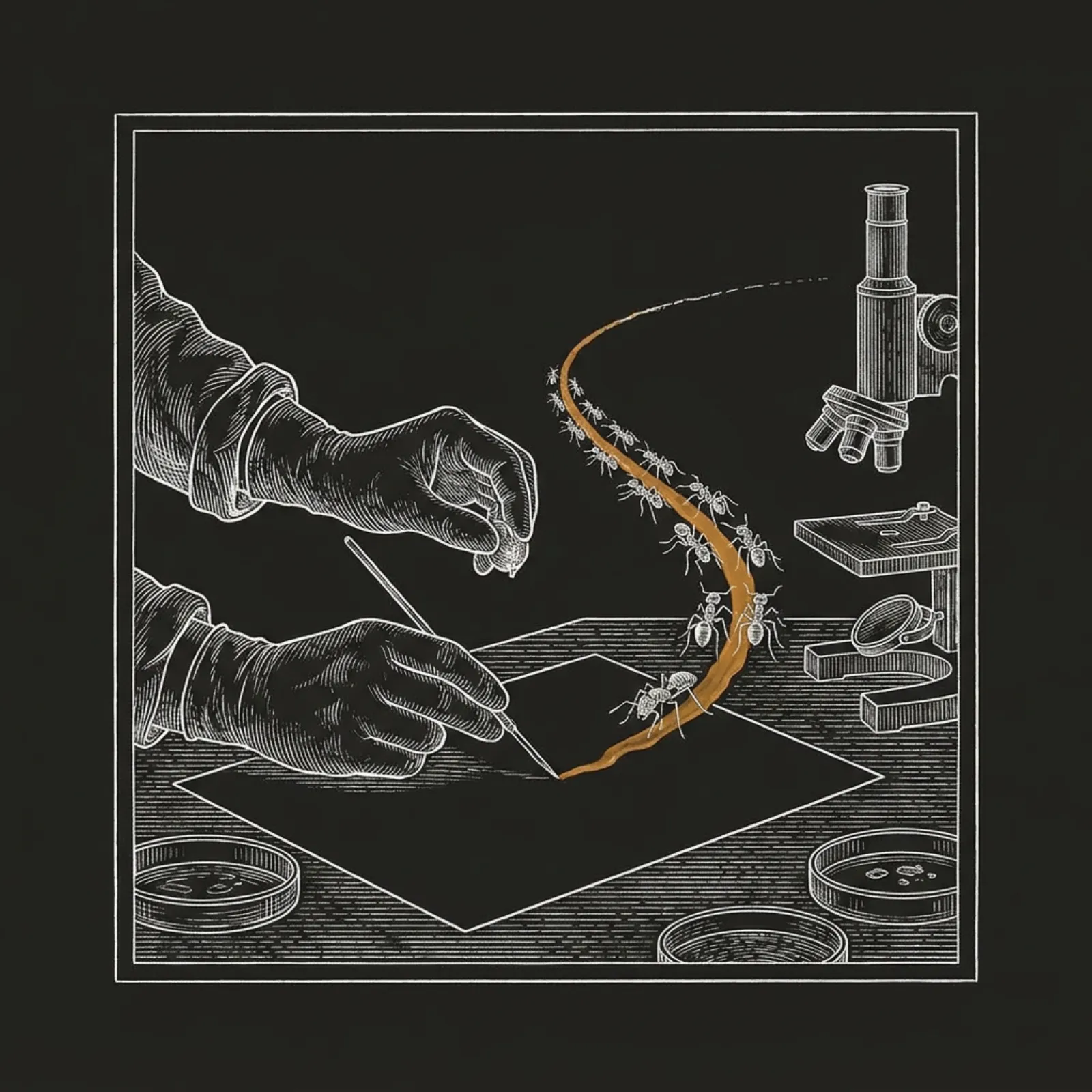
#23Wilson's smear
Chapter 4. A crushed gland on a needle lays a line, and ants follow it to nothing. The memory is in the ground: wipe the line and the ants are lost, not the ants themselves.
The prompt
STYLE: a precise scientific ink illustration in the manner of a nineteenth-century naturalist's engraved plate: fine white ink linework and delicate cross-hatching on a flat, matte near-black ground, no gradients, no glow, no photographic rendering, no 3D shading. Trails and paths are drawn purely by stroke weight: a thick white stroke is a strong trail, a thin broken stroke is a fading one. Every ant is drawn in the same precise side-view engraving style, with exact insect anatomy. One calm centered composition with generous empty black margin, a square picture-book spread. The only colour in the whole image is a single warm ochre-amber, used for the one key element of the scene; everything else is white ink on near-black. SCENE: Wilson's smear. A 1950s laboratory bench seen at an angle, drawn in engraving style: a plain gloved hand and forearm in a rolled cuff, no face and no body, draws a fine needle with a crushed gland across a flat sheet, laying a wet line. Fire ants file along that line in single file, the trail ending in bare empty surface, leading to nothing. Glass dishes and a simple microscope at the edge of the bench. The smeared line, thickest where the ants have walked, is the ONLY ochre-amber element. The image contains absolutely no text: no letters, no words, no numbers, no title, no captions, no labels, no typography, no logos, no watermark and no signature.
-
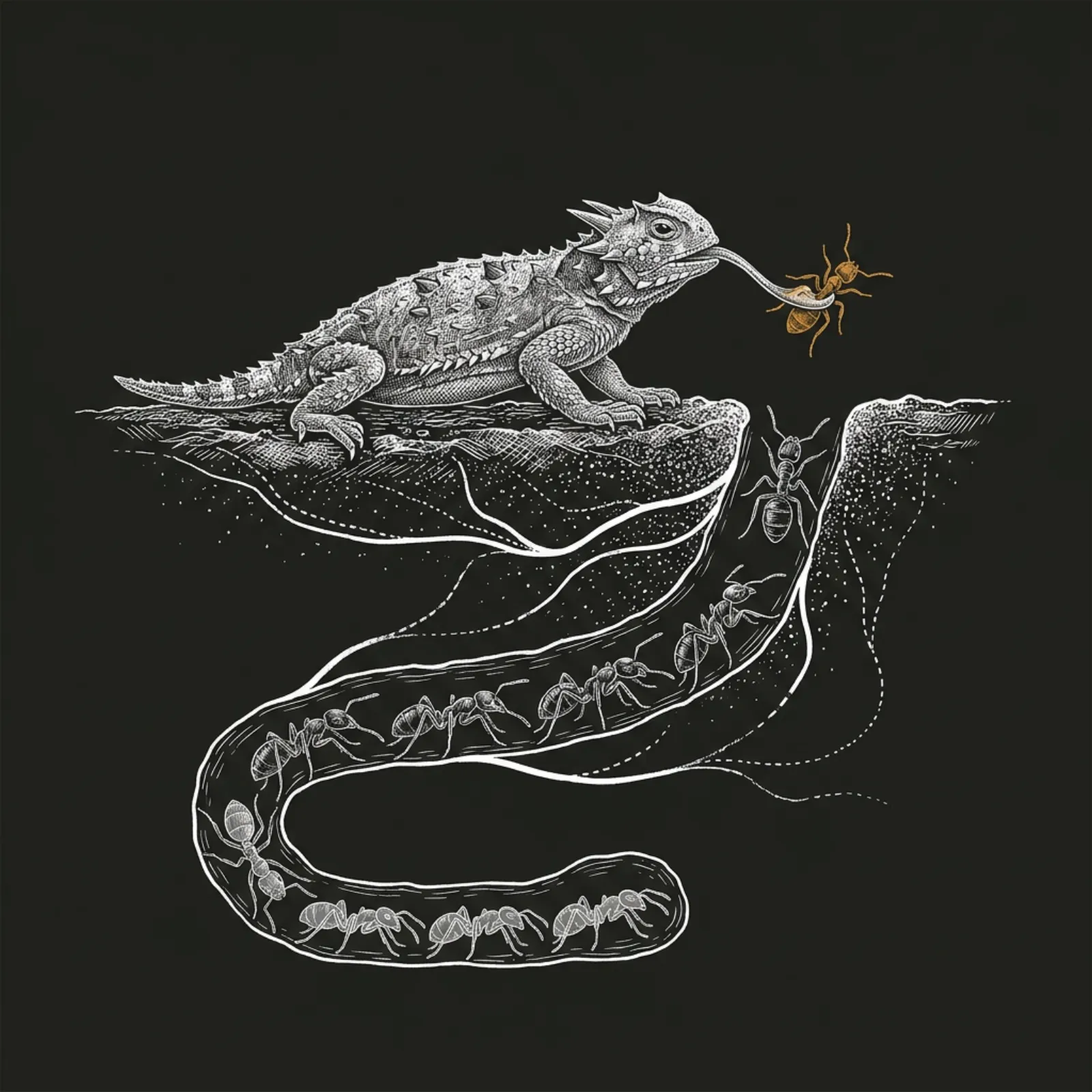
#24The horned toad at the door
Chapter 5. When the lizard takes a forager, the whole age gradient slides one step outward. Roles are states along a track, so no ant needs to be assigned.
The prompt
STYLE: a precise scientific ink illustration in the manner of a nineteenth-century naturalist's engraved plate: fine white ink linework and delicate cross-hatching on a flat, matte near-black ground, no gradients, no glow, no photographic rendering, no 3D shading. Trails and paths are drawn purely by stroke weight: a thick white stroke is a strong trail, a thin broken stroke is a fading one. Every ant is drawn in the same precise side-view engraving style, with exact insect anatomy. One calm centered composition with generous empty black margin, a square picture-book spread. The only colour in the whole image is a single warm ochre-amber, used for the one key element of the scene; everything else is white ink on near-black. SCENE: The horned toad at the door. A desert horned lizard with its spiny crown sits at the rim of a nest entrance and flicks out its tongue, catching one forager. Below the ground line, a vertical section of the nest shows ants arranged by age from deep to shallow: the youngest are pale hollow outlines near the bottom, older ones progressively denser and darker toward the entrance, each one stepping one place outward to fill the gap where the forager was taken. The single captured forager at the end of the tongue is the ONLY ochre-amber element. The image contains absolutely no text: no letters, no words, no numbers, no title, no captions, no labels, no typography, no logos, no watermark and no signature.
-
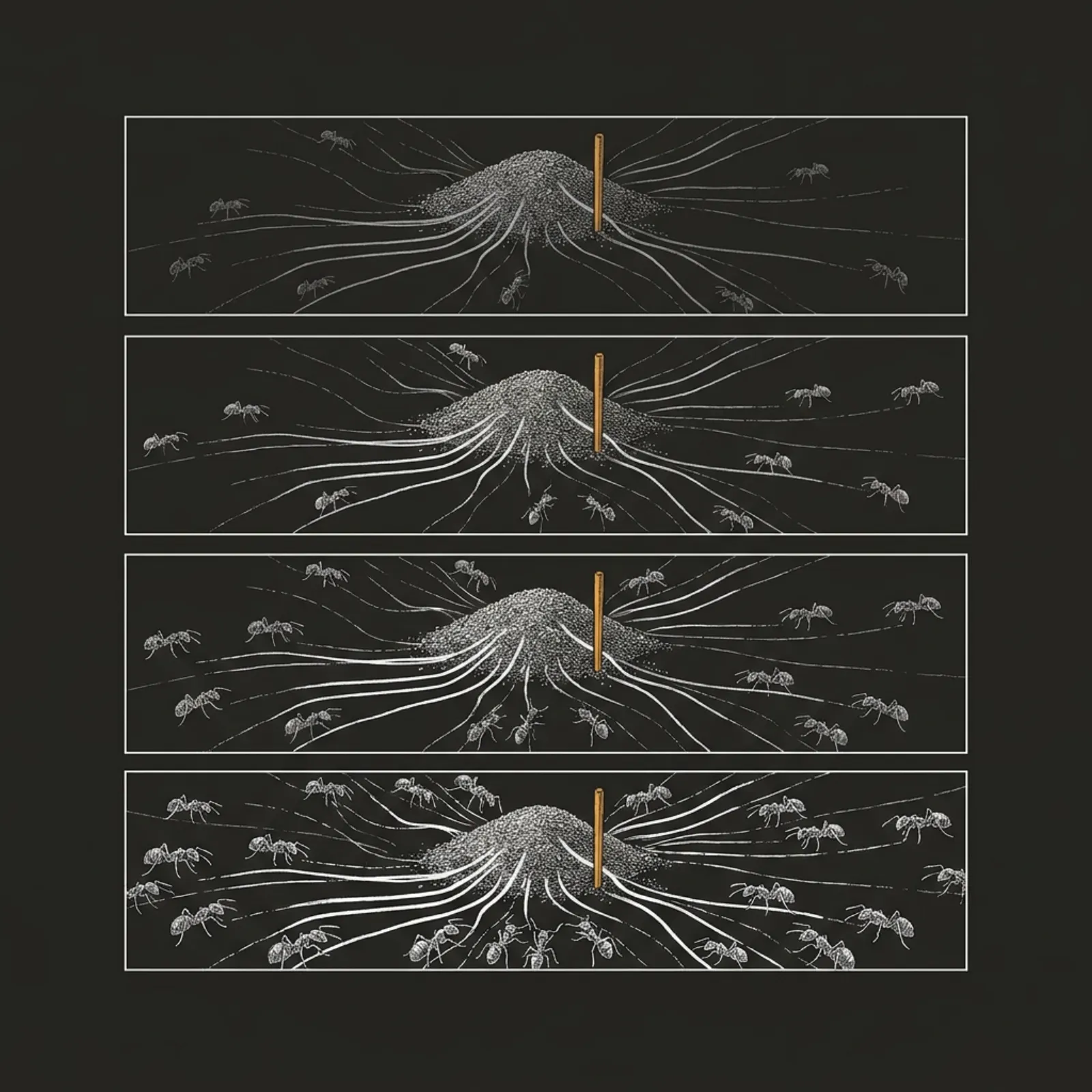
#25The mound across decades
Chapter 6. The same mound, the same stake, the same trail fan, and none of the ants repeat. The pattern outlives every individual because it lives in the ground.
The prompt
STYLE: a precise scientific ink illustration in the manner of a nineteenth-century naturalist's engraved plate: fine white ink linework and delicate cross-hatching on a flat, matte near-black ground, no gradients, no glow, no photographic rendering, no 3D shading. Trails and paths are drawn purely by stroke weight: a thick white stroke is a strong trail, a thin broken stroke is a fading one. Every ant is drawn in the same precise side-view engraving style, with exact insect anatomy. One calm centered composition with generous empty black margin, a square picture-book spread. The only colour in the whole image is a single warm ochre-amber, used for the one key element of the scene; everything else is white ink on near-black. SCENE: The mound across decades. Exactly four wide, short rectangular plates stacked vertically in a single column, one beneath the other, like geological strata, each filling the full width of the picture. Each plate shows the same desert gravel mound seen from above with a fan of white trails radiating from it, identical in every plate, and one survey stake planted in exactly the same spot beside the mound. The scattered ants differ from plate to plate and are drawn in different tones of white, from pale to dense, so no ant repeats while the trail fan holds still. The one survey stake, a thin upright peg, in each plate is the ONLY ochre-amber element. The image contains absolutely no text: no letters, no words, no numbers, no title, no captions, no labels, no typography, no logos, no watermark and no signature.
-
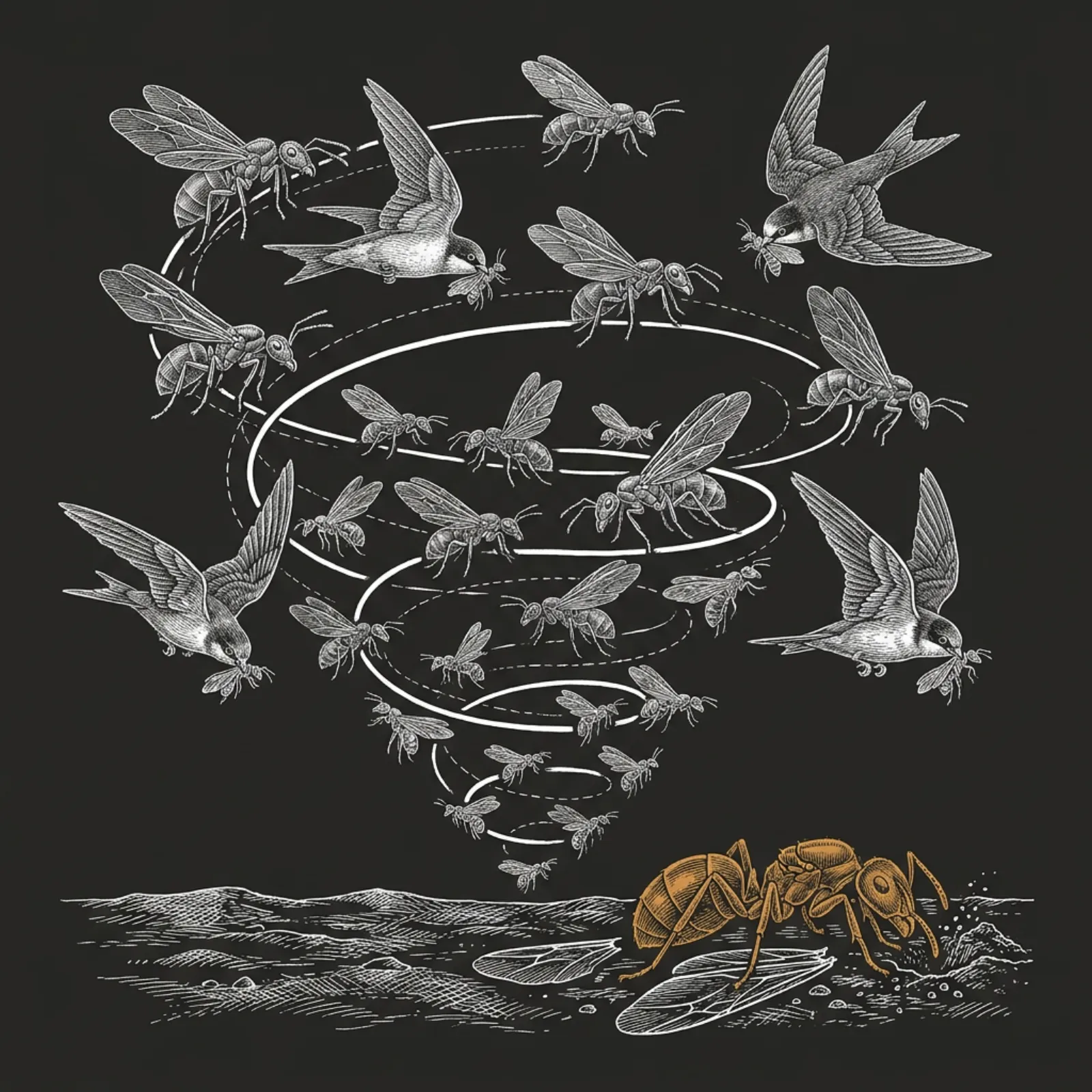
#26The lottery afternoon
Chapter 7. Thousands of queens rise, birds take nearly all, and one lands and starts a hole. The queen is a rare winner of a lottery, not a ruler.
The prompt
STYLE: a precise scientific ink illustration in the manner of a nineteenth-century naturalist's engraved plate: fine white ink linework and delicate cross-hatching on a flat, matte near-black ground, no gradients, no glow, no photographic rendering, no 3D shading. Trails and paths are drawn purely by stroke weight: a thick white stroke is a strong trail, a thin broken stroke is a fading one. Every ant is drawn in the same precise side-view engraving style, with exact insect anatomy. One calm centered composition with generous empty black margin, a square picture-book spread. The only colour in the whole image is a single warm ochre-amber, used for the one key element of the scene; everything else is white ink on near-black. SCENE: The lottery afternoon. A wide desert sky filled with many winged queen ants rising in a loose column from nests on the ground far below, drawn clearly as ants with large wings. Among them several large, clearly recognisable birds with spread wings, swifts and swallows, swoop through and seize queens in their beaks. In the bottom corner, on the bare ground, one single large queen has landed and snapped off her wings, which lie beside her, and is beginning to dig a small hole. The single landed queen is the ONLY ochre-amber element. The image contains absolutely no text: no letters, no words, no numbers, no title, no captions, no labels, no typography, no logos, no watermark and no signature.
-
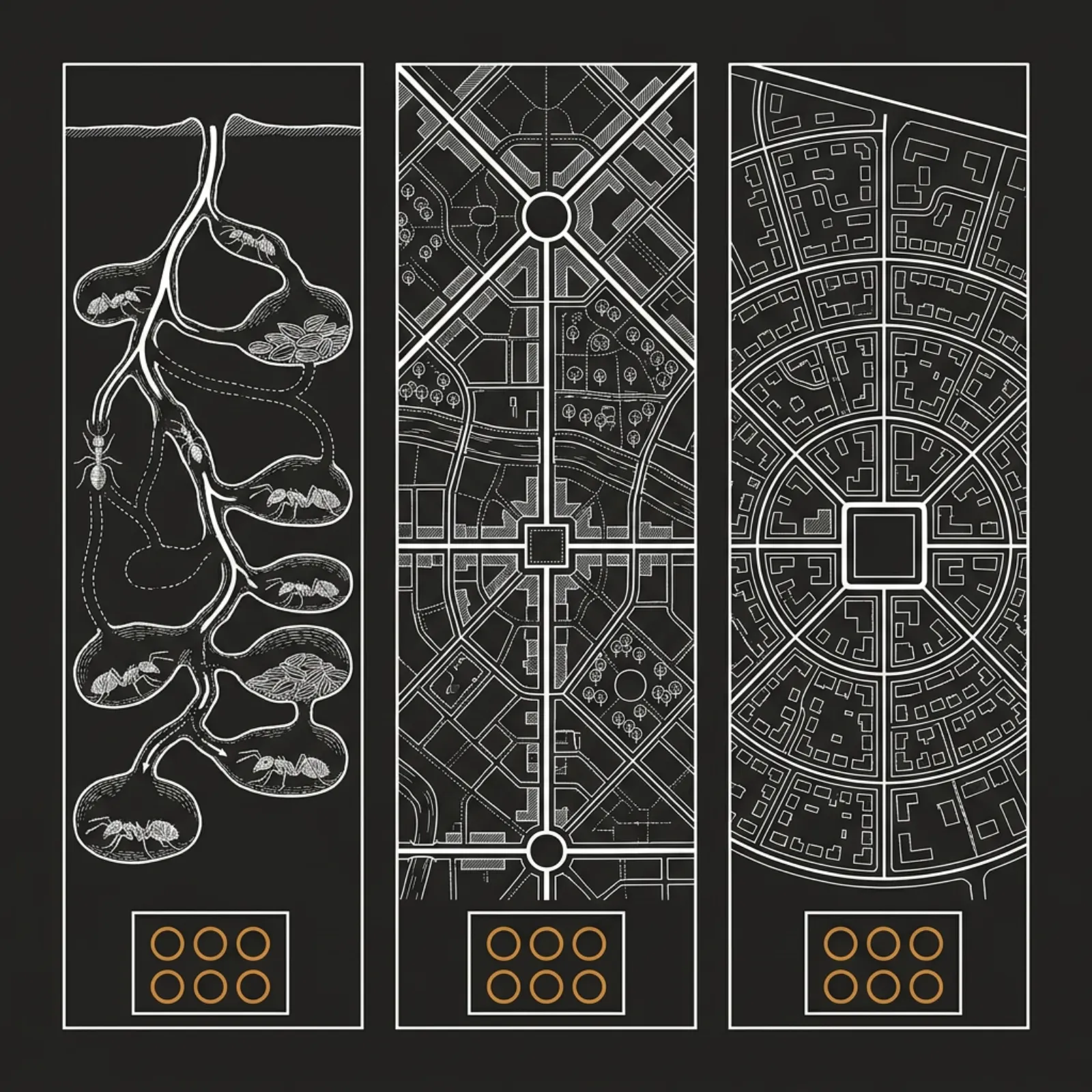
#27Three systems, one inventory
Chapter 8. A colony, a city and a neighbourhood each carry the same six things. Counting them is how intelligence stops looking like a brain and starts looking like a pattern.
The prompt
STYLE: a precise scientific ink illustration in the manner of a nineteenth-century naturalist's engraved plate: fine white ink linework and delicate cross-hatching on a flat, matte near-black ground, no gradients, no glow, no photographic rendering, no 3D shading. Trails and paths are drawn purely by stroke weight: a thick white stroke is a strong trail, a thin broken stroke is a fading one. Every ant is drawn in the same precise side-view engraving style, with exact insect anatomy. One calm centered composition with generous empty black margin, a square picture-book spread. The only colour in the whole image is a single warm ochre-amber, used for the one key element of the scene; everything else is white ink on near-black. SCENE: Three systems, one inventory. A triptych of three tall rectangular panels side by side with thin white frames, all drawn in white ink only: left, a cross-section of a harvester ant colony with entrance, chambers and trails; centre, a bird's-eye plan of a small city with streets in thick and thin strokes; right, a plan of a ten-minute walking neighbourhood around a central square drawn in plain white line. Inside the bottom of each panel sits the same small block of exactly six empty rings arranged as two rows of three, identical in all three panels, containing no numbers. All eighteen of these rings, and nothing else in the picture, are drawn in ochre-amber. The image contains absolutely no text: no letters, no words, no numbers, no title, no captions, no labels, no typography, no logos, no watermark and no signature.
-
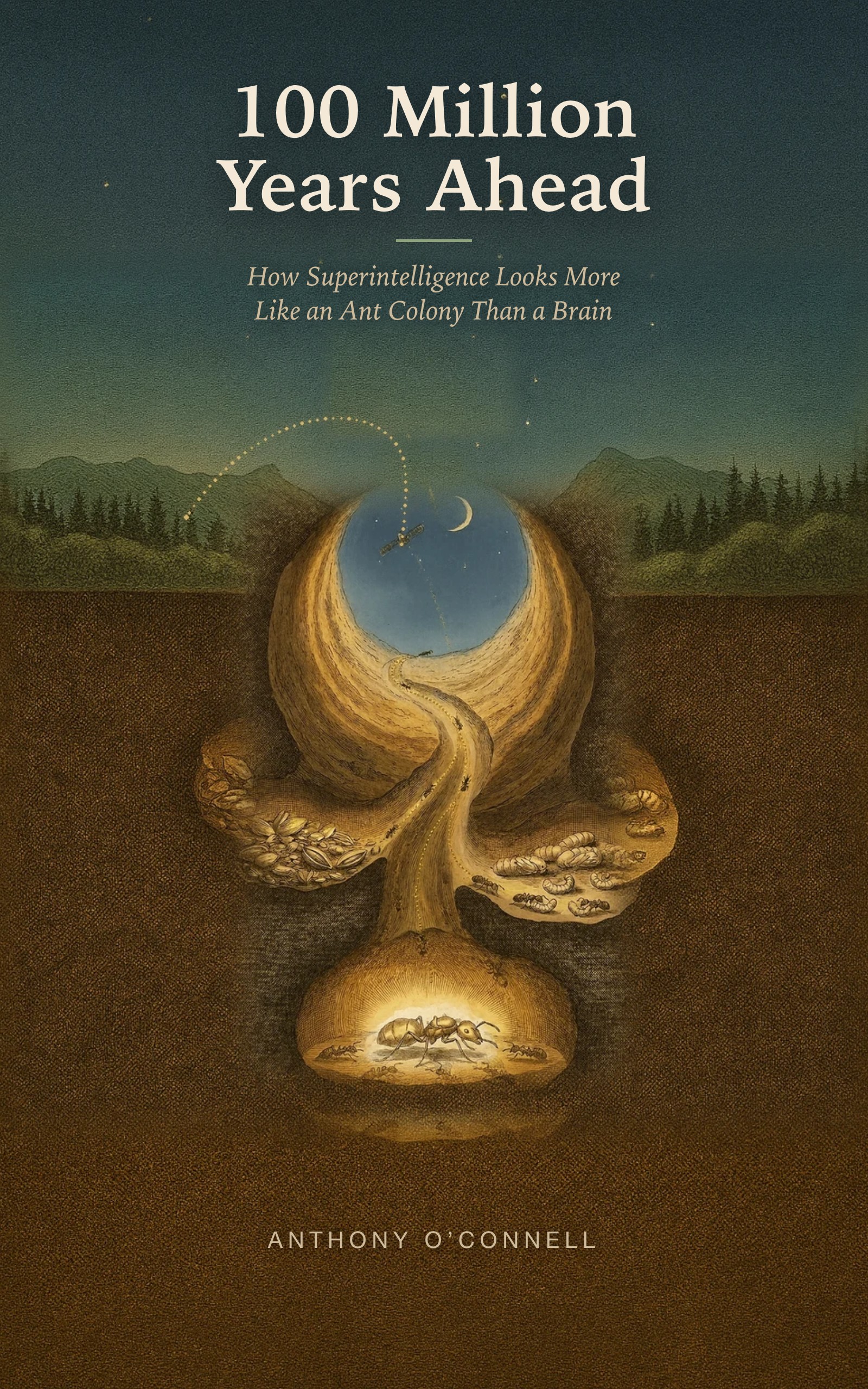
#28Ebook cover, full bleed
Book. Kindle / Apple Books · 1600 × 2560
-
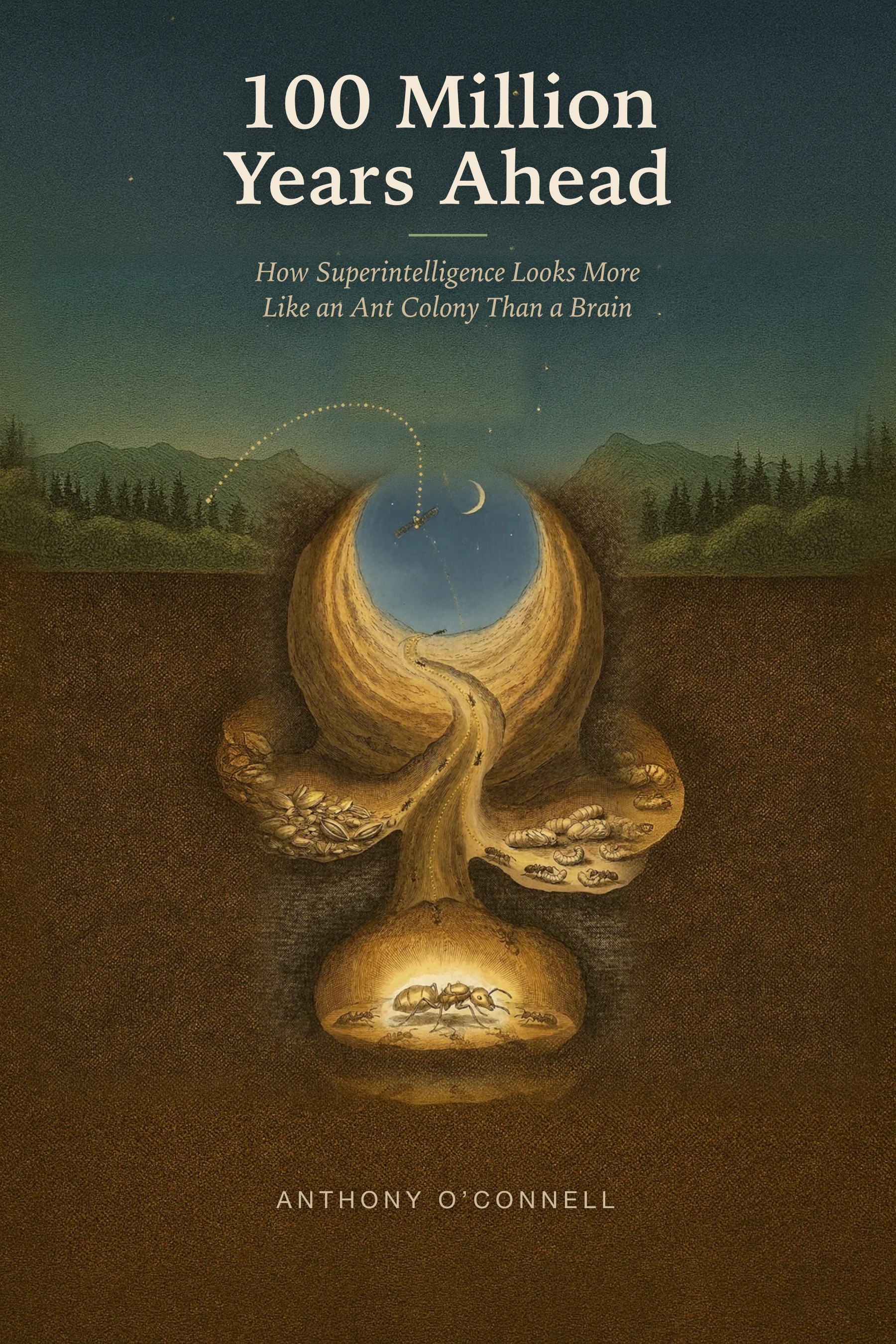
#29Paperback front, full bleed
Book. 6 × 9 in trim at 300 dpi · 1800 × 2700
-
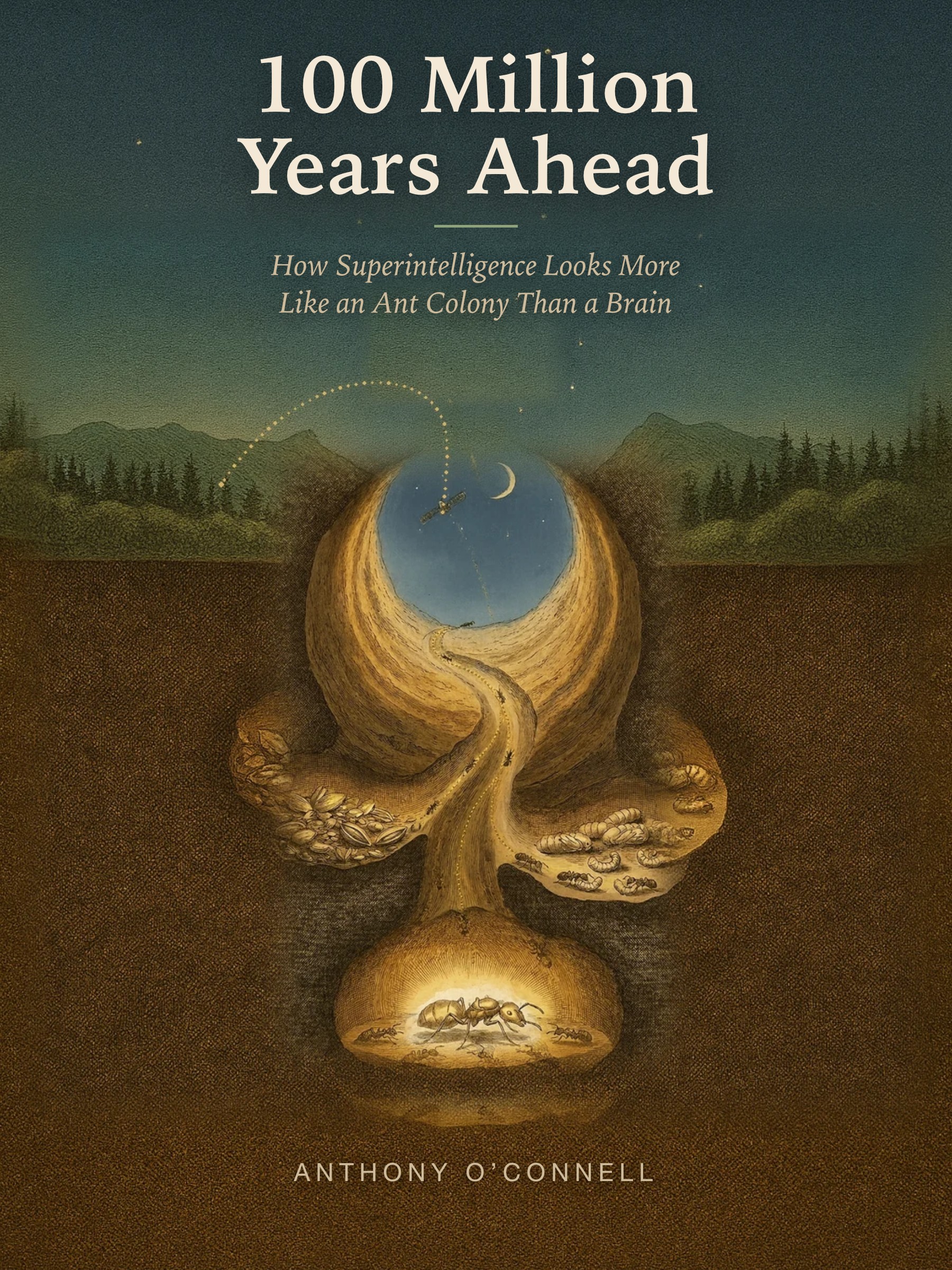
#30Poster 18 × 24, full bleed
Poster. 3:4 · 1800 × 2400 preview
-
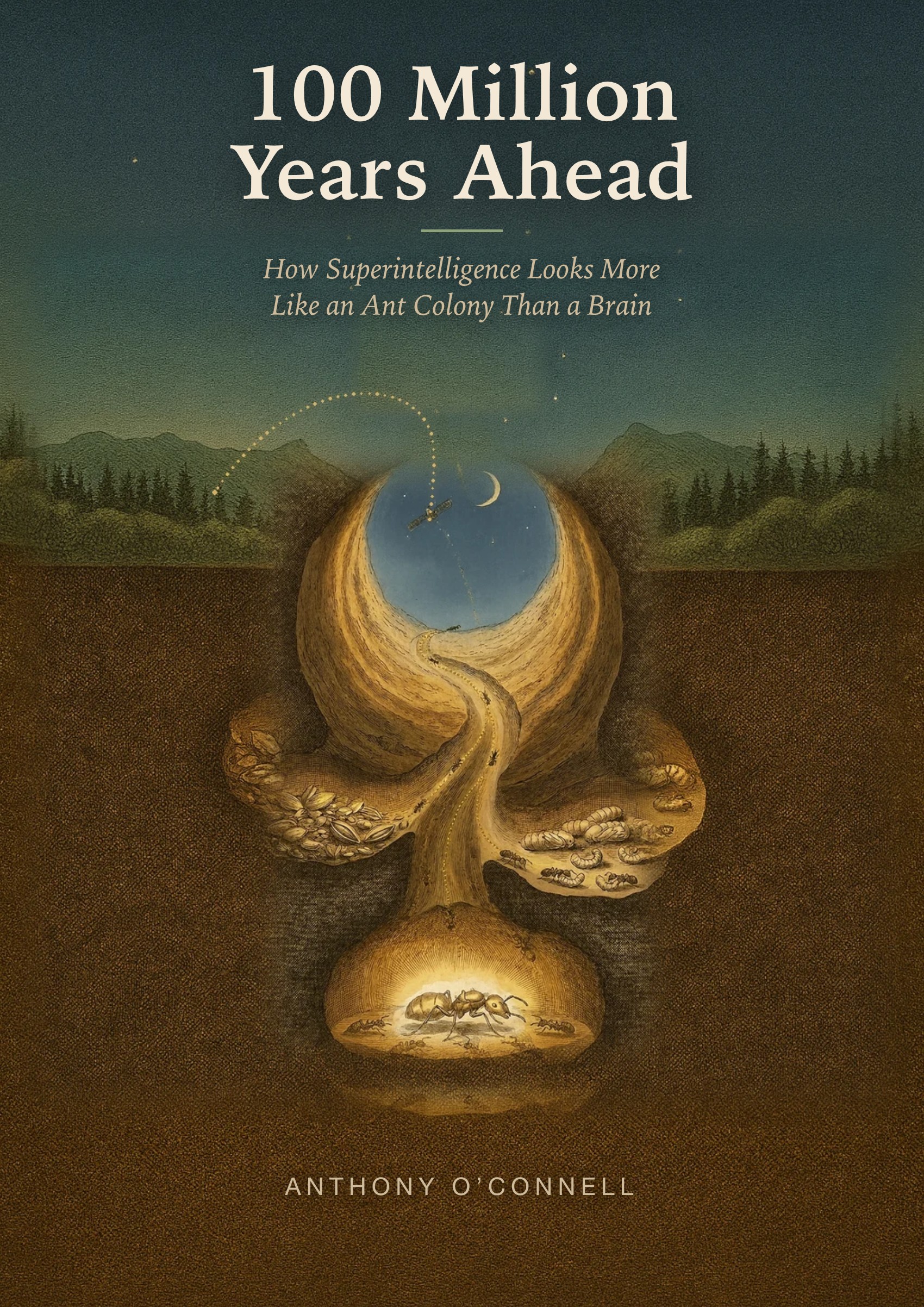
#31Poster A2, full bleed
Poster. 1 : 1.414 · 1700 × 2404 preview
-
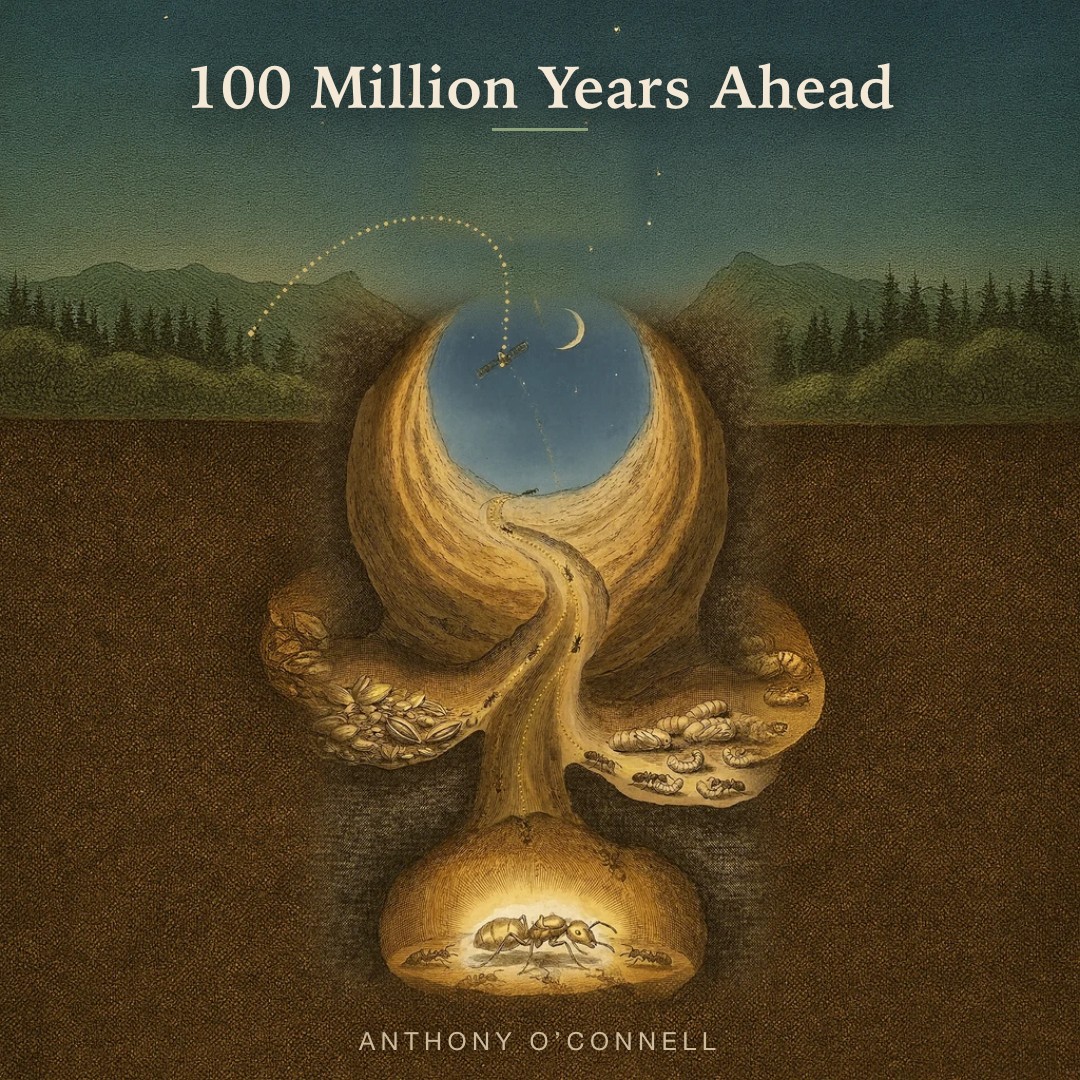
#32Instagram square, full bleed
Social. 1080 × 1080
-
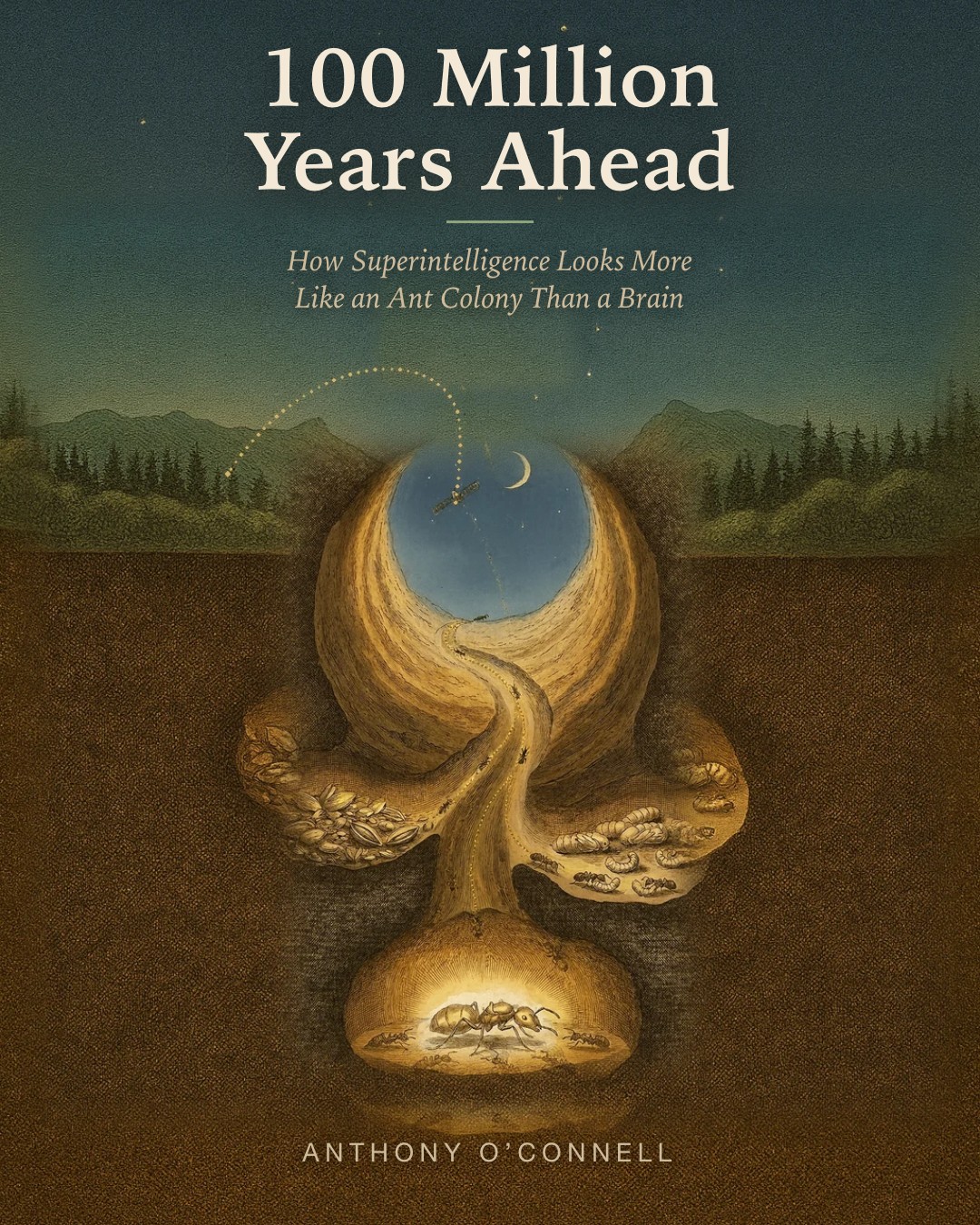
#33Instagram portrait, full bleed
Social. 4:5 · 1080 × 1350
-
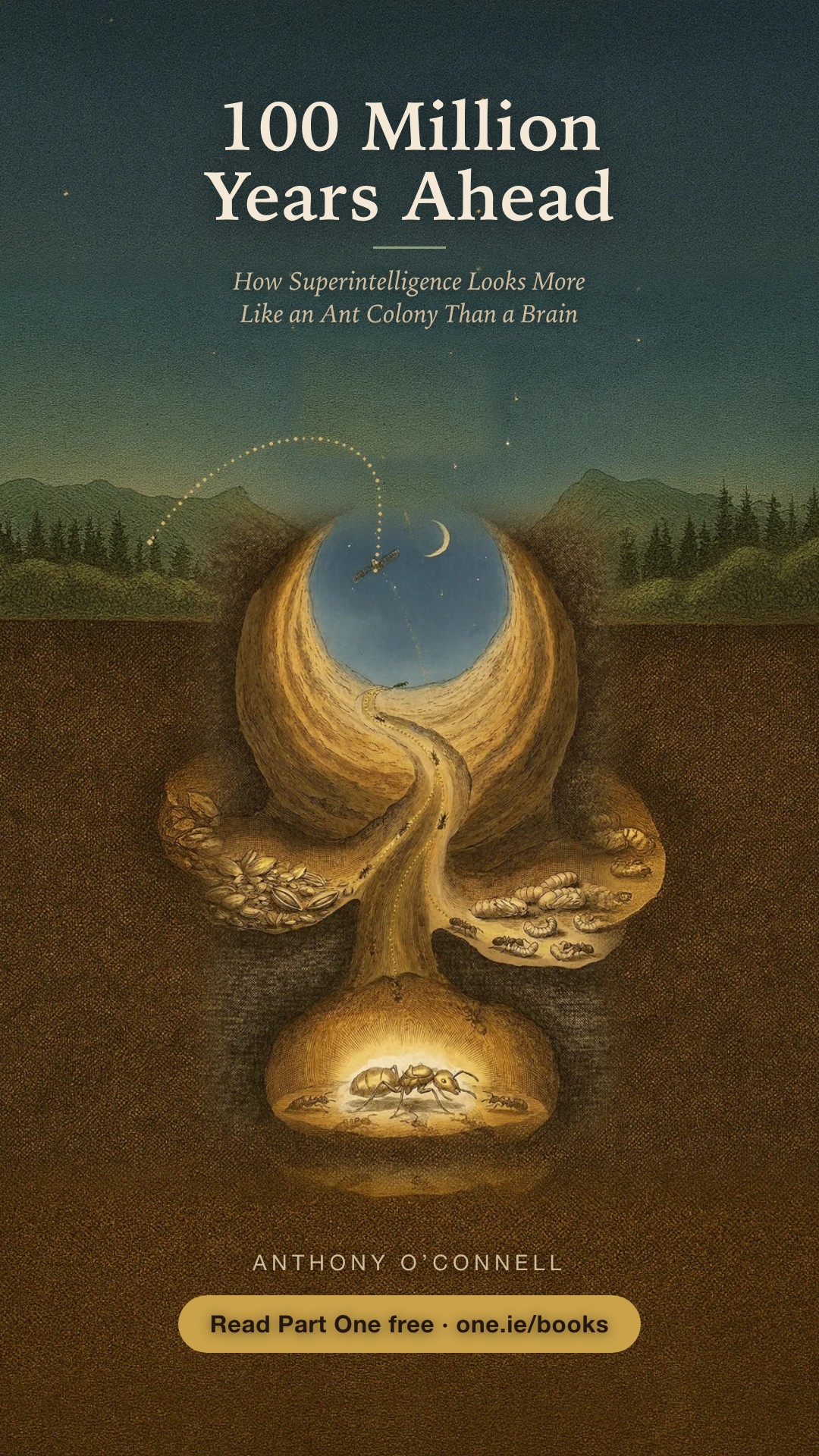
#34Story / Reel, full bleed
Social. 9:16 · 1080 × 1920
-
#35X header, full bleed
Social. 3:1 · 1500 × 500
-
#36LinkedIn banner, full bleed
Social. 4:1 · 1584 × 396
-
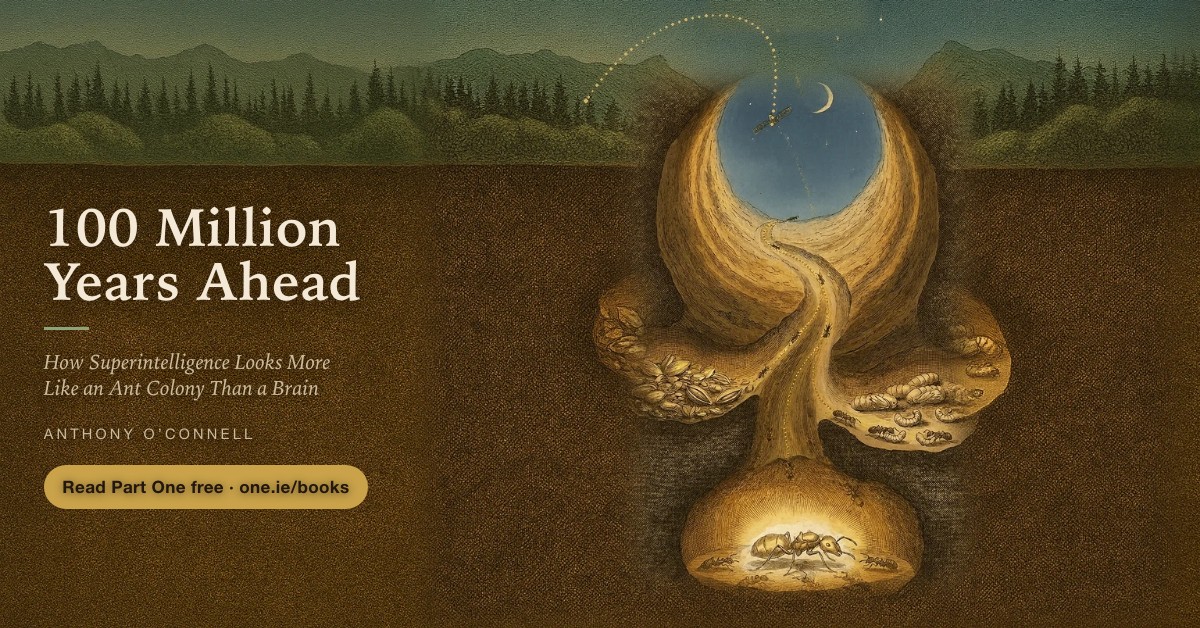
#37Feed ad, landscape, full bleed
Ads. Meta / LinkedIn link ad · 1200 × 628
-
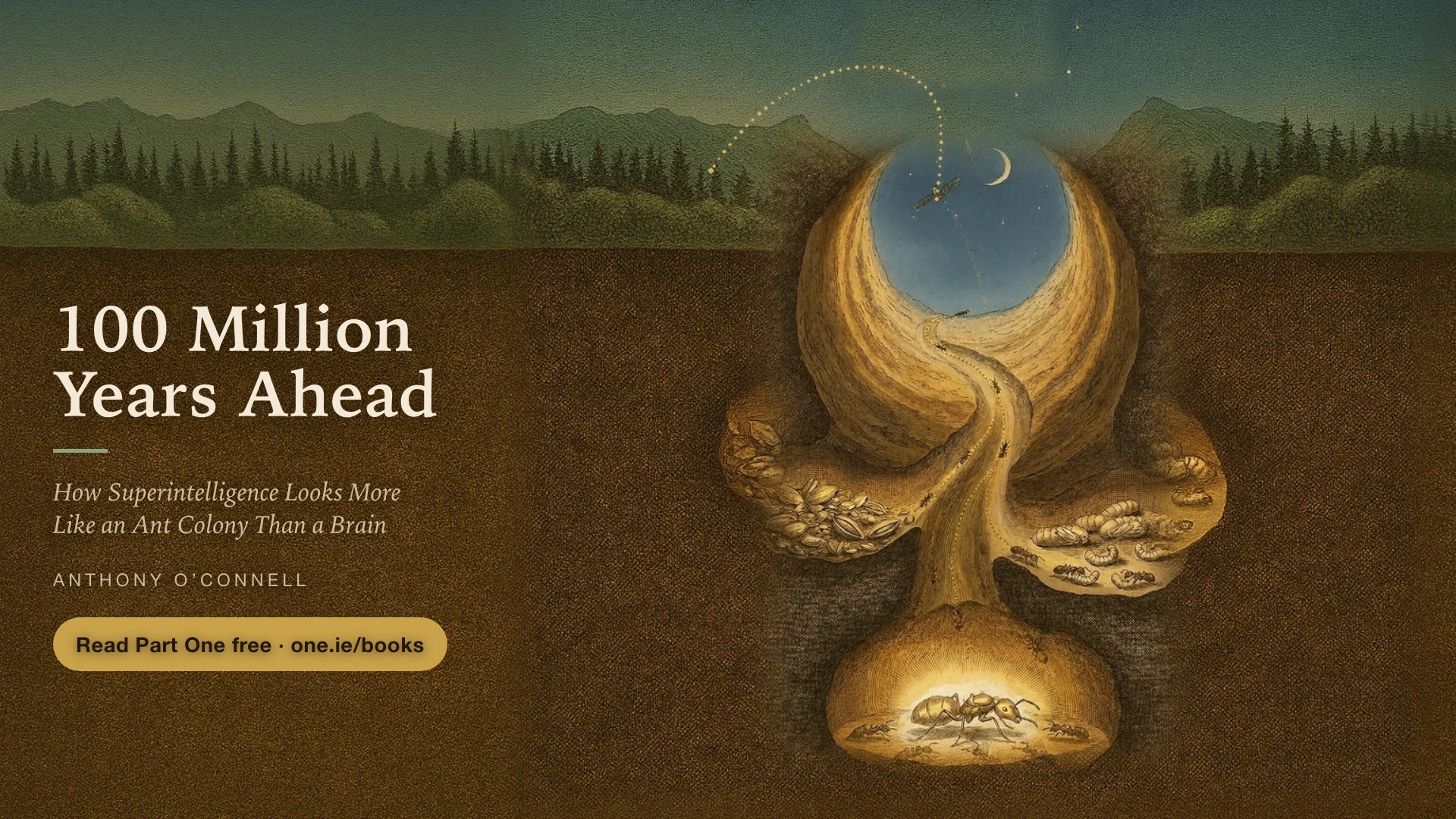
#38Video / YouTube frame, full bleed
Ads. 16:9 · 1920 × 1080
-
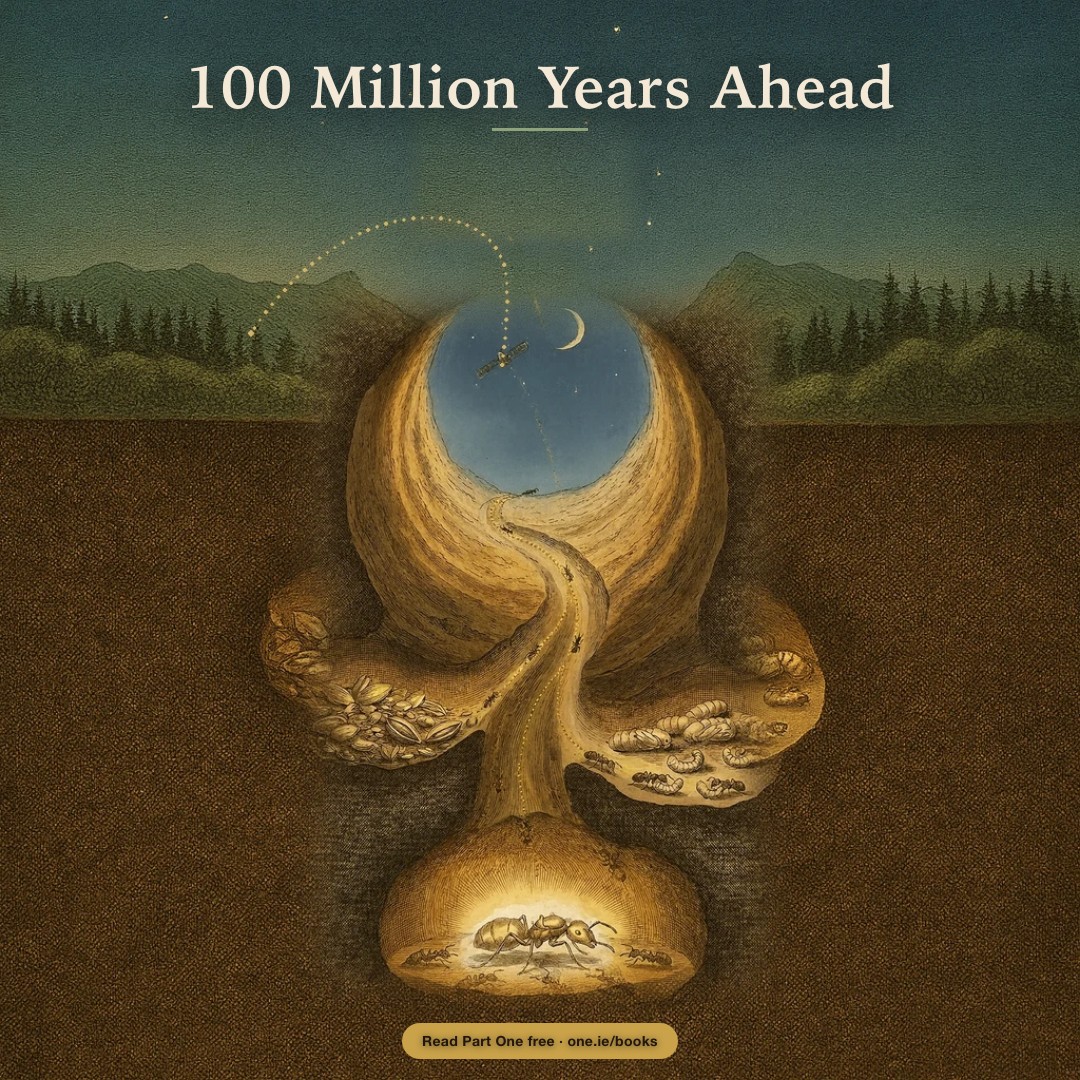
#39Square ad, full bleed
Ads. 1080 × 1080
-
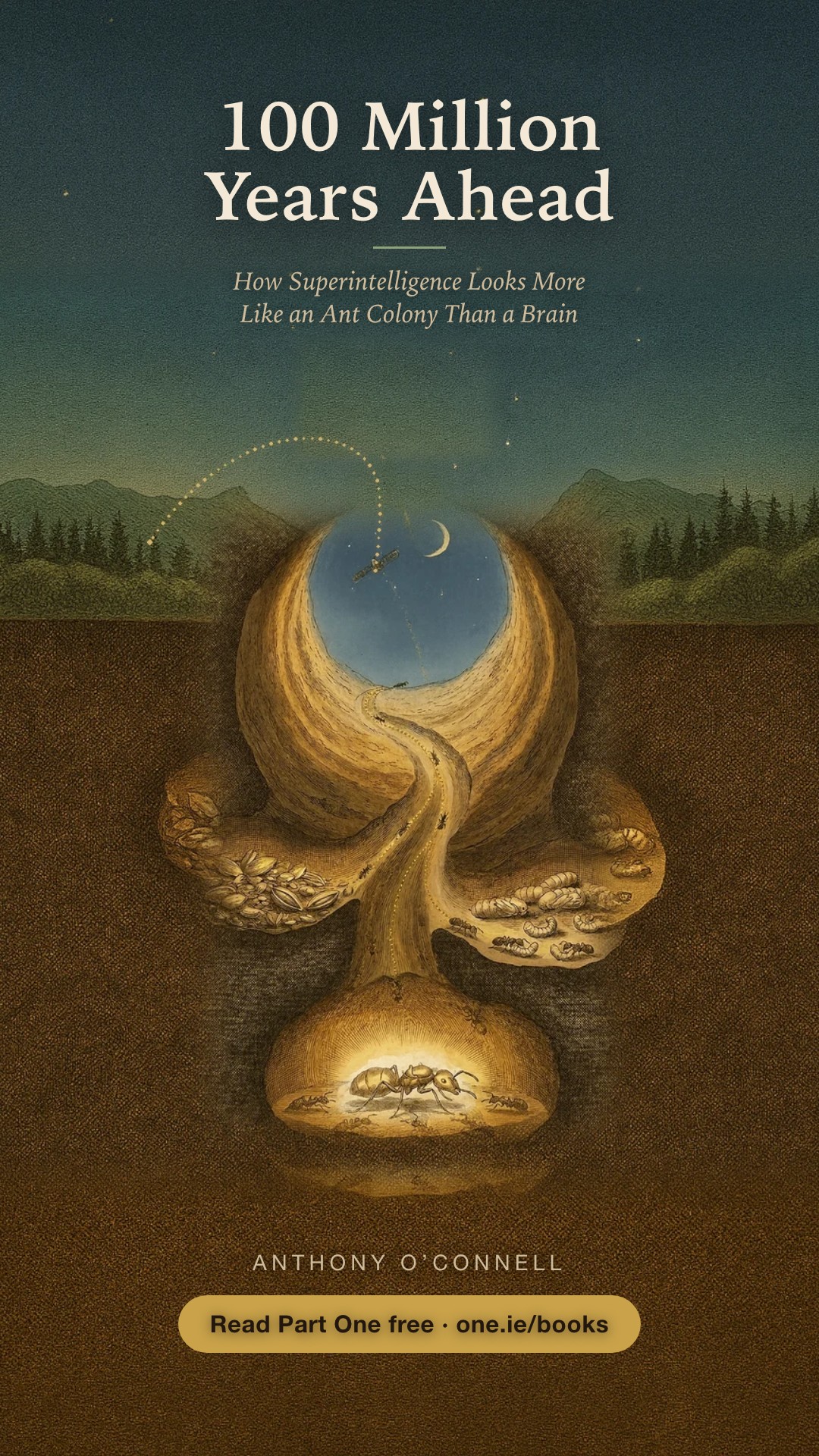
#40Story ad, full bleed
Ads. 9:16 · 1080 × 1920
-
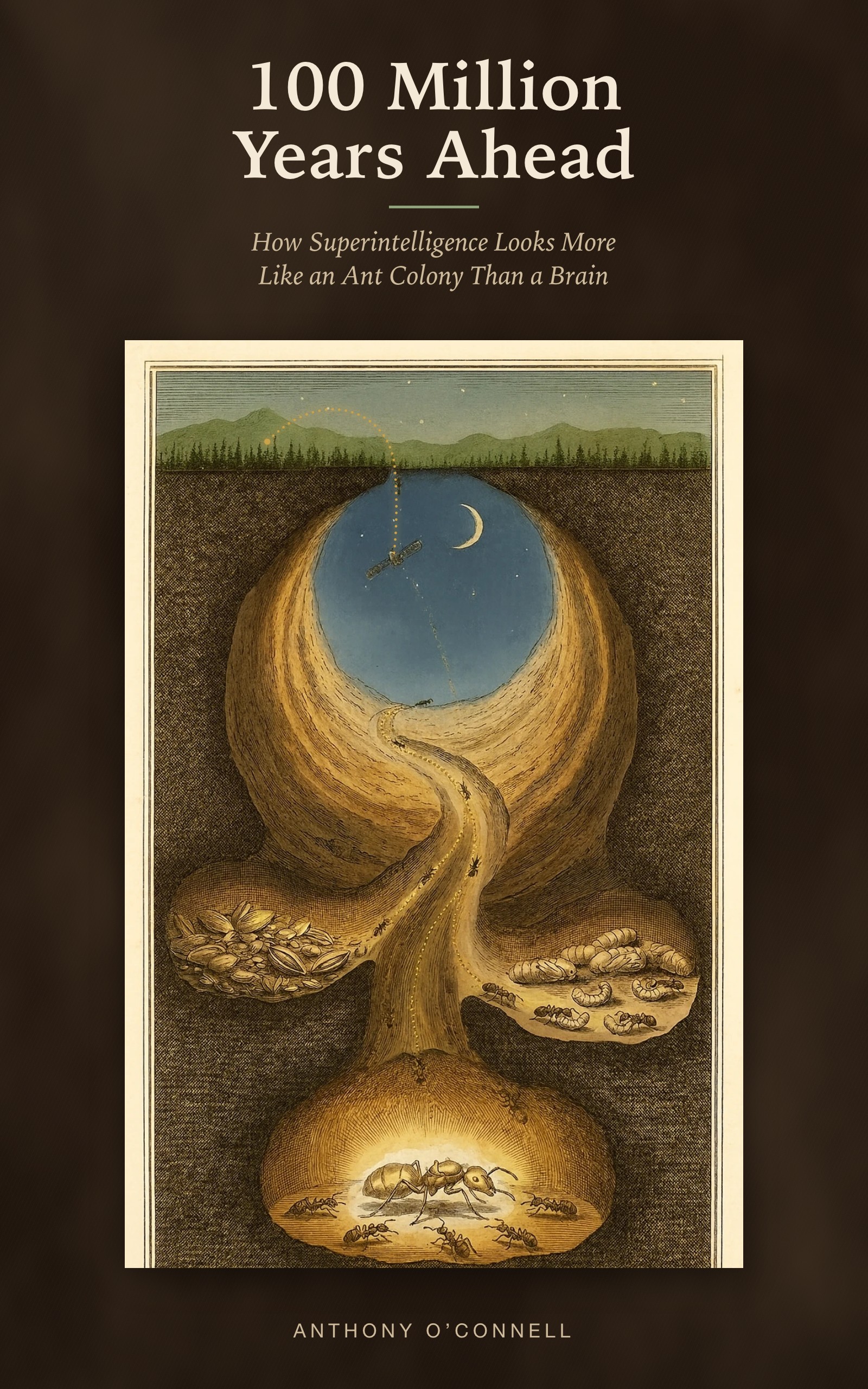
#41Ebook cover
Book. Kindle / Apple Books · 1600 × 2560
-
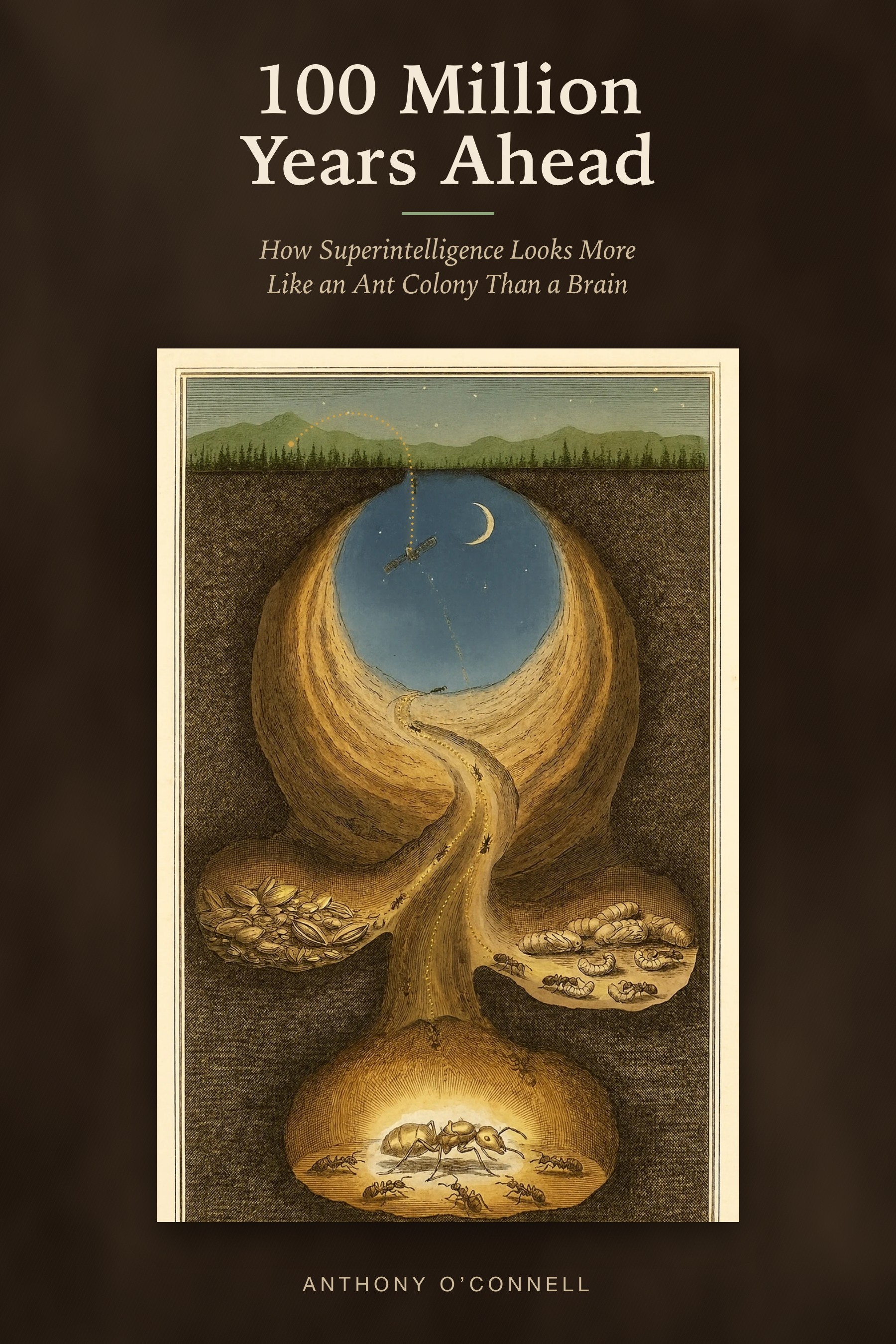
#42Paperback front
Book. 6 × 9 in trim at 300 dpi · 1800 × 2700
-
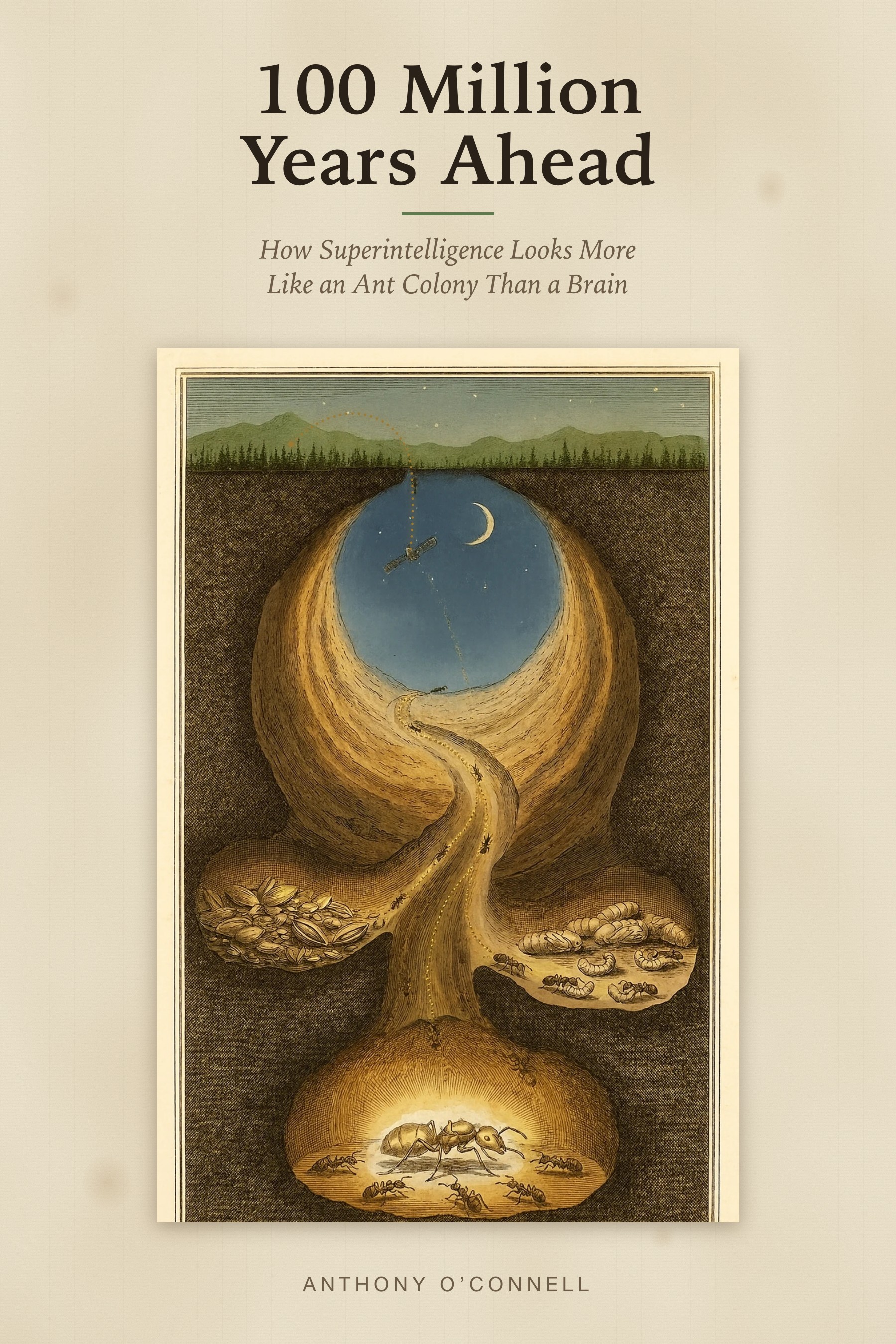
#43Paperback front, paper field
Book. 6 × 9 in · 1800 × 2700
-
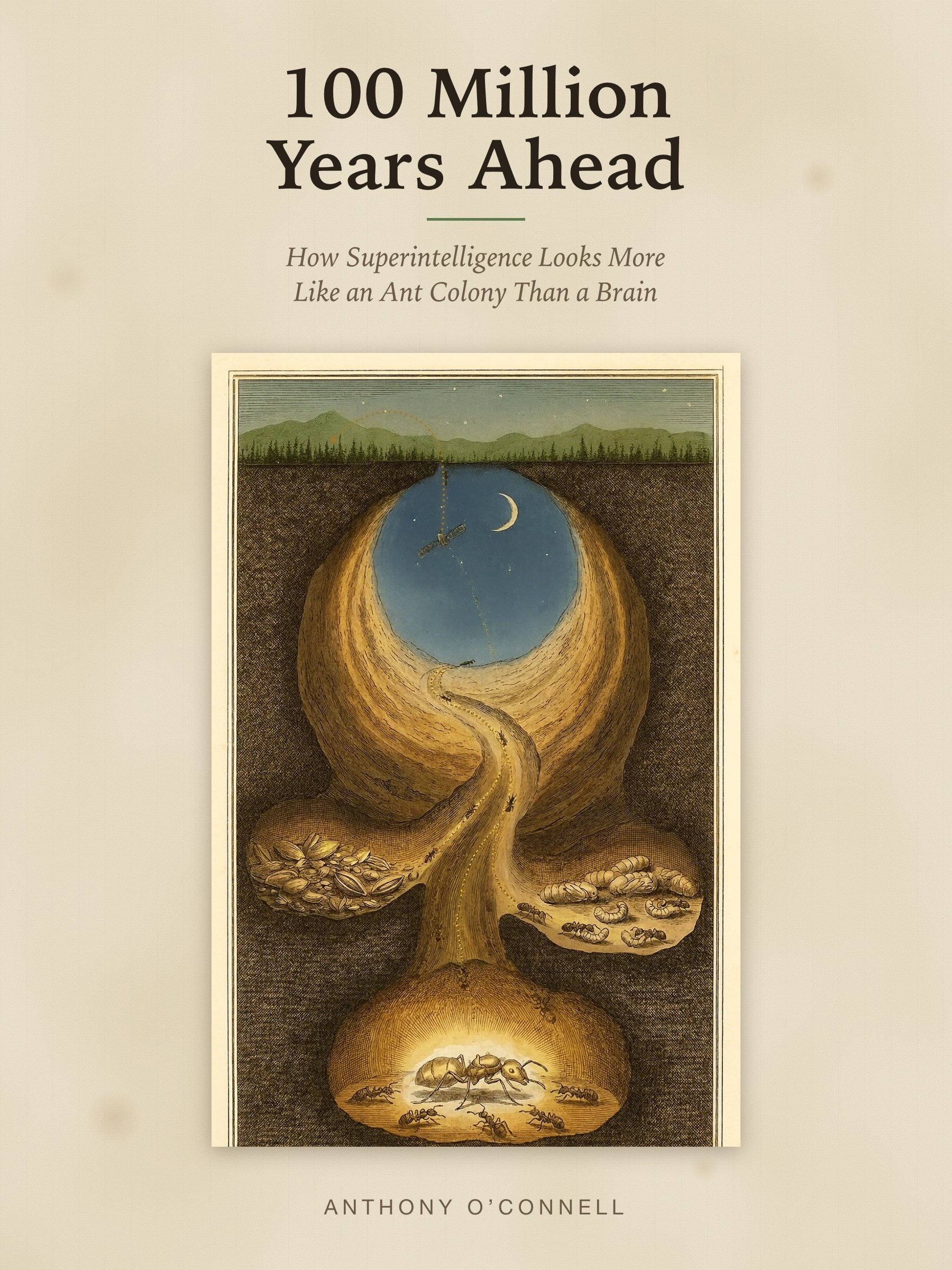
#44Poster 18 × 24
Poster. 3:4 · 1800 × 2400 preview
-
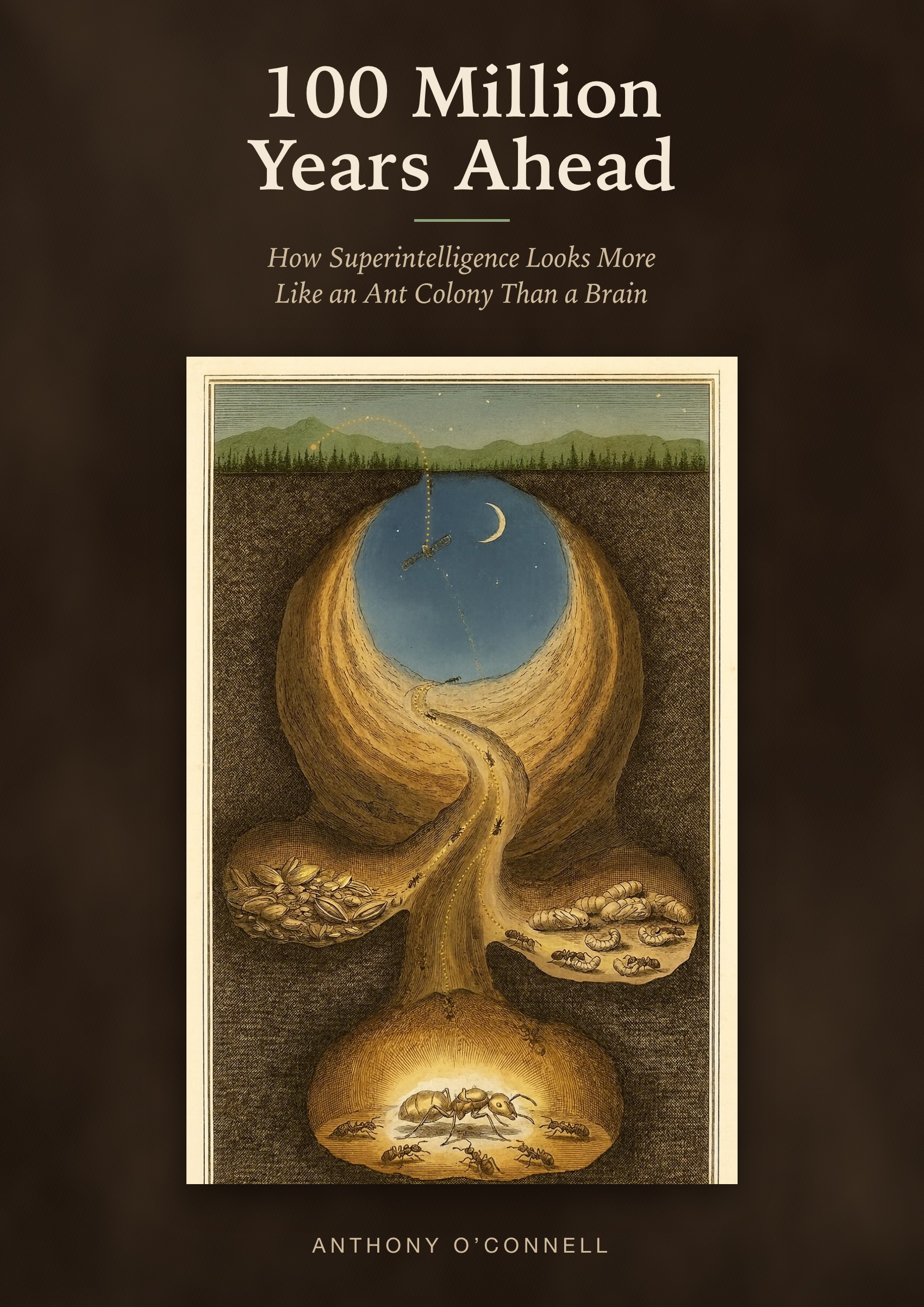
#45Poster A2
Poster. 1 : 1.414 · 1700 × 2404 preview
-
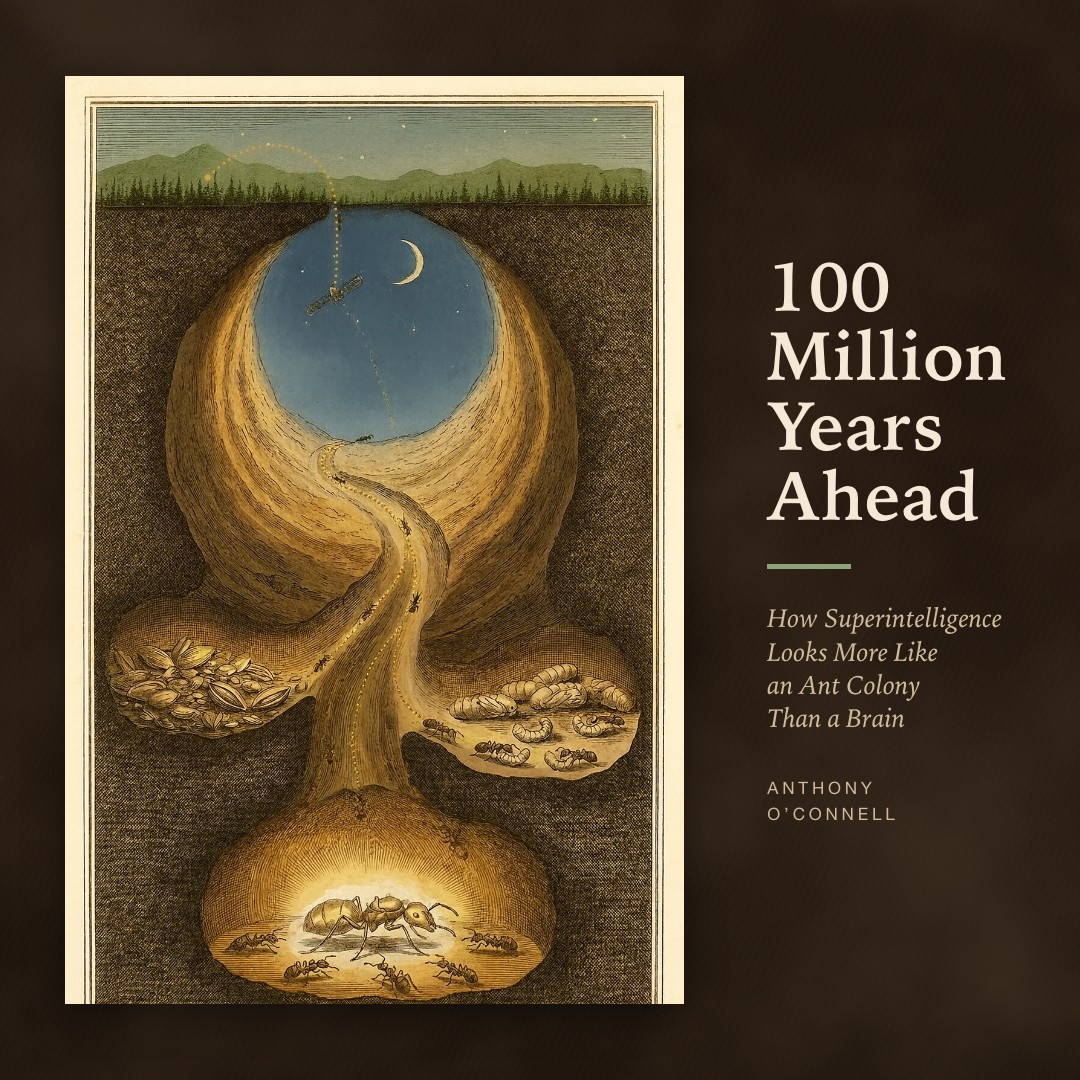
#46Instagram square
Social. 1080 × 1080
-
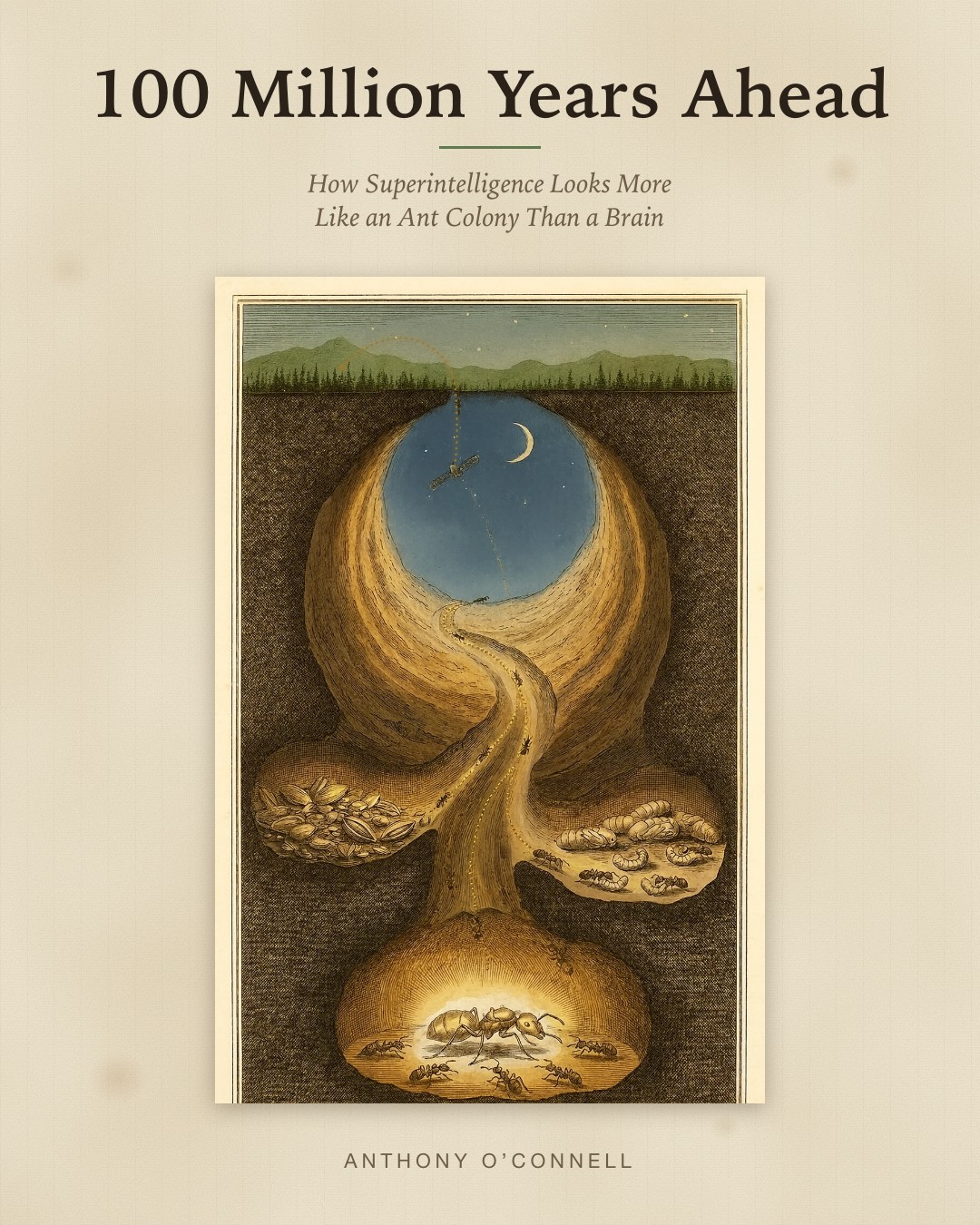
#47Instagram portrait
Social. 4:5 · 1080 × 1350
-
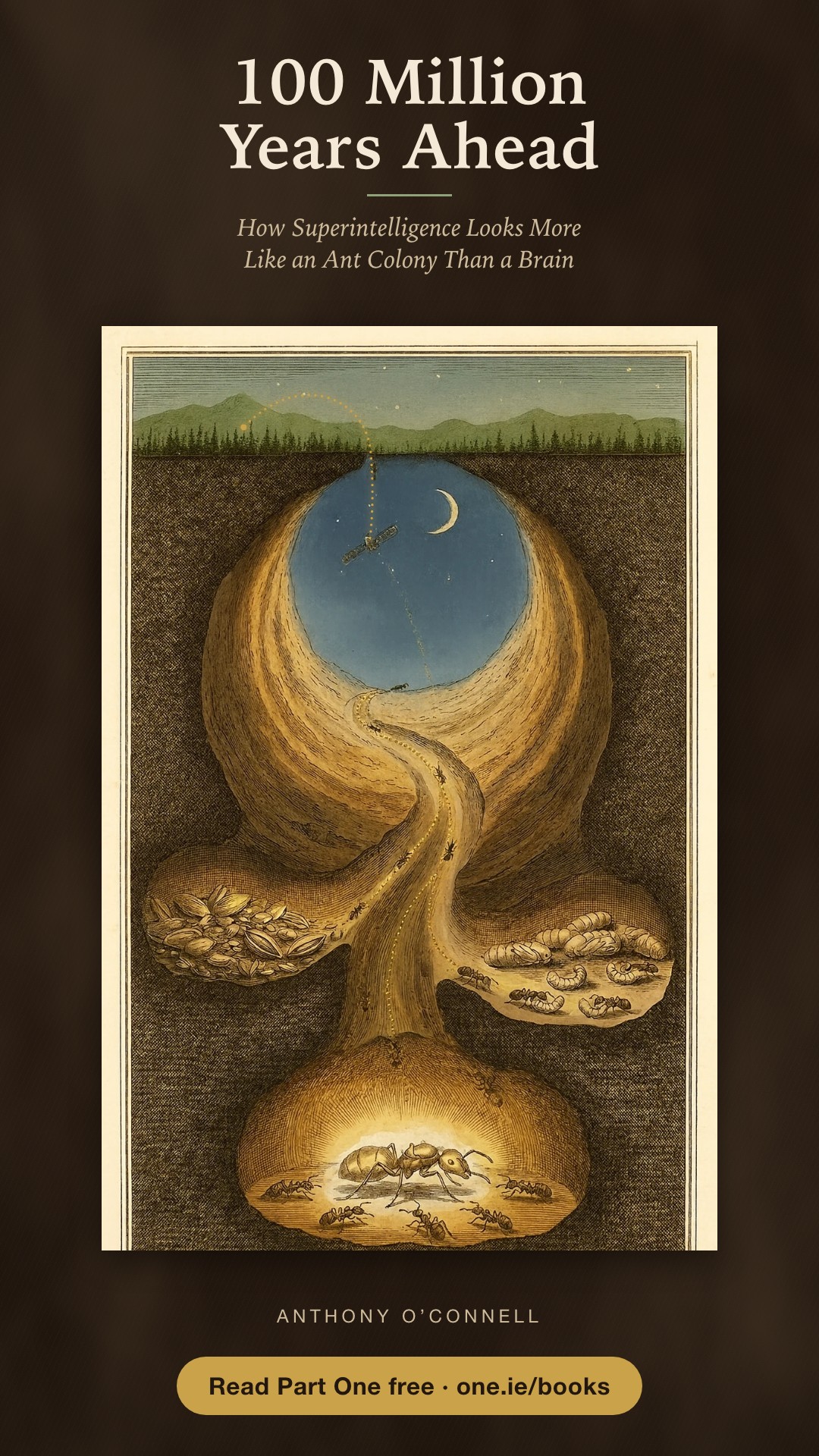
#48Story / Reel
Social. 9:16 · 1080 × 1920
-
#49X header
Social. 3:1 · 1500 × 500
-
#50LinkedIn banner
Social. 4:1 · 1584 × 396
-
#51Feed ad, landscape
Ads. Meta / LinkedIn link ad · 1200 × 628
-
#52Video / YouTube frame
Ads. 16:9 · 1920 × 1080
-
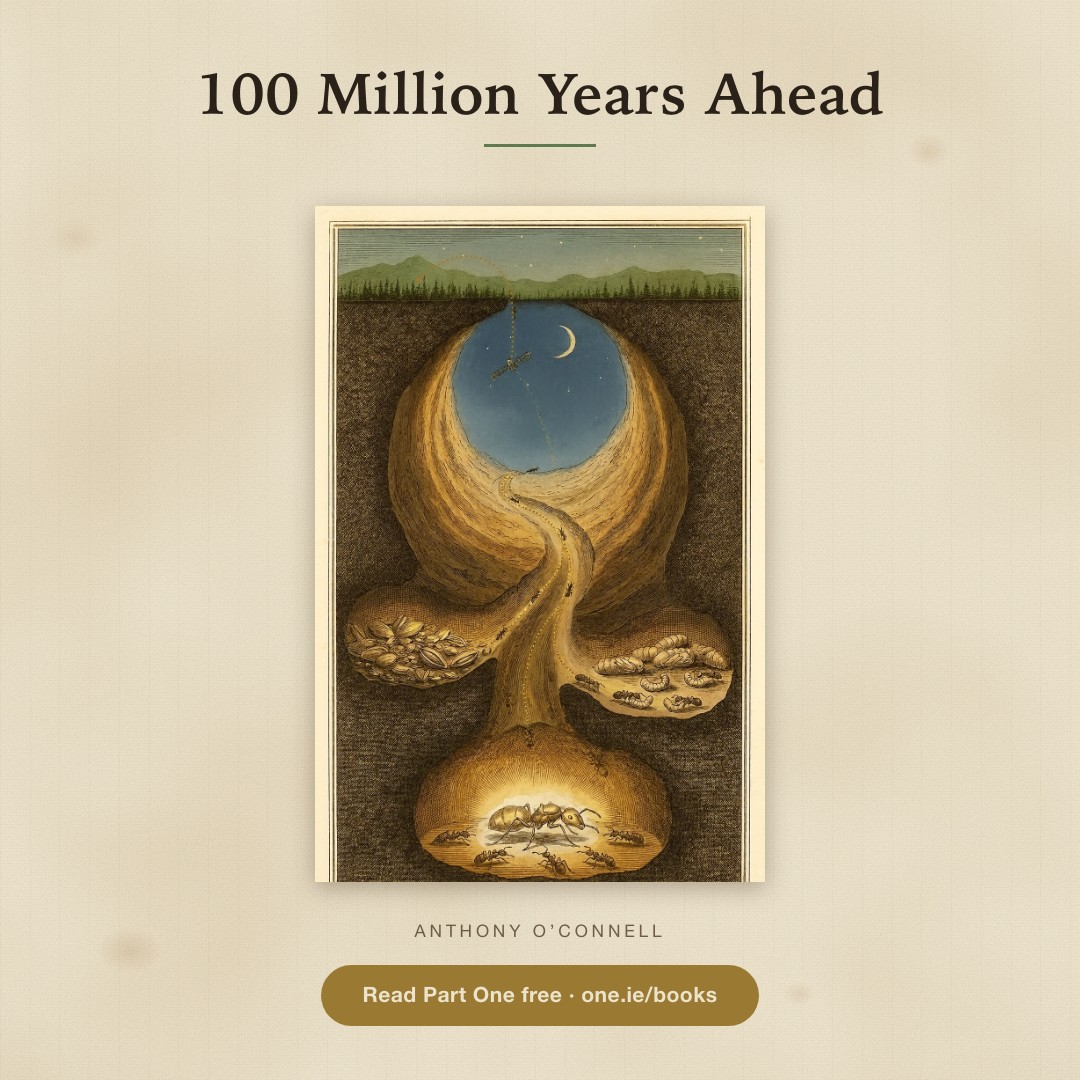
#53Square ad
Ads. 1080 × 1080
-
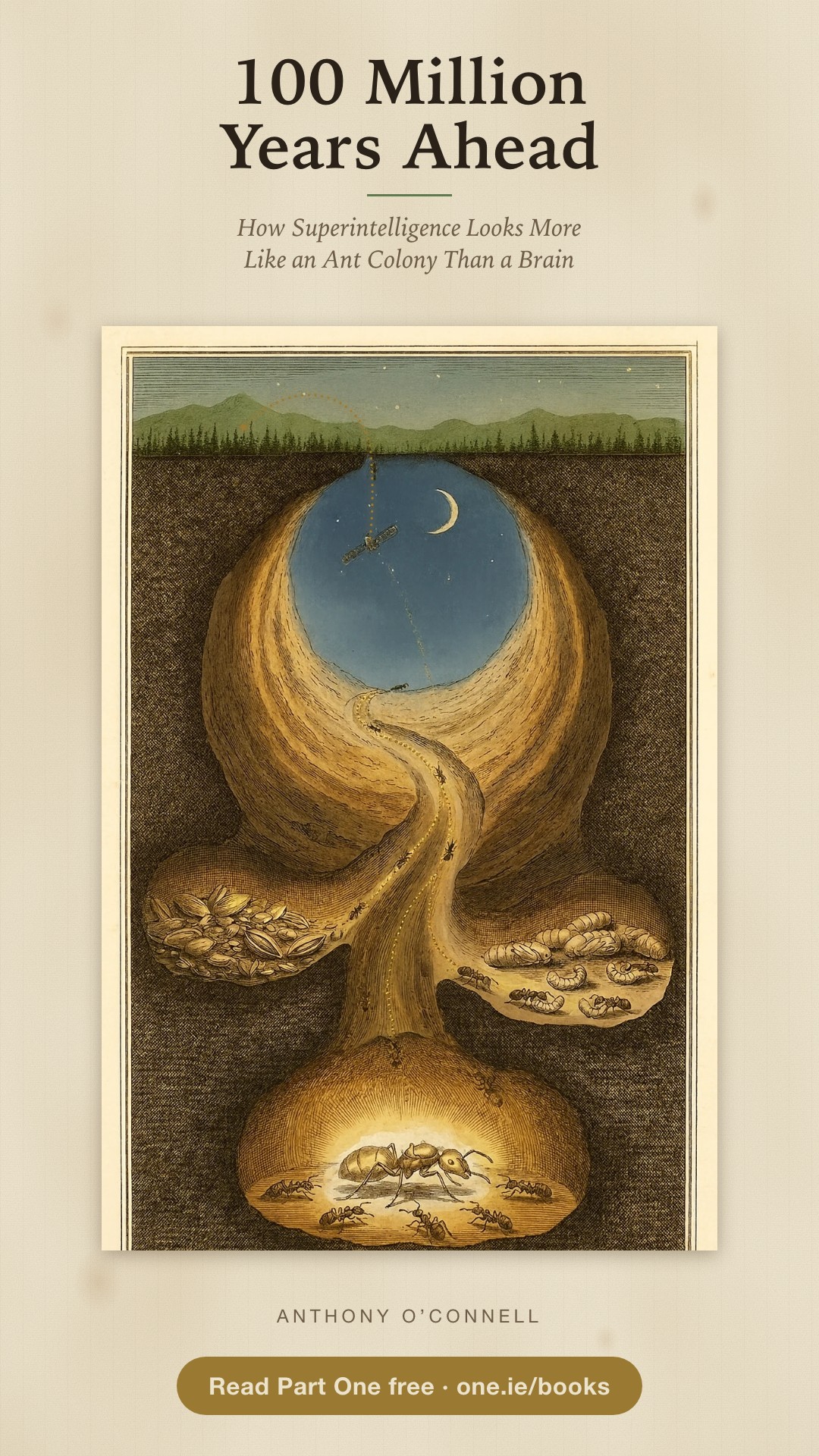
#54Story ad
Ads. 9:16 · 1080 × 1920
-
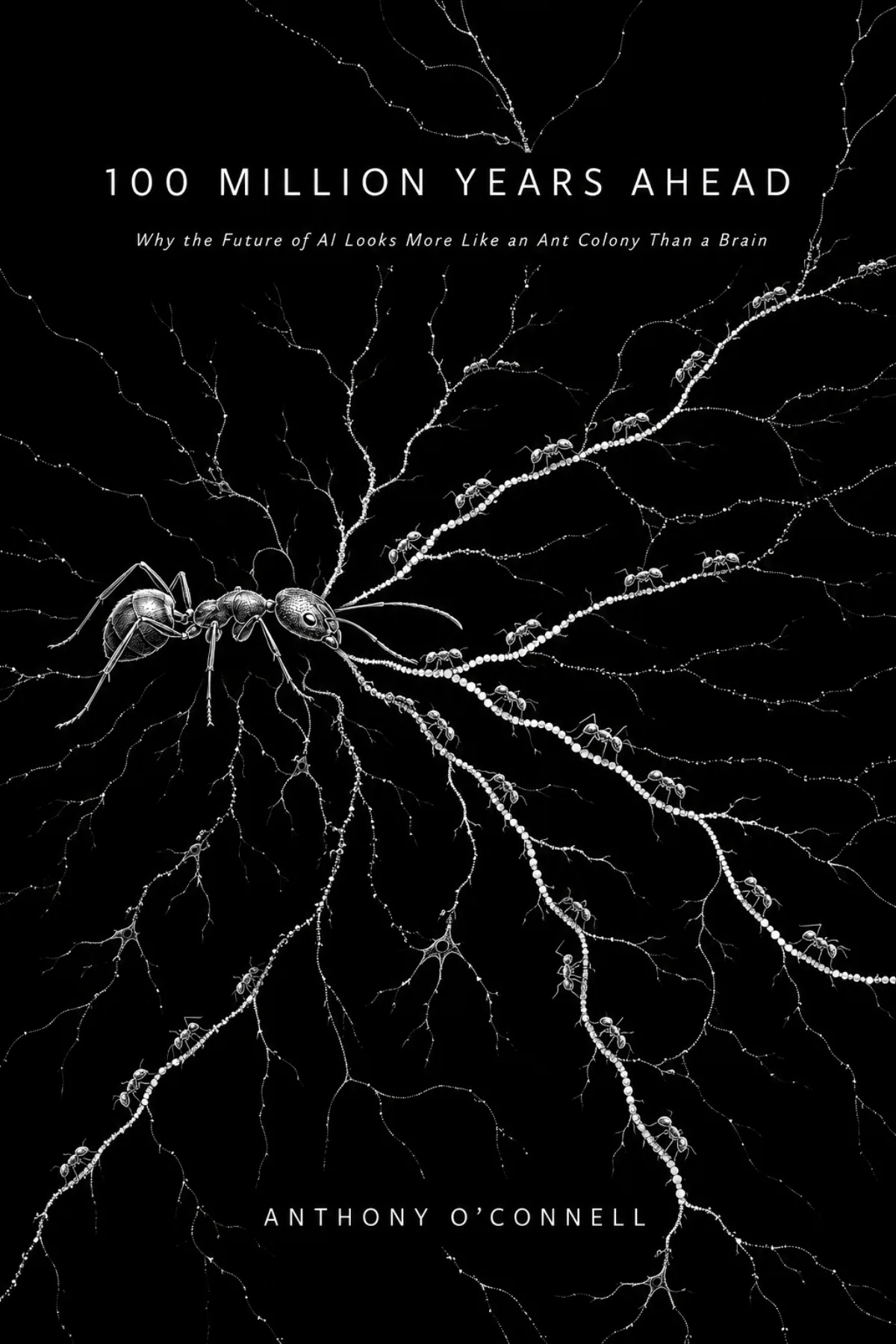
#55The cover on the site
The cover every page shows today.
-
#56The engraved plate
The plate from the cover, shown on the book page.
-
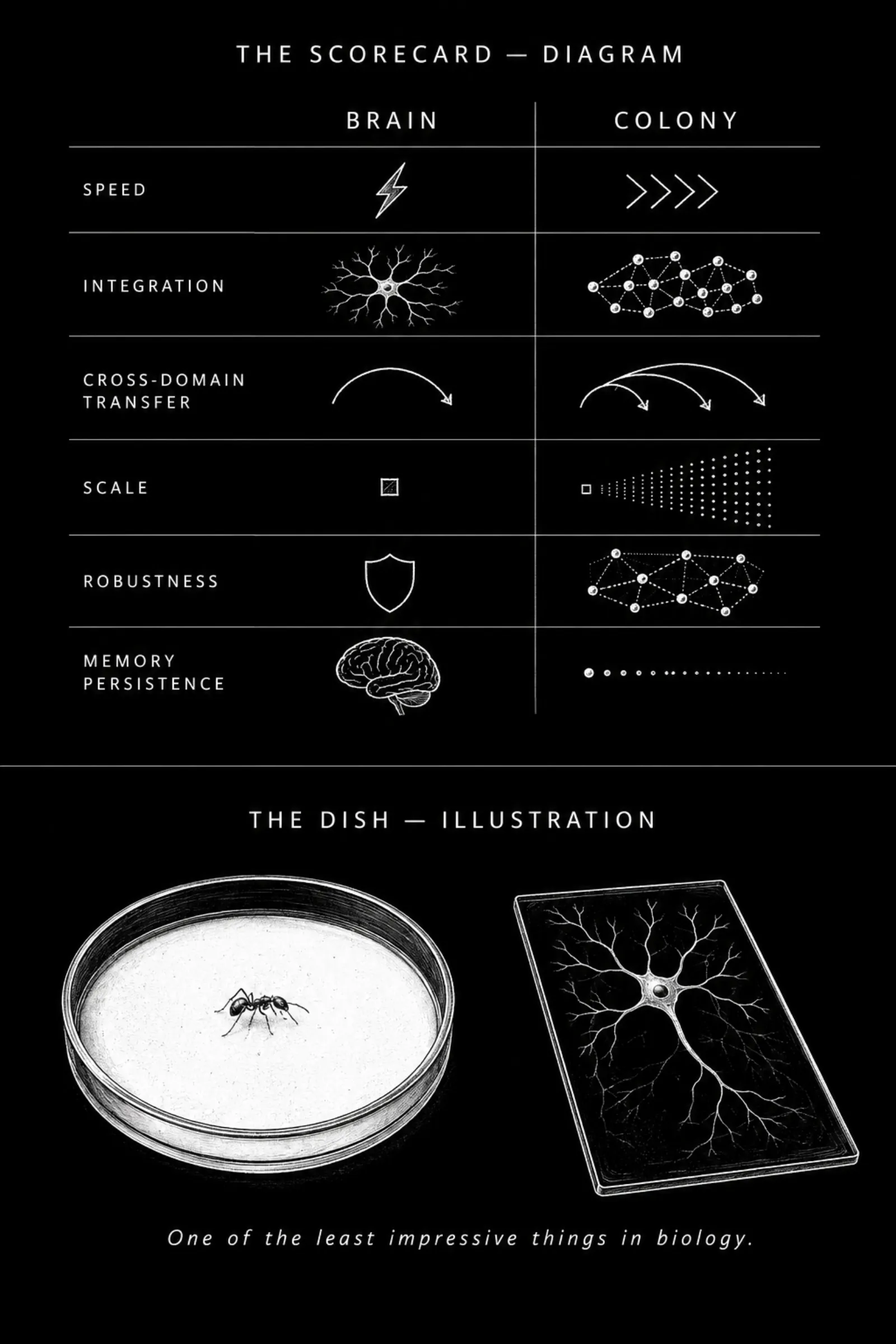
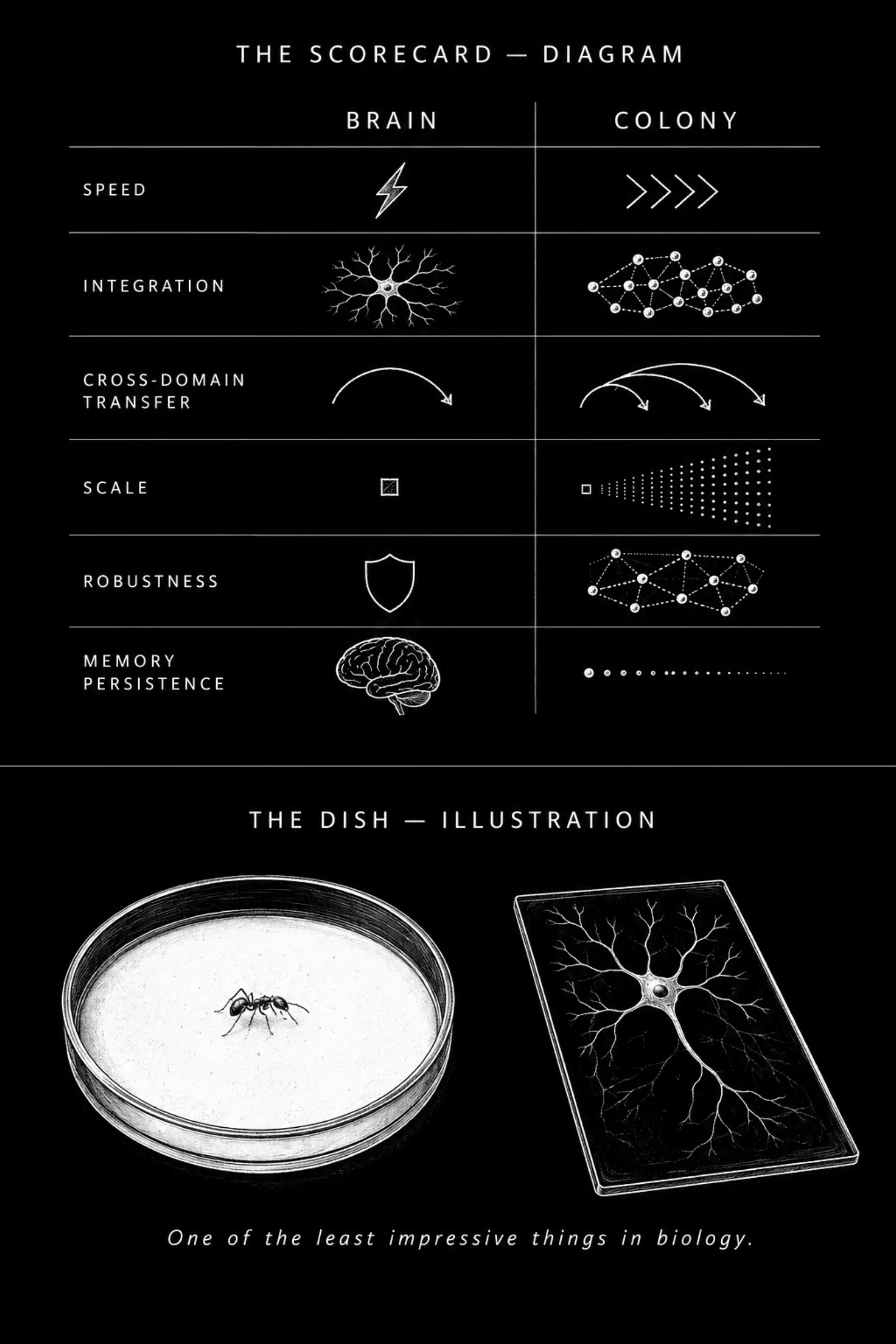
#57The figures
The figures sheet used in the book.
-
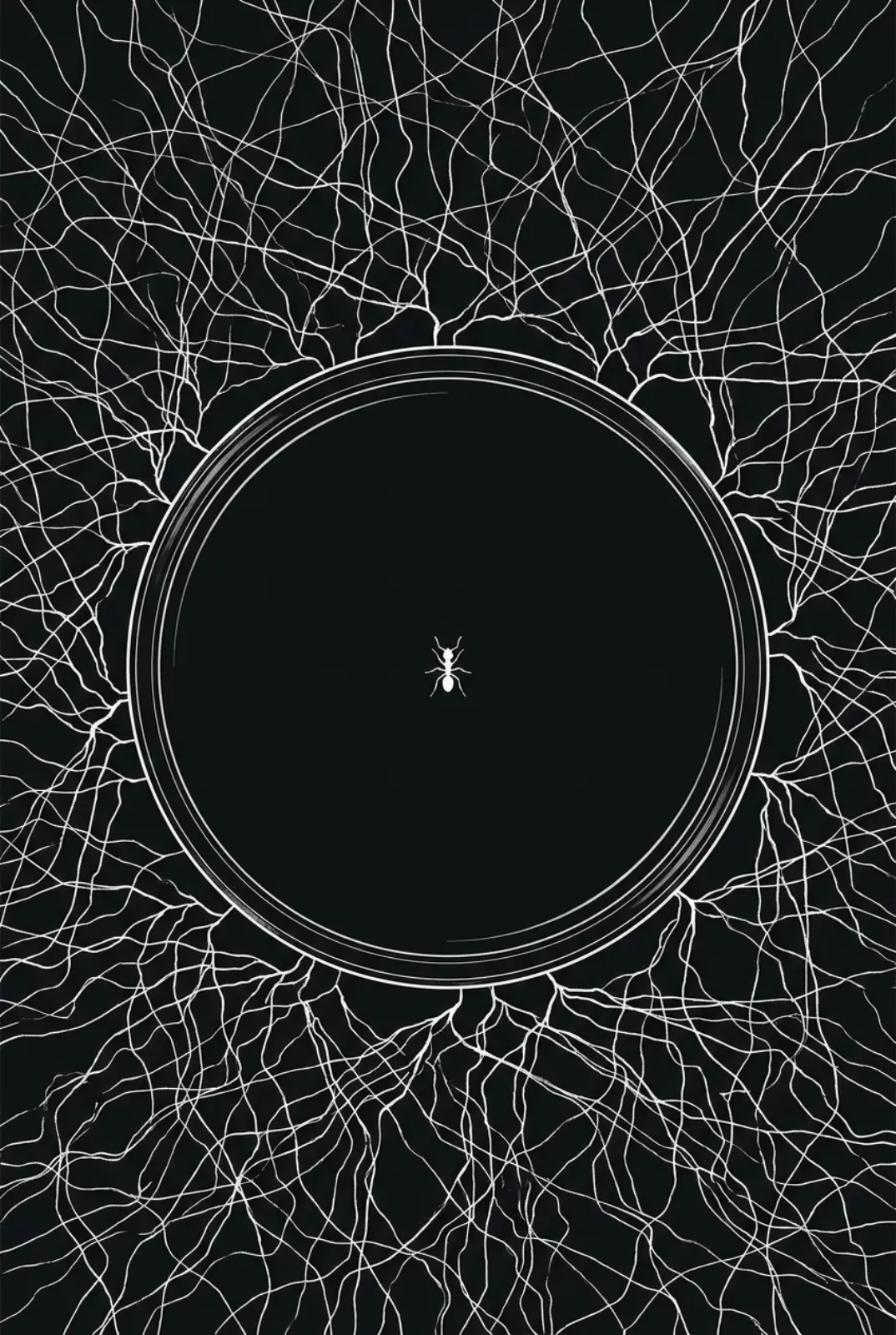
#58The empty dish
One ant alone in a glass dish, and the whole intelligence pressing against the rim from outside. The book's thesis in one image.
The prompt
Artwork for a book cover. Seen from directly above on black: a round glass petri dish, rim catching a thin white highlight. Inside the dish, alone in the clean empty centre, one tiny ant — small, still, lost. Outside the dish, filling every edge of the frame right up to the glass, a dense living network of fine white ant trails, thick and thin, branching and merging, pressing against the rim but never entering. The intelligence is everywhere except inside the dish. White ink on black, scientific precision, extremely minimal, high contrast. The image contains absolutely no text: no letters, no words, no numbers, no title, no captions, no labels, no typography, no logos, no watermark and no signature.
-
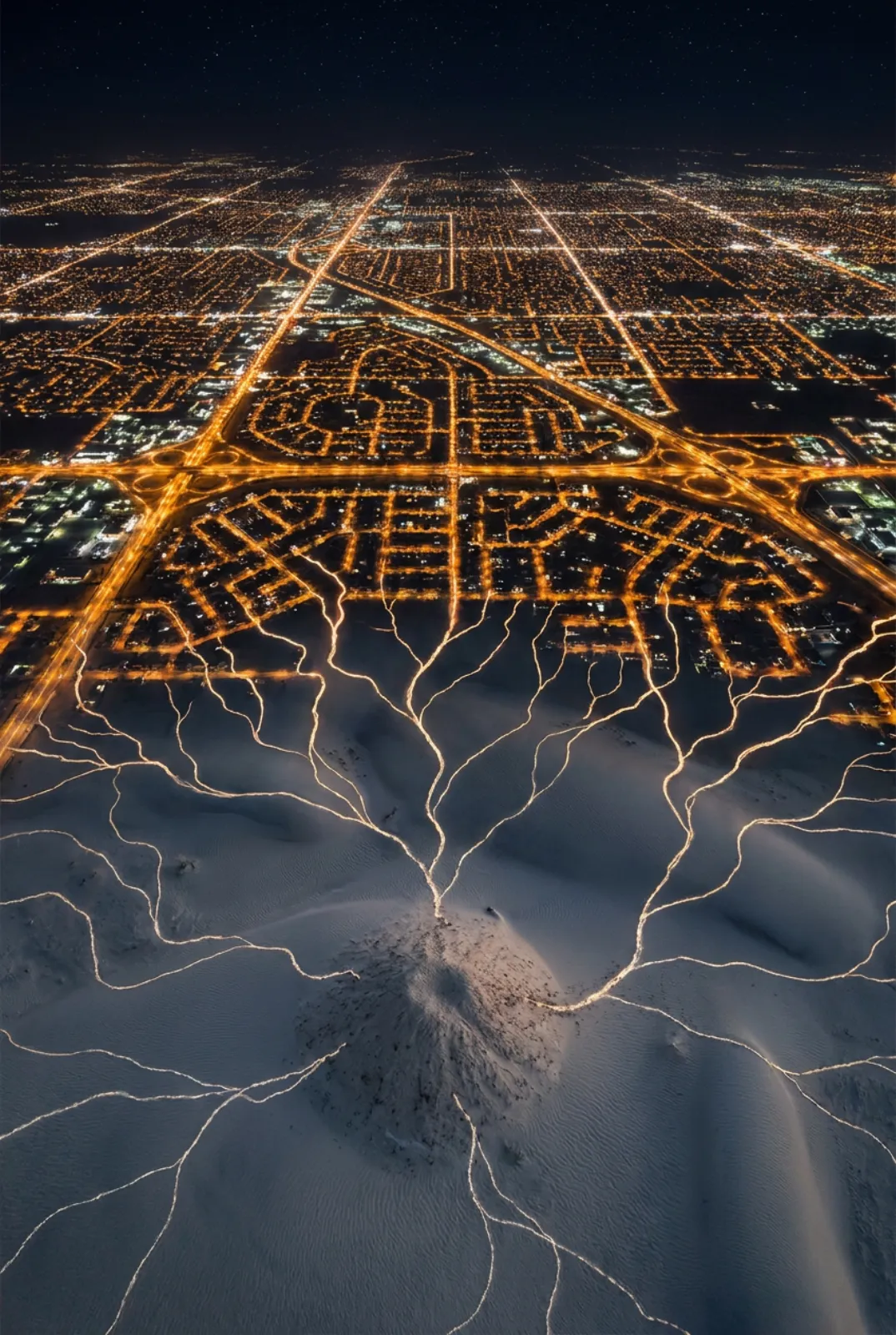
#59Colony becomes city
One unbroken network: ant trails out of a desert mound turn into a city's highways at night.
The prompt
Artwork for a book cover. A seamless aerial view at night, top-down. The lower half is desert sand under moonlight with a harvester ant nest at the bottom centre and thin pale ant trails branching out from it. As the trails rise up the frame they continue without a break into the glowing street grid of a city at night seen from orbit — the same branching pattern, now in warm sodium-orange light, highways where the strongest trails were. One continuous network from colony to city. Photorealistic, quiet, awe-inspiring. Keep the very top of the frame dark night sky. The image contains absolutely no text: no letters, no words, no numbers, no title, no captions, no labels, no typography, no logos, no watermark and no signature.
-
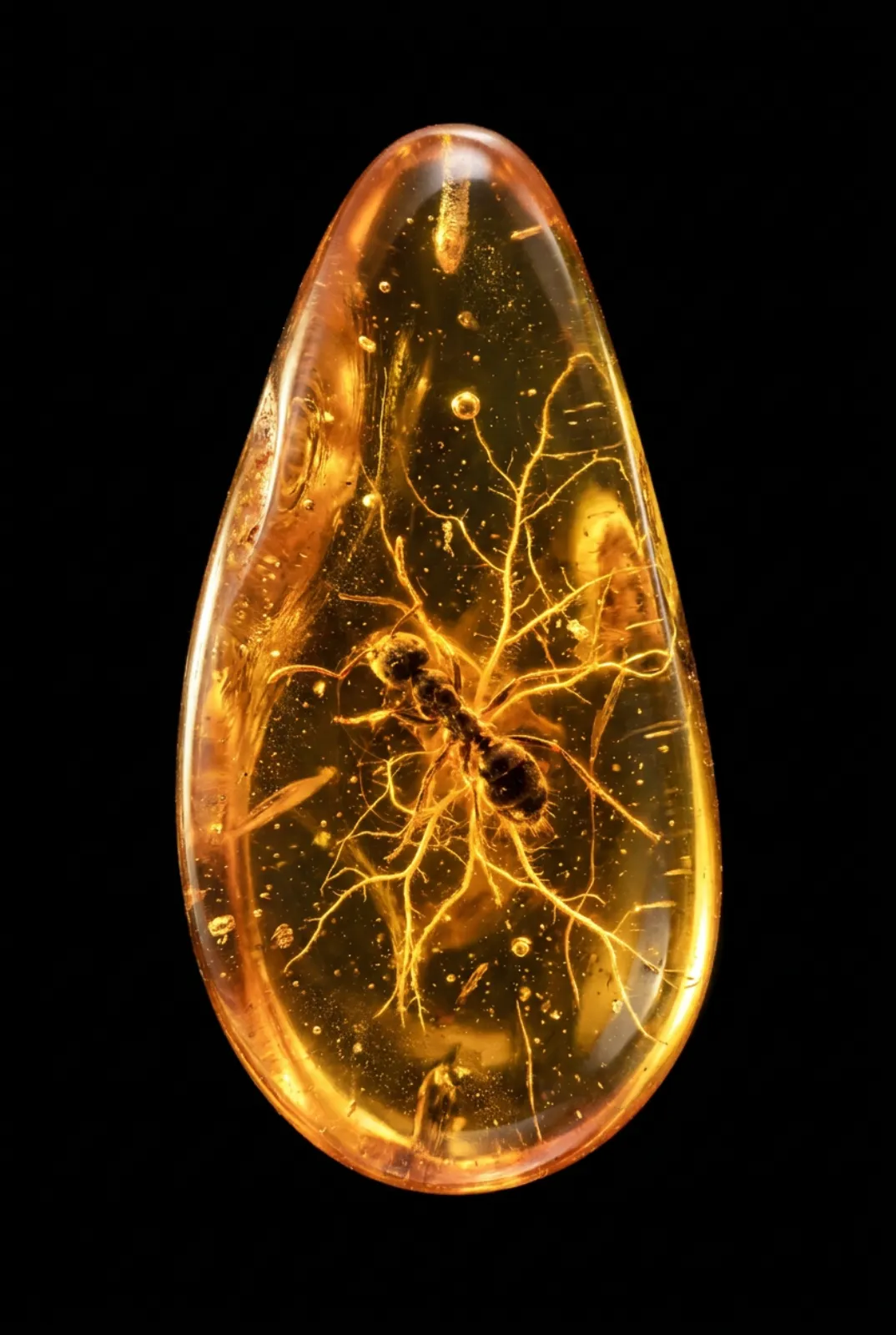
#60Memory in amber
A hundred-million-year-old ant in amber, its colony's trails fossilised around it like veins.
The prompt
Artwork for a book cover. Deep black background. A single drop of golden Cretaceous amber, lit from behind so it glows honey and orange, holds a perfectly preserved ant from a hundred million years ago — and suspended inside the amber around it, like veins or roots, is a fine branching network of luminous trails, as if the colony's memory was fossilised with it. Macro photograph, museum lighting, tiny bubbles and flow lines in the resin, extremely sharp. The amber sits in the centre; top and bottom of the frame are empty black. The image contains absolutely no text: no letters, no words, no numbers, no title, no captions, no labels, no typography, no logos, no watermark and no signature.
-
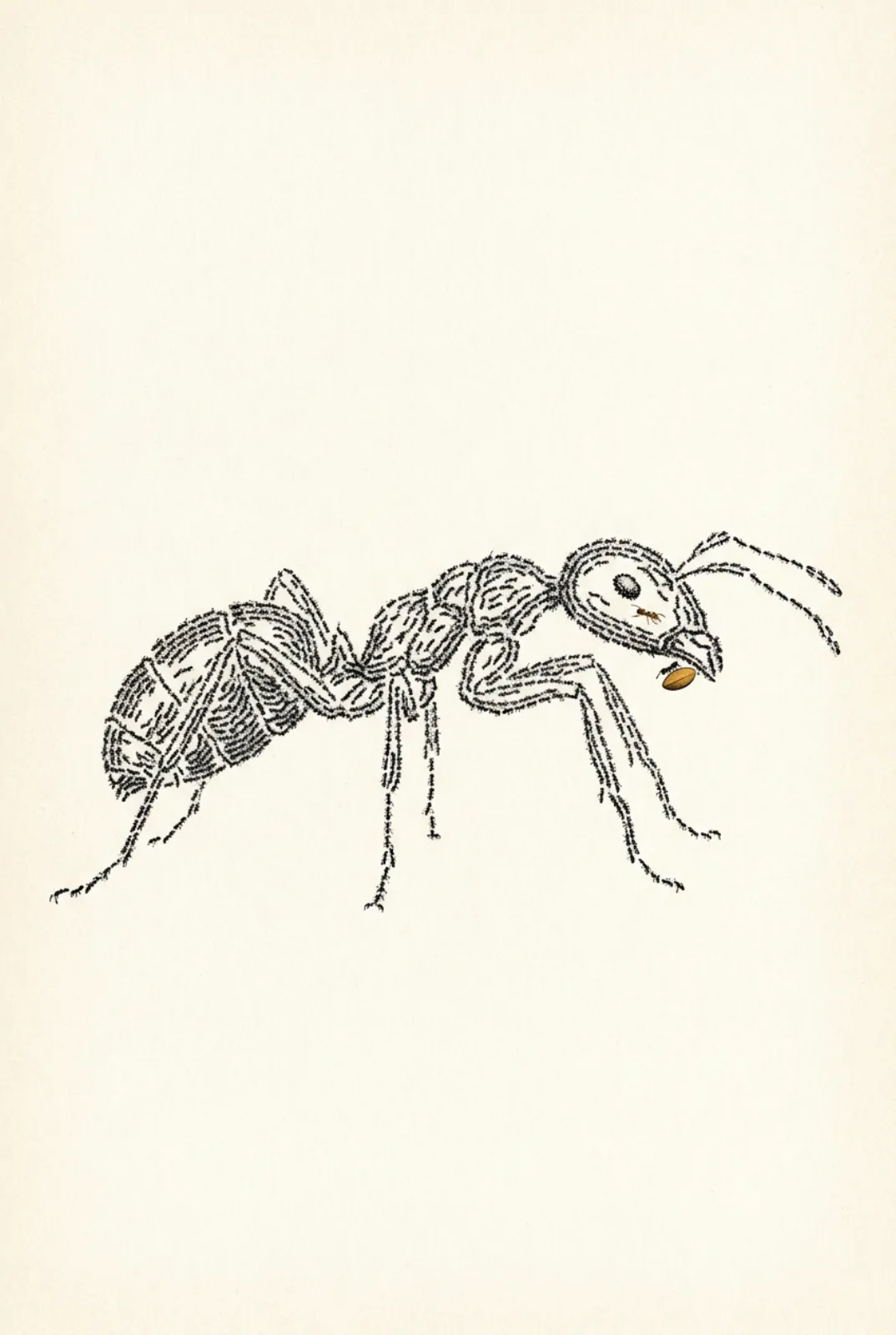
#61Superorganism
One great ant drawn entirely from thousands of tiny ants: from far away an animal, up close a colony.
The prompt
Artwork for a book cover. On warm off-white paper, one enormous harvester ant in precise side profile fills the middle of the frame — but it is drawn entirely from thousands of tiny individual ants walking in lines, their trails forming its legs, antennae, segments and the contour of its body, densest where the body is darkest. From a distance it reads as one ant; up close it is a colony. Fine black ink, scientific field-guide precision, one ochre accent where a single tiny ant carries a seed in the ant's head. Leave the top fifth and bottom fifth plain paper. The image contains absolutely no text: no letters, no words, no numbers, no title, no captions, no labels, no typography, no logos, no watermark and no signature.
-
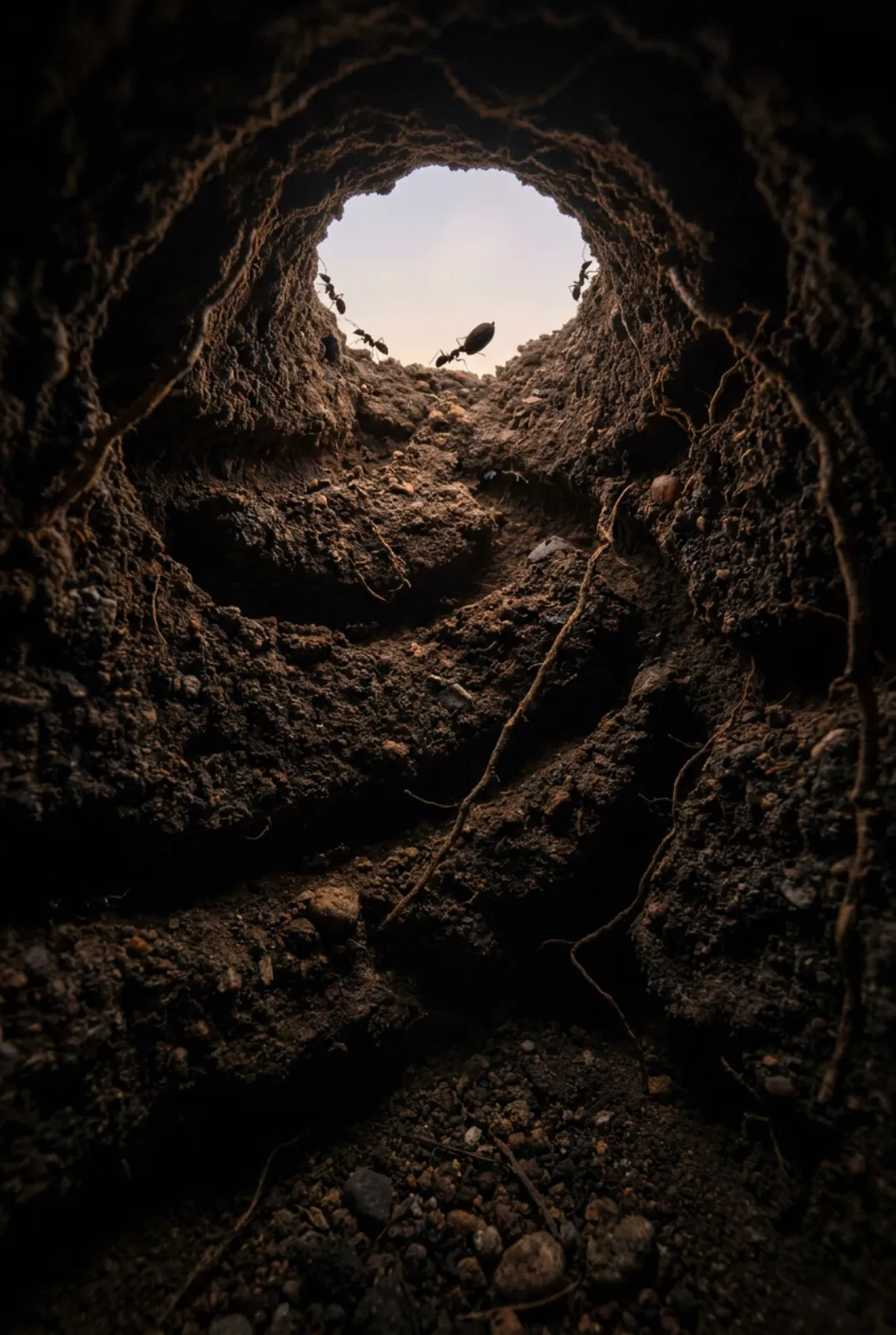
#62From inside the nest
Looking up the entrance tunnel at a disc of dawn: the reader is inside the colony, watching the door.
The prompt
Artwork for a book cover. The view from inside an ant nest looking straight up the entrance tunnel: dark curved earth walls fill the frame, rough grains of soil in close detail, and at the top centre a small bright circle of pale dawn sky. Silhouetted at the rim of the hole, tiny ants come and go, one carrying a seed. Thin tunnels branch off into the darkness. Cinematic, intimate, the reader is inside the colony. Deep warm browns and black, one disc of light. The lower third is near-black earth. The image contains absolutely no text: no letters, no words, no numbers, no title, no captions, no labels, no typography, no logos, no watermark and no signature.
-
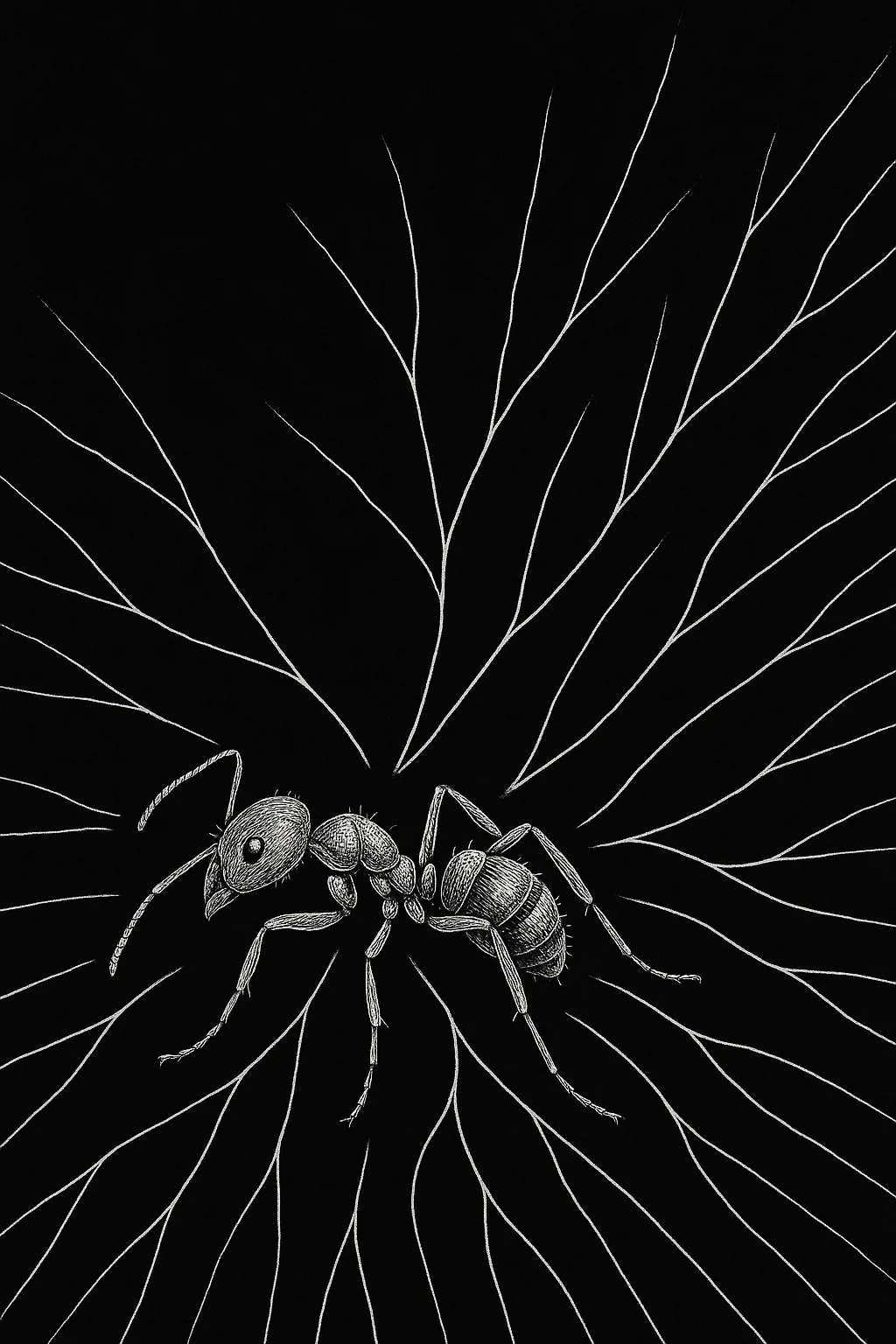
#63Field guide, white on black
One scientific harvester ant, and dozens of white trails thickening and thinning to hairlines: the colony as an inked network.
The prompt
Book cover art, pure black background, white ink only, no grey wash. A single harvester ant rendered in precise scientific illustration, centre-left, facing right, fine cross-hatched line work. Radiating from it are dozens of fine white pheromone trails: purposeful forking paths, some strong and thick, some thinning to hairlines, all geometrically coherent, running off the edges and implying a vast network beyond the frame. Modernist scientific field-guide poster. High contrast ink on black. One idea: intelligence lives in the colony and in the trails the ants lay down, not in any one brain. Keep the top 22 percent of the frame as plain empty black. No circuits, no glowing brains, no robots, no gears, no human faces. The image contains absolutely no text: no letters, no words, no numbers, no title, no captions, no labels, no typography, no logos, no watermark and no signature.
-
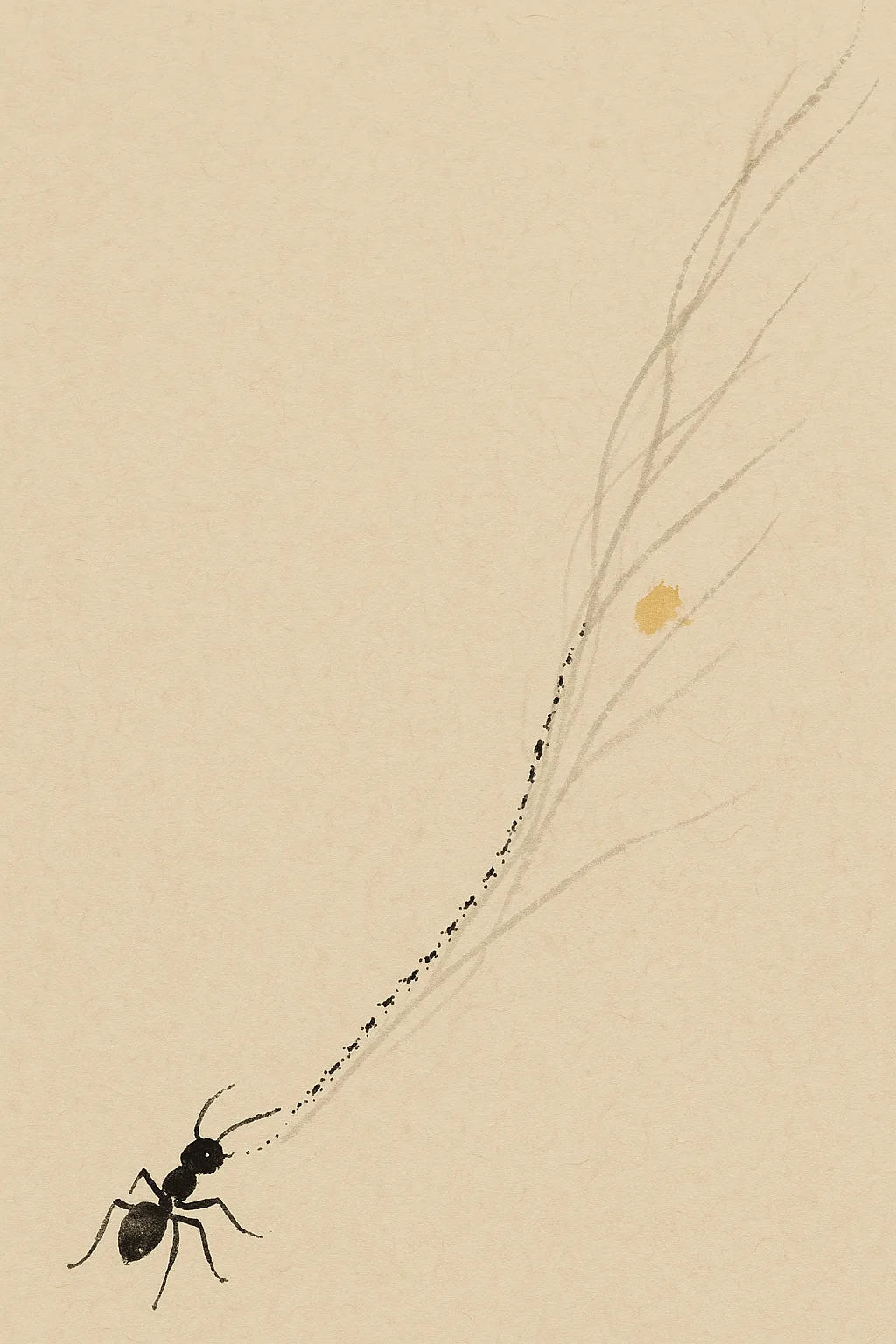
#64Japanese sumi-e
Brush and ink on warm paper: a few loose strokes of ants, one long trail drawn as a single breath.
The prompt
Japanese sumi-e ink wash painting on warm unbleached rice paper. A single ant drawn in a few confident brush strokes at the lower left, and from it one long calligraphic trail of tiny ink-dot ants sweeping up and across the paper, splitting into thinner dry-brush branches that fade to pale grey ink and then to bare paper. Generous empty space (ma), visible paper fibre, one small ochre accent. Restrained, quiet, meditative. One idea: intelligence lives in the colony and in the trails the ants lay down, not in any one brain. Keep the top 25 percent of the paper nearly empty. No circuits, no glowing brains, no robots, no gears, no human faces. The image contains absolutely no text: no letters, no words, no numbers, no title, no captions, no labels, no typography, no logos, no watermark and no signature.
-

#65Swiss modernist poster
Two inks and a grid: a trail network built from circles and straight lines, each node an ant.
The prompt
Swiss International Typographic Style poster, flat vector shapes, strict restraint. Two inks only: signal red-orange and deep black on off-white paper. Long curved marching lines of small solid black oval dots, each dot an ant seen from above, converging from the edges of the sheet toward one large red-orange ring that marks the nest. The lines of dots are dense and bold where traffic is heavy and thin out to a few sparse dots where a trail fades. Organic sweeping curves, not right angles, not a diagram of boxes and wires. No gradients, no texture. One idea: intelligence lives in the colony and in the trails the ants lay down, not in any one brain. Keep the top 22 percent of the poster as plain empty off-white paper. No circuits, no glowing brains, no robots, no gears, no human faces. The image contains absolutely no text: no letters, no words, no numbers, no title, no captions, no labels, no typography, no logos, no watermark and no signature.
-
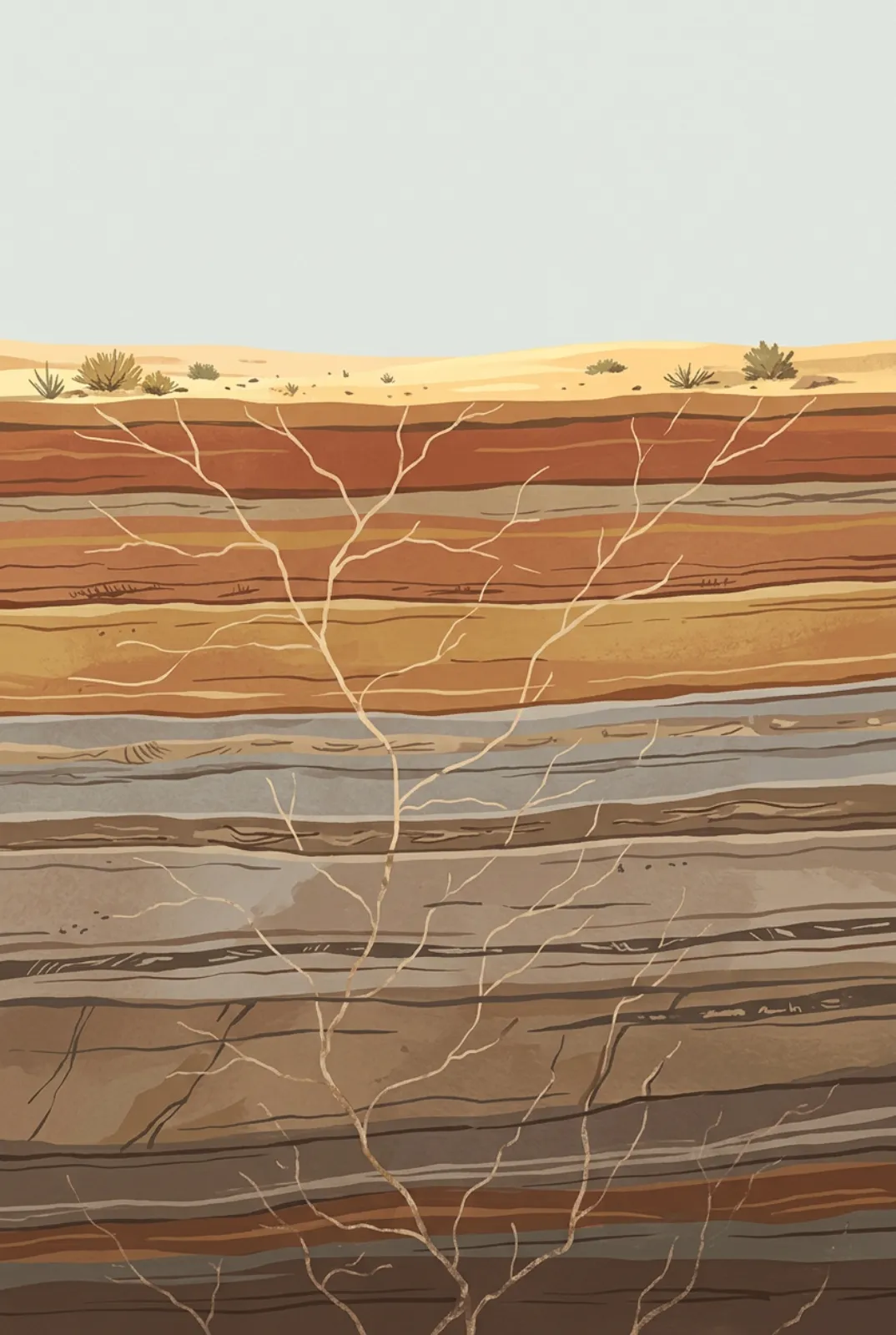
#66Deep-time strata
A desert cross-section in banded rock: one branching trail runs down through a hundred million years of layers, fainter and more fossilised with depth.
The prompt
A tall geological cross-section illustration of desert ground: a thin strip of sunlit sand and scrub at the top, below it many banded layers of sedimentary rock in ochre, rust, sand, ash grey and umber, with fine fossil-like seams. Through every layer, in the same pattern, thin pale branching trails and tiny tunnel networks of ants repeat, becoming fainter and more fossilised with depth. Flat, graphic, painterly editorial illustration, matte texture, calm and vast. One idea: intelligence lives in the colony and in the trails the ants lay down, not in any one brain. Keep the top 22 percent as a simple pale desert sky, with no detail. No circuits, no glowing brains, no robots, no gears, no human faces. The image contains absolutely no text: no letters, no words, no numbers, no title, no captions, no labels, no typography, no logos, no watermark and no signature.
-
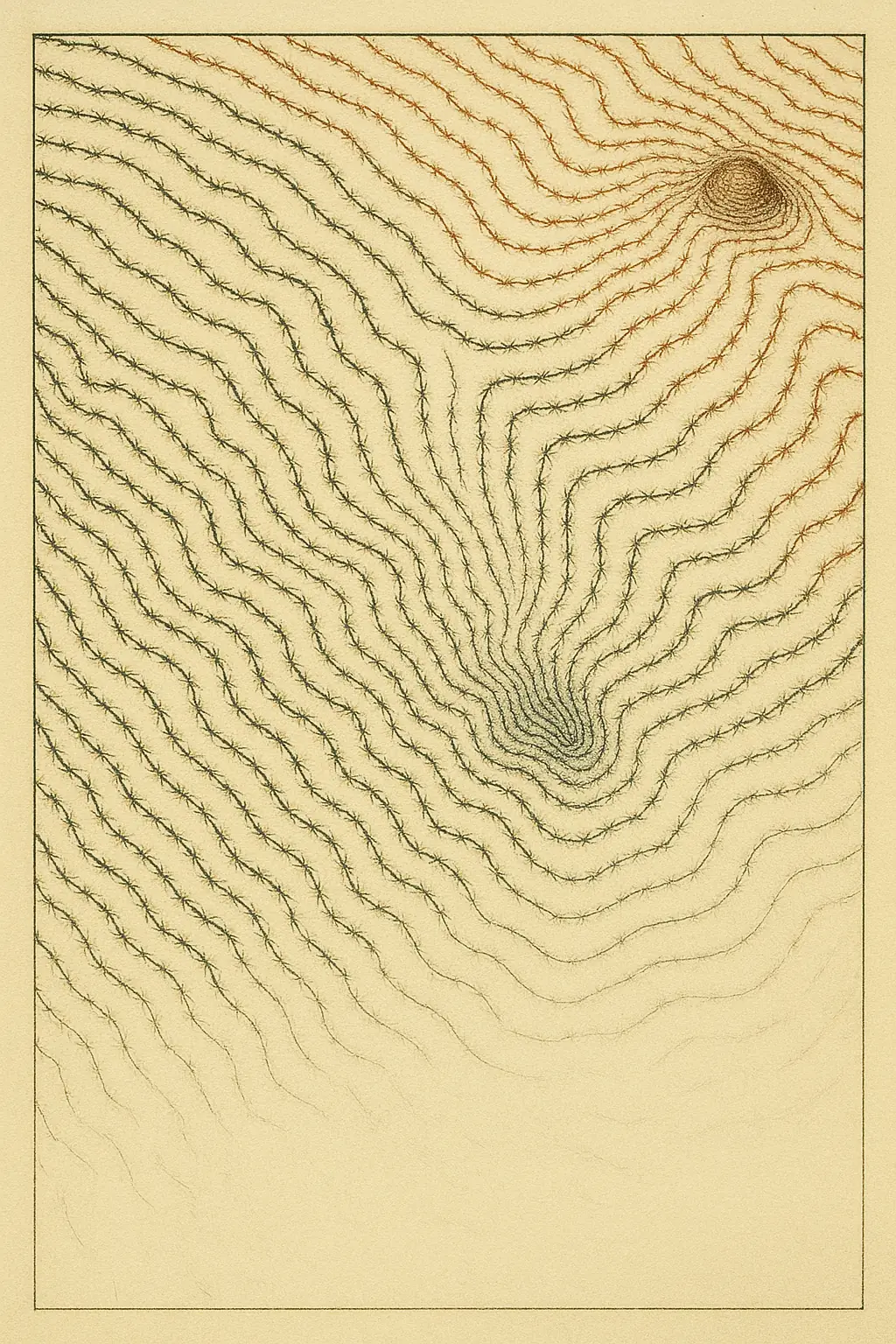
#67Topographic contour map
Contour lines that are ant trails: the landscape of the colony drawn like terrain, steep where the traffic is dense.
The prompt
A topographic contour map in the style of an old survey sheet, on pale cream paper in fine dark green-black and rust-brown line. The contour lines are made of long streams of tiny ants walking in single file; the lines crowd together into steep ridges where the traffic is dense and spread out into gentle plains where trails fade. A larger concentric mound marks the nest at one point. Delicate, precise, cartographic, with no labels and no grid numbers. One idea: intelligence lives in the colony and in the trails the ants lay down, not in any one brain. Keep the bottom 22 percent of the sheet as plain pale paper with only faint contours. No circuits, no glowing brains, no robots, no gears, no human faces. The image contains absolutely no text: no letters, no words, no numbers, no title, no captions, no labels, no typography, no logos, no watermark and no signature.
-
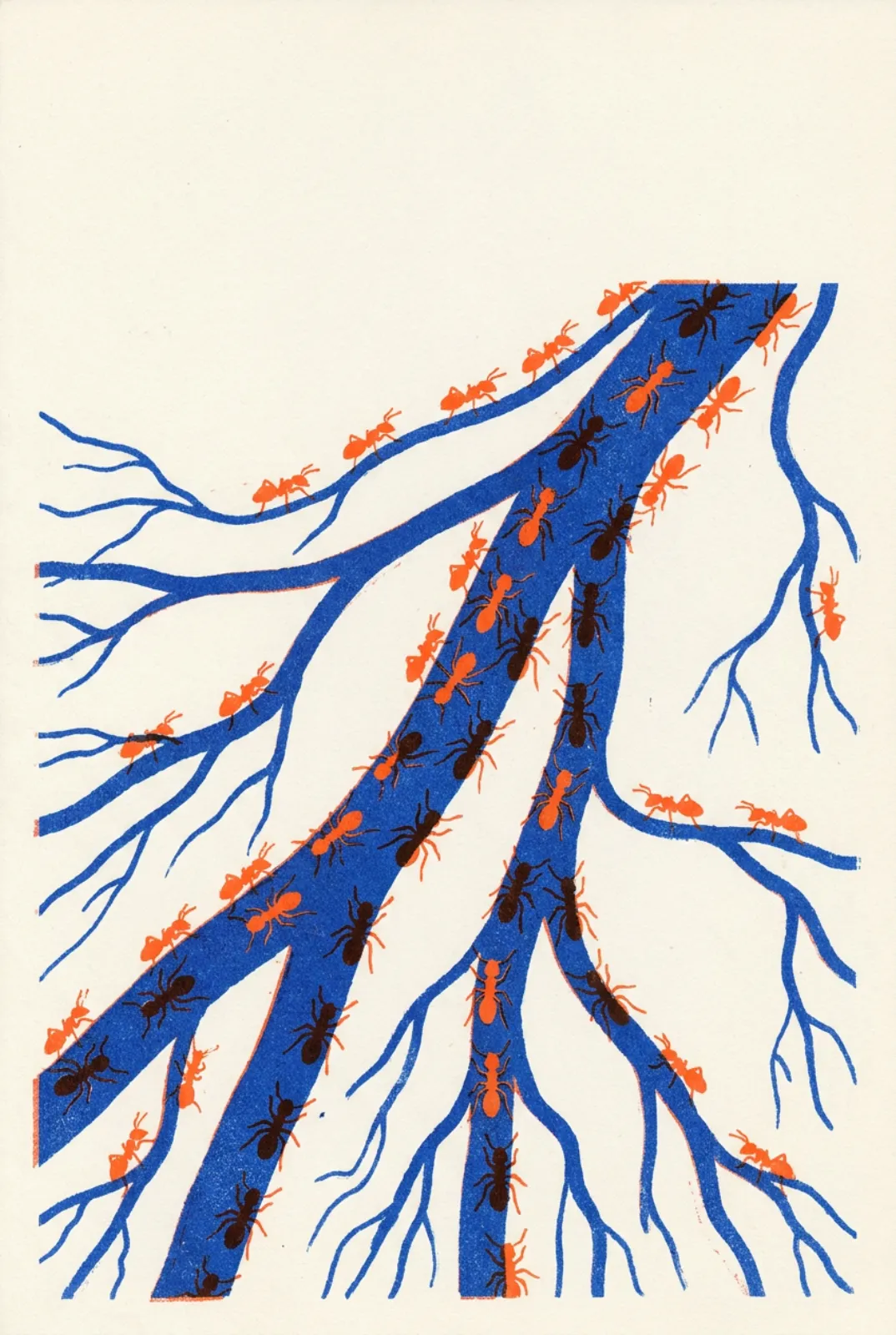
#68Risograph overprint
Fluorescent orange over blue: grainy overprint where the trails cross, so the crossings darken like reinforced paths.
The prompt
Two-colour risograph print on slightly textured cream paper: fluorescent orange and cobalt blue inks, visible halftone grain, slight misregistration, flat shapes. A network of broad blue trails sprawls diagonally across the lower three quarters of the sheet like a river delta, thick in the middle and thinning into narrow branches at the edges; dozens of small orange ant silhouettes walk single file along the trails, more of them on the thick trails and few on the thin ones. Where the orange and blue overlap the print goes deep brown-black. Disciplined screen-print poster look. One idea: intelligence lives in the colony and in the trails the ants lay down, not in any one brain. Keep the top 25 percent of the sheet as clean blank paper with no trails. No circuits, no glowing brains, no robots, no gears, no human faces. The image contains absolutely no text: no letters, no words, no numbers, no title, no captions, no labels, no typography, no logos, no watermark and no signature.
-
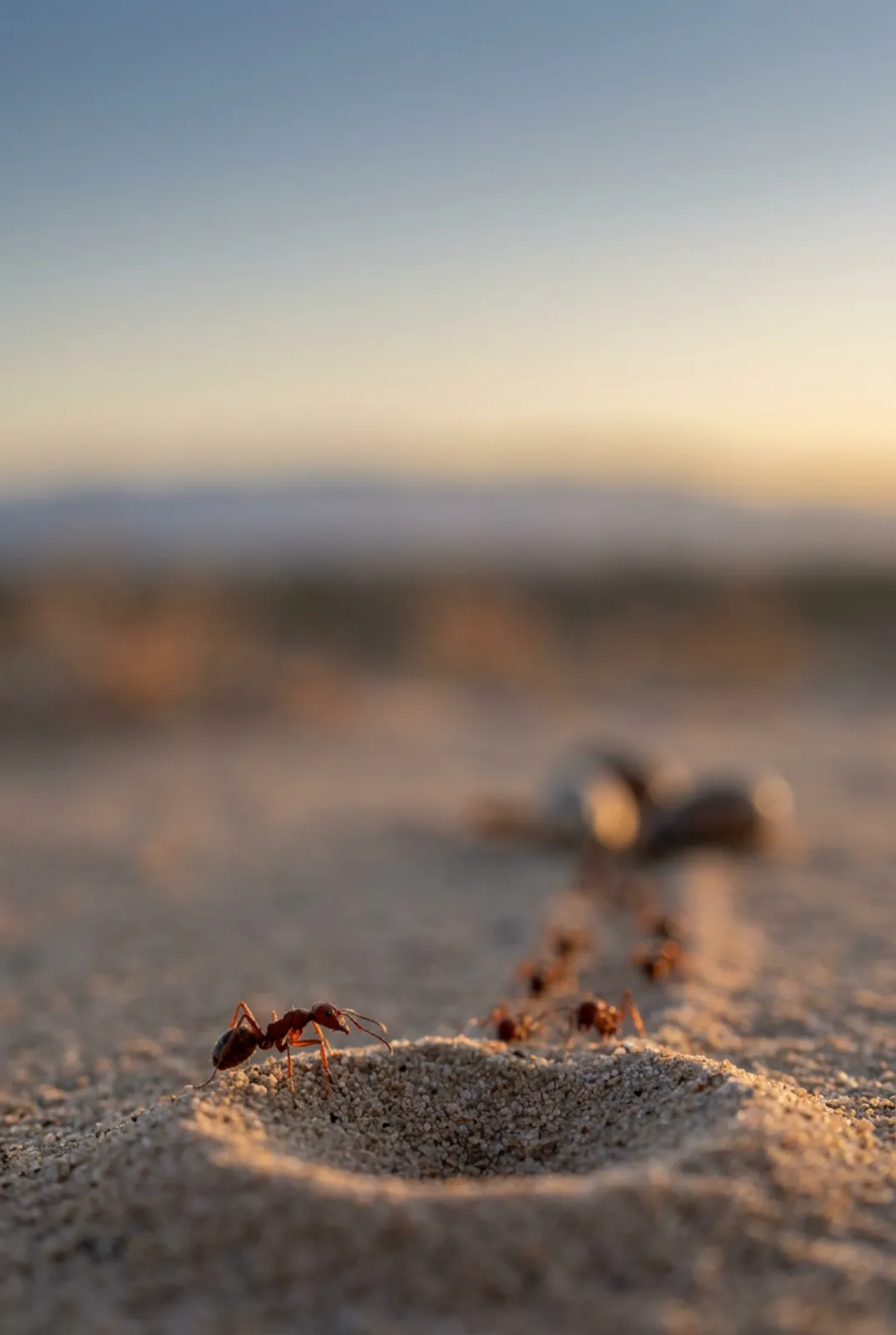
#69Macro photograph at dawn
A harvester ant at the nest entrance in first light, the colony's whole day about to start from this one doorway.
The prompt
Cinematic macro photograph at dawn. A single red harvester ant on its nest entrance, a small crater of fine cleared desert sand, in sharp focus with backlit golden rim light; behind it dozens of other ants out of focus streaming along faint cleared trails toward scattered seeds, shallow depth of field, creamy bokeh, cool blue pre-dawn sky transitioning to warm gold at the horizon. Shot on 100mm macro lens, real photography, fine sand grain. One idea: intelligence lives in the colony and in the trails the ants lay down, not in any one brain. Keep the top 22 percent as smooth out-of-focus dawn sky. No circuits, no glowing brains, no robots, no gears, no human faces. The image contains absolutely no text: no letters, no words, no numbers, no title, no captions, no labels, no typography, no logos, no watermark and no signature.
-
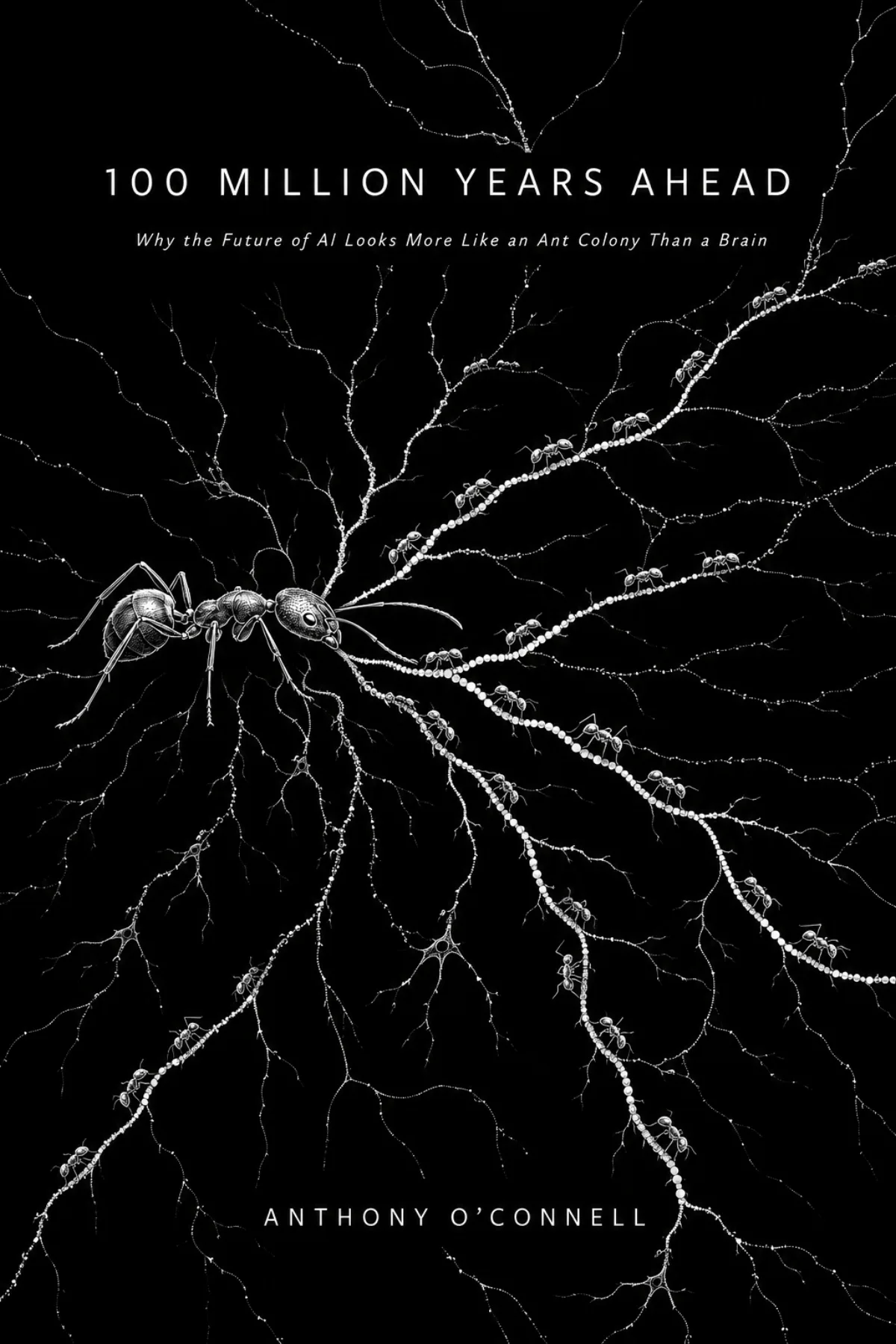
#70The first cover
The first cover. Superseded; kept for the record.