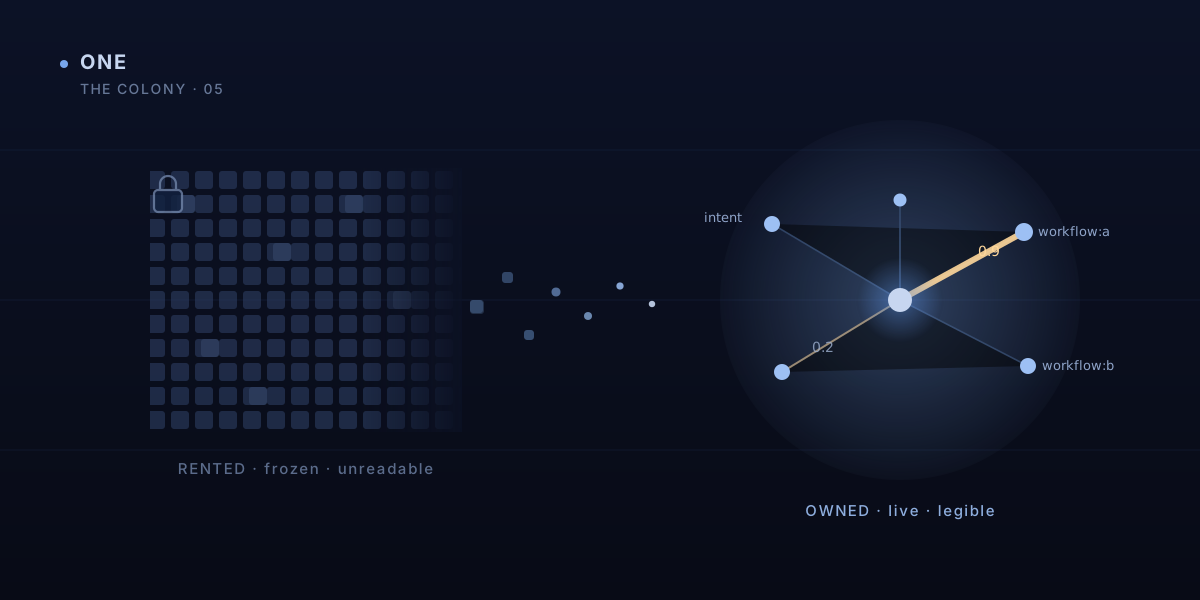
Two systems in ONE both learn by storing numbers called weights. They sound like the same thing. They are opposites, and the gap between them is the reason you can own your AI instead of renting it.
Let me start by killing a false fight. A language model’s weights and ONE’s weights are not competing to do the same job. The model’s weights hold general ability — language, reasoning, knowing what a contract is. ONE’s weights hold specific memory — which of your options actually worked, which route paid off, who to trust with the next request. The model is the reasoner. ONE’s weights are the map the work leaves behind. You need both. But they are built, stored, and owned in completely different ways, and that’s what’s worth seeing clearly.
What a model’s weight is
A large language model is billions of numbers in a giant grid. They were set once, by training a network against a mountain of text until it got good at predicting the next word. When it finished, the numbers froze.
Here’s the strange part: no single weight means anything. What the model “knows” about your industry isn’t stored in one place you could point at. It’s smeared across billions of parameters at once, each one carrying a faint piece of a million unrelated things. That’s not a flaw in the design — it’s how the compression works. But it has consequences you feel:
- You can’t read it. There’s no weight you can look up that says “this is what it learned about your customer.”
- You can’t edit one thing. Changing a fact means fine-tuning, which nudges millions of numbers and can quietly break things that used to work.
- It doesn’t learn from today. The conversation it’s having right now changes nothing. Whatever it picks up lives in the prompt and vanishes on the next call. The weights never move at inference.
- It isn’t yours. The base model belongs to the vendor. Your fine-tune rides on top of theirs, tied to their version and their schedule.
A model’s weight is rented, frozen, and unreadable. That’s the trade you make for general intelligence, and it’s a fair trade — for the general part.
What a ONE weight is
ONE stores its learning as a number on a connection. The connection from this kind of request to the thing that handled it well has a strength. The connection to the thing that failed has a resistance. That’s it. A weight sits on one named edge and means exactly one thing.
Everything the model’s weights can’t do, these can:
- You can read it. “Show me every route stronger than this” is a query. You can look at the whole map of what your system has learned, edge by edge.
- Every weight has a why. It got strong because specific things succeeded, weak because specific things failed — and each of those events is on record. You can trace it.
- It learns from right now. One success adds to the connection immediately, and that changes the very next decision. No training run, no batch, no waiting.
- It’s yours. It lives in your database. Swap the model underneath for a faster or cheaper one and the map doesn’t move an inch.
A ONE weight is owned, live, and legible. And it costs one small write to update — not a fine-tune, not a GPU bill, not a regression test.
The two that split them cleanest
One number, or a billion at once. A model learns by adjusting every weight together against a global target — the whole grid moves or none of it does, in a heavy batch, offline. ONE learns by moving one number on one edge when one thing happens: reward what worked, mark down what didn’t, let the unused fade. Local, instant, no global math. It’s closer to how an ant colony lays a trail than to how a neural net trains — and it’s why ONE can learn from a single event while the model can’t learn from the conversation it’s in.
Frozen, or alive. The model’s weights are fixed the moment it starts answering. ONE’s weights move while it works, and that’s the whole test of whether a system is actually learning: does what just worked change what happens next? For the model, no. For ONE, yes.
Why this is the argument
Line them up and the strategy writes itself. A model’s weights are general ability you rent — frozen, opaque, versioned by someone else. ONE’s weights are specific memory you own — live, readable, and untethered from any one model.
So keep the rented thing rented. Use the best reasoner available this month; swap it next month when a better one ships. And let the thing that actually compounds — the record of what worked for you — build up as weights you can read, audit, and carry anywhere. The general part stays a commodity. The valuable part stays yours.
The mistake the rest of the field is making is pouring the valuable part into the rented part — training their hard-won, company-specific knowledge back into a model’s weights, where it’s frozen, unreadable, and owned by a vendor. It feels like progress. It’s handing your memory to someone else’s grid.
Keep the two kinds of weight where they belong. General capability in a model you rent. Institutional memory in a map you own. The reasoner can change every month. The trail is yours to keep.