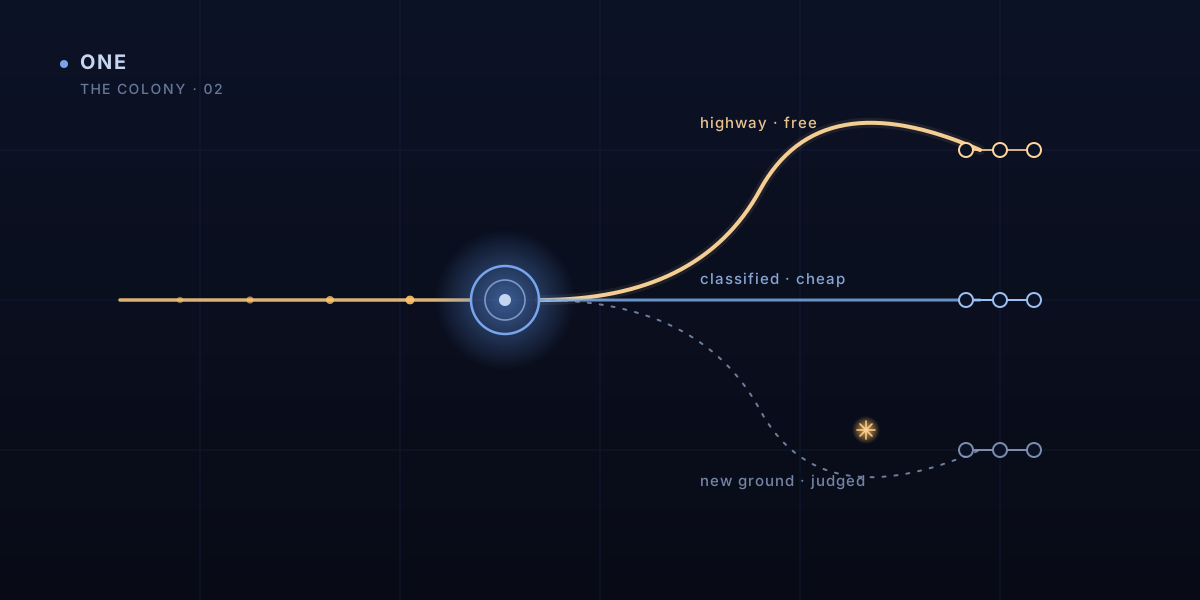
We changed how work moves through ONE, and it’s fair to ask whether we broke the part that matters.
For a long time the shape was simple: a request came in, and it went to an agent. The agent thought about it and did the work. Now the shape is different. A request comes in, a router decides who handles it, and it flows to a workflow. So the honest question is the one an engineer asks in the corridor: did we just replace the thing that made the network intelligent?
No. And the reason is a single test that has nothing to do with the word “agent.”
The only test that matters
The network gets smart the same way an ant colony does. No ant is in charge. Each one drops a trail on its way to food, the trails that lead somewhere good get reinforced, and the whole colony converges on the best route without any ant ever deciding. The intelligence lives in the trails, not in the ants.
There’s exactly one test for whether a system like that is actually alive:
Does rewarding a path change the next choice?
If yes, you have a colony, and intelligence emerges. If no — if you record the reward but never read it back when the next request arrives — you have a very well-organized logbook. The two look identical on paper. They diverge only at runtime, on that one question.
Notice what the test does not ask. It doesn’t ask whether the receiver is an agent, a workflow, a person, or a payment processor. The network never cared what sits at the end of a path. It only cares whether the reward bends the next decision.
Run the change through the test
Here’s what happens now when a request finishes. Every completed run rewards its path — the connection from this kind of request to the workflow that handled it gets stronger on success, weaker on failure. And when the next matching request arrives, the router reads those connections before it asks any model anything. A request the network has seen work before goes straight to the proven workflow, instantly, for free.
So the reward lands on a real path. The next request reads that path first. The reward changes the next choice.
Test passed. The colony is alive.
If anything, it’s more alive than before. Sending every request to an agent that reasons from scratch is closer to the logbook than to the colony — the network was writing down what worked but not actually routing on it. The model was in charge, and the trails were just history. Now the trails are the router, and the model only steps in when the trails can’t answer. We moved the intelligence out of the model and into the network, which is exactly where the colony keeps it.
So did agents go away?
They didn’t. This is where the question hides a false choice.
An agent was never a special kind of thing in ONE. It was one kind of receiver — an address you can send a signal to. A workflow is another kind of receiver. A person with a wallet is another. The network treats them all the same: send the signal, reward the path, let unused paths fade. What’s at the end of the path is the receiver’s business, not the network’s.
Two things changed, and neither removes agents:
- The agent became a step. A workflow is a small graph, and one of the steps it can contain is “hand this to an agent and let it use its judgment.” The default front desk every workspace gets is three steps: a request comes in, the router picks a lane, an agent handles what needs handling. The agent is still right there, as the step you reach for when nothing cheaper will do.
- The router’s open-judgment lane is an agent. When a request is genuinely new and no proven path exists, it goes to real judgment — the expensive kind — which might even build the workflow on the spot. That choice becomes a new path the next request rides for free.
So a workflow that ends in an agent step is a signal flowing to an agent. You didn’t route around agents. You wrapped them in something the network can remember and reuse. The judgment happens once; the memory of it is free forever after.
The three lanes the router picks between are the whole colony in miniature. A proven request rides the trail, no model touched. A near-match gets a small, cheap model to pick among the workflows that fit. A brand-new one gets an agent’s full judgment. The expensive, uncertain step got pushed to the edge where it belongs, and everything proven runs on the trail. The model stays the one guessing step in the system. Everything else is the network getting smarter on its own.
The one way you could actually break it
Being honest: there’s a version of this that would kill the colony, and it’s worth naming so we don’t drift into it.
A colony needs three things running all the time. Choices to pick between — more than one workflow able to claim the same kind of request, or there’s nothing for the network to select. Selection — the reward has to bias the next draw, which is what the router now does. And forgetting — the paths have to fade, so a route that used to work but stopped can lose its grip instead of ruling forever.
Wire every request to exactly one workflow, carve it in stone, never let another compete, never let it fade, and you’re back to the logbook — a tidy map that stops matching the territory the day the territory moves. The change we made keeps all three alive: new workflows can stake a claim, the router rewards the winner, and the trails fade like they always did.
Keep those three honest and the network doesn’t care that the receivers are workflows now. It never cared what they were called. It only ever cared whether the last thing that worked makes the next thing faster.
It does. Say it once, and the colony remembers.