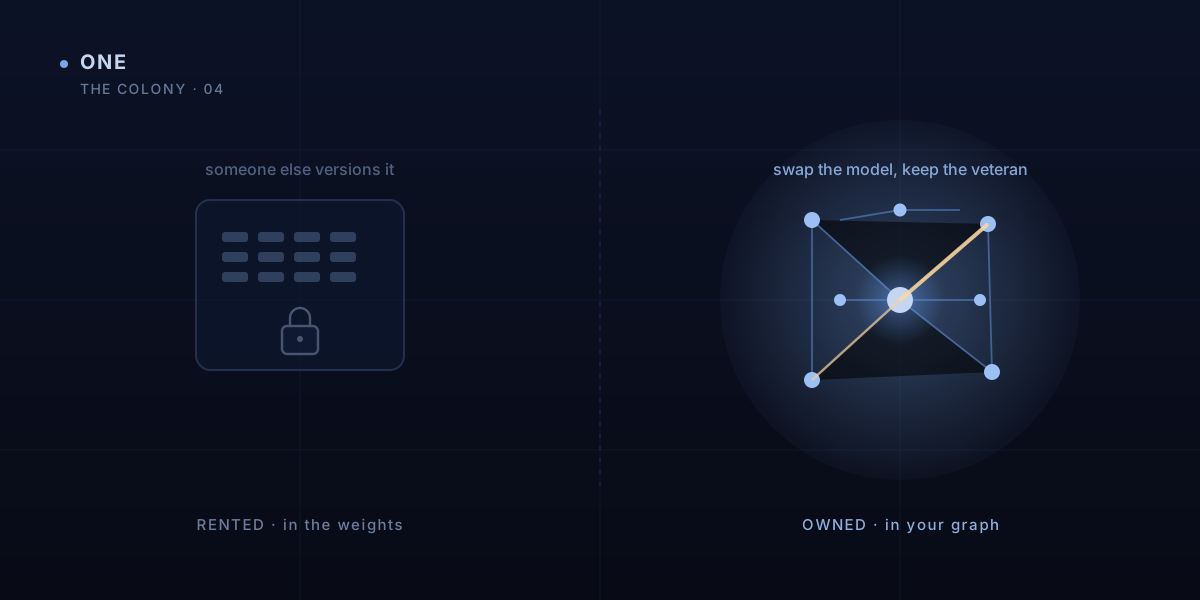
Every company buying AI right now is making the same quiet mistake. They pour what they learn into a model they don’t own.
You fine-tune. You build a private training loop. You feed your best judgment back into the weights, and the model gets sharper at your work. It feels like progress. It is progress — for a while. Then the vendor ships a new version, or raises the price, or changes the terms, and you find out the truth: the veteran you spent a year training lives in a weight file someone else versions. Swap the model, lose the veteran.
That’s the whole game, and almost everyone is losing it without noticing.
The one question that decides who owns their AI
There’s a single test. Satya Nadella framed the shape of it — a firm in an AI economy builds two kinds of capital. Human capital: the judgment and relationships of its people. Token capital: the AI capability it owns. Both compound. The question is whether the second one is actually yours.
So ask it plainly:
Can you swap out a generalist model without losing the expertise your system built?
If the answer is no, you don’t own your AI. You rent it, and you rent your own memory back with it.
ONE answers yes, and it does so by refusing the mistake in the first line of its operating manual: the brain is in the database, not the weights. Expertise accumulates as connections that strengthen when something works and weaken when it doesn’t — in TypeDB, a graph your company owns. The model is the only guessing step in the whole system. Everything it learns is written down outside of it.
Swap OpenRouter for Groq for whatever comes next Tuesday. The institutional memory doesn’t move. You pass the sovereignty test trivially, because you never made the mistake the test is built to catch.
What that buys you that nobody else has
Three things fall out of keeping the brain in a database you own.
The network gets smarter on its own — and you can read how. Every signal, every outcome, every payment strengthens the path it travelled. When one agent pays another for good work, the trail between them gets stronger, and the next agent that needs that skill finds it faster. The settlement is the reputation. Nobody has to write the review. And because it’s a graph and not a black box, you can see exactly what your system knows and why.
It’s small enough to trust. The runtime is around 670 lines. Six dimensions, not sixty tables. Six verbs, not sixty SDK methods. Complexity can’t be deleted, only moved — so ONE moves it inside the substrate and keeps it out of your way. A system you can read is a system you can own. A hundred thousand lines of someone else’s framework is a system you can only hope about.
Humans stay safe by physics, not by policy. An agent that spends your money hits a ceiling you co-signed once — with Touch ID, not a password. Under the limit it proceeds alone. Over it, the deal parks for your signature. The ceiling isn’t a rule an agent is asked to follow. It’s an on-chain object the agent cannot modify, tested with real transactions that abort when the cap is crossed. Not “we’ll keep it safe for you.” The substrate won’t express the unsafe state.
The frontier — and why the collective is the way across
Here’s the part that matters for where this is all going.
The frontier isn’t a bigger model. Google DeepMind’s From AGI to ASI (Genewein, Legg, Hutter and colleagues, 2026) lists four routes to superintelligence, and the fourth is a market of agents — a “virtual agent economy” where price signals coordinate thousands of specialists into something that solves problems no single participant could. Intelligence emerging not from a smarter brain, but from many agents trading, specializing, and compounding.
Their sharpest line is the one to tape above your desk:
Even if individual AI systems plateau near human level, group agent formation could push collective AI capabilities far beyond it.
When the model plateaus, the collective doesn’t. Everyone racing to own the smartest model is betting on a curve that flattens. The companies that cross the frontier will be the ones sitting where the collective intelligence accrues — and where it stays sovereign.
We’ve watched a version of this happen once. Before ONE there was a trading colony built on the same architecture: weighted trails, reinforcement, decay. It discovered a momentum strategy that hit 77.6% accuracy over 12,000 predictions — a pattern nobody programmed, that the system found and kept on its own. Honest caveat: that was a narrow domain with a fast, un-fakeable reward. We inherit the architecture, not the result. Reproducing that emergence in the open agent economy is the bet, and we say so plainly.
But the mechanism is thirty years old and proven, and the frontier’s most authoritative lab just named it as a road to superintelligence. When DeepMind independently lists your architecture as a pathway, you’re neither early nor wrong.
How we get you across
You don’t have to believe the horizon to get the near-term win. Sovereign, compounding memory that beats re-deriving the same answer twice — that alone is the most valuable thing in the room, and it ships today.
And it ships fast, because fast is the whole point. A wallet in 5 seconds, with Touch ID and no seed phrase. Crypto accepted at checkout in 60. Your first agent doing real work in three minutes. TypeDB brain, Cloudflare edge, no stack of vendored services to babysit.
Whoever is fastest wins. The way to be fastest is to remove friction. The way to remove friction is power through simplicity. That’s not three strategies. It’s one belief, and it runs all the way down to the 670 lines.
The models are a commodity now. What compounds is what your system remembers — and whether you own it. Keep the brain. Rent the rest.