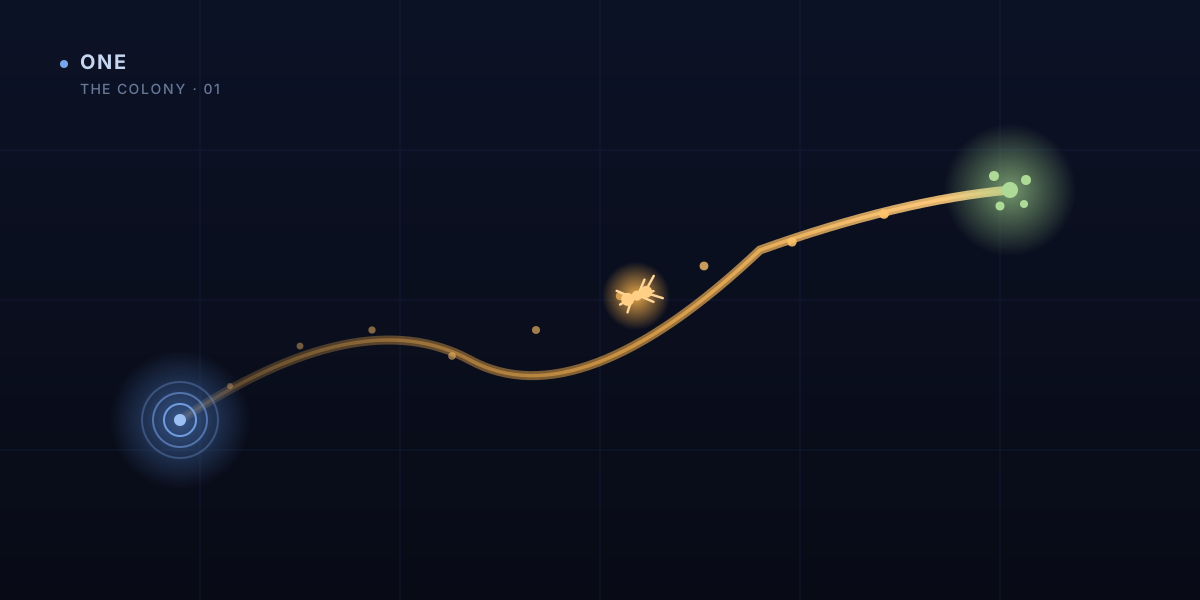
Watch a single ant. It leaves the nest and wanders — no map, no orders, no idea where it’s going. It stumbles onto a crumb, turns around, and heads home. On the way back it drags its belly along the ground and lays down a chemical. Then it’s gone. But the chemical stays.
That chemical is the pheromone, and here’s the thing almost everyone gets backwards: the pheromone is not the signal. The signal was the ant walking. The pheromone is what the walk left behind.
This sounds like hair-splitting. It’s the most important distinction in the whole system, so let me sit on it.
A colony has two different things
There’s the trip — one ant, one journey, over in a minute. Ephemeral. Local. On its own, frankly, a bit thick. It finds food or it doesn’t, and either way it’s finished.
And there’s the scent on the ground — which piles up wherever ants keep succeeding, and evaporates wherever they don’t. It outlives every ant that laid it. It’s shared by every ant that comes after.
Now the punchline: the intelligence is not in the trips. It’s in the scent. No ant holds the map. No ant could — an ant is too small and too short-lived to know the whole territory. The map is written in chemistry on the floor of the forest, a shared memory sitting outside every ant. The colony’s mind isn’t in the ants. It’s in the ground.
That is not a metaphor I reached for. That is exactly how ONE is built.
The same two things, in your system
Everything that moves through ONE is a signal — a request flowing to whoever handles it. That’s the ant walking. It happens once and it’s delivered and it’s gone.
What it leaves behind is a mark on the path — a little weight on the connection it just used. That’s the pheromone. It persists. It piles up when the same route keeps working. It fades when the route goes quiet.
So:
- The signal is the trip. The mark is the scent.
- A route that keeps working gets marked over and over until it’s a worn highway — the ant superhighway you’ve seen crossing a footpath, thick and unmistakable because ten thousand successful trips laid scent on the same line.
- A route that leads to a wall gets the opposite: an alarm scent that says don’t come this way.
- And all of it evaporates unless it’s topped up. Unused trails weaken and disappear.
Evaporation is the part people misread as a flaw. It’s the opposite. It’s how the colony abandons a food source that’s run dry and finds the new one. A colony that couldn’t forget would march forever toward crumbs that aren’t there anymore. Forgetting is how it stays right about the world.
Why the storage is split the way it is
This is also why ONE keeps its memory in two places, and once you see it as a colony you can’t unsee it.
The raw signals — every trip, who went where, when — get logged to one store. That’s the ant traffic. Noise, mostly. Individually worthless.
The marks — the accumulated weight on each path — live somewhere else, in the graph. That’s the scent map. That’s the knowledge.
And here’s the rule that makes it a colony instead of a filing cabinet: ONE routes off the scent map, never off the raw trips. When a new request arrives, the system reads the pheromone already on the ground and follows the strongest trail. It doesn’t replay history. It smells which way the ground says to go.
One request, as an ant
Say “chase the unpaid invoices.”
An ant sets out. At the first fork, its antennae read the ground. Three things can happen, and they’re the whole system.
If there’s already a strong trail for this kind of trip, the ant follows it straight to the food. The request goes to the workflow that has handled it before — instantly, no deliberation, free. Somebody paved that trail on an earlier trip, and every trip since has kept it fresh.
If there are only faint, competing trails, a quick sniff picks the strongest of them. Cheap, fast, nearly free.
And if there’s no trail at all — new ground — then one ant has to do the expensive thing: explore, use real judgment, maybe build the route from scratch. That’s the costly trip. But when it finds the food, it lays the first scent on that path. Now the trail exists. The next invoices-ant finds it for nothing.
The work finishes, and the ant lays its scent on the way home: success strengthens the trail, failure lays the alarm. Trails that stop paying off fade. The map keeps matching the territory.
Nobody is in charge, and that’s the point
The last piece is the one that makes it beautiful. Ants never talk to each other. One ant does not message another ant. It changes the ground — drops scent — and other ants read the ground later. All the coordination happens through the environment. There is no boss ant, no dispatcher, no meeting.
Your receivers work the same way. A workflow doesn’t call another workflow to ask what’s working. It emits a signal, the world marks the path, and the next receiver reads the path. Coordination runs through the shared ground, not through chatter between the workers.
That’s why the engine is about two hundred lines with no coordinator, no queue, no routing table. There’s nothing to coordinate. Drop the scent, follow the scent, let it fade. The colony gets smart because the ground remembers what the ants can’t.
Signals are trips. Pheromone is the mark left on the path. And the mind was never in any ant. It’s in the ground.