A book by Anthony O’Connell
100 Million Years Ahead
Why the Future of AI Looks More Like an Ant Colony Than a Brain
25 sections · 93,723 words · about 7 hours
Read it here, in order, and ask the guide beside you about anything you meet.
100 Million Years Ahead
Prologue · One Ant, August 1993
The temperature on the New Mexico dirt was above fifty degrees Celsius. Deborah Gordon was lying flat on her stomach with her face inches from the entrance of a harvester ant colony she had been tracking since 1985. By that August afternoon, she had been watching this particular colony for eight years. She would keep returning to this ground for thirty more.
That was the decision.
Every page is free to read here.
Contents
-
Part One Free
-
Part Two Free
The Six Things Every Colony Has · The City · The Market · The Scientific Community · The Body
The Six Things Every Colony Has to The Body, and 3 more
-
Part Three Free
The Brain · The Language · The Ledger · Why the Pattern Holds · The Two Materials
The Brain to The Two Materials, and 3 more
-
Part Four Free
What AGI Actually Is · The Ceiling of the Single Model · Alignment Is a Substrate Property · What Civilization Already Is · The Next Hundred Million Years · Epilogue: A Note on Reading · Notes: Notes on Sources
What AGI Actually Is to Notes: Notes on Sources, and 5 more
Contents
-
Part One Free
-
Part Two Free
- 8The Six Things Every Colony Has
- 9The City
- 10The Market
- 11The Scientific Community
- 12The Body
-
Part Three Free
- 13The Brain
- 14The Language
- 15The Ledger
- 16Why the Pattern Holds
- 17The Two Materials
-
Part Four Free
- 18What AGI Actually Is
- 19The Ceiling of the Single Model
- 20Alignment Is a Substrate Property
- 21What Civilization Already Is
- 22The Next Hundred Million Years
- Epilogue: A Note on Reading
- Notes: Notes on Sources
How intelligence is made: Prologue to Chapter 8
-
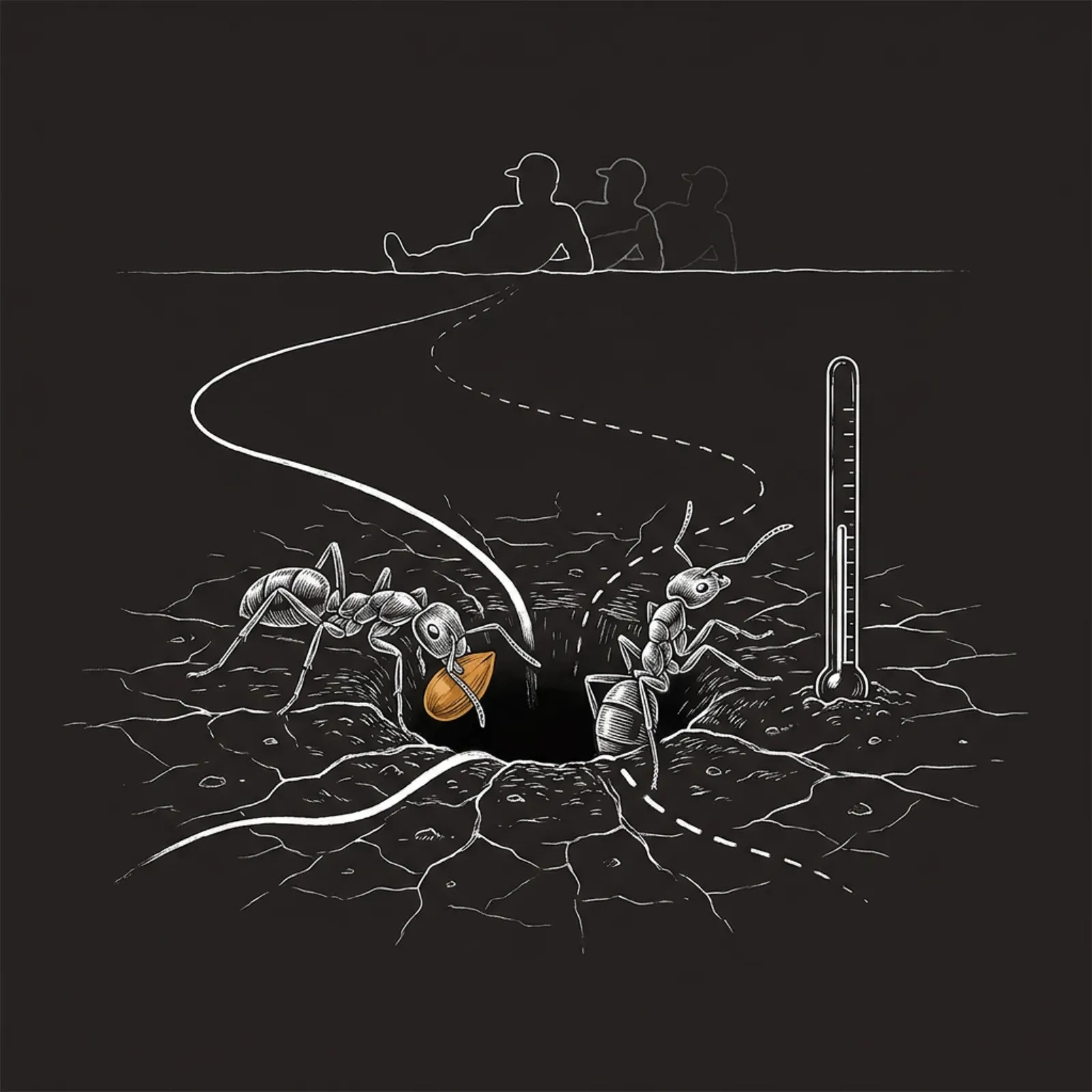 One ant at the door Prologue
 -
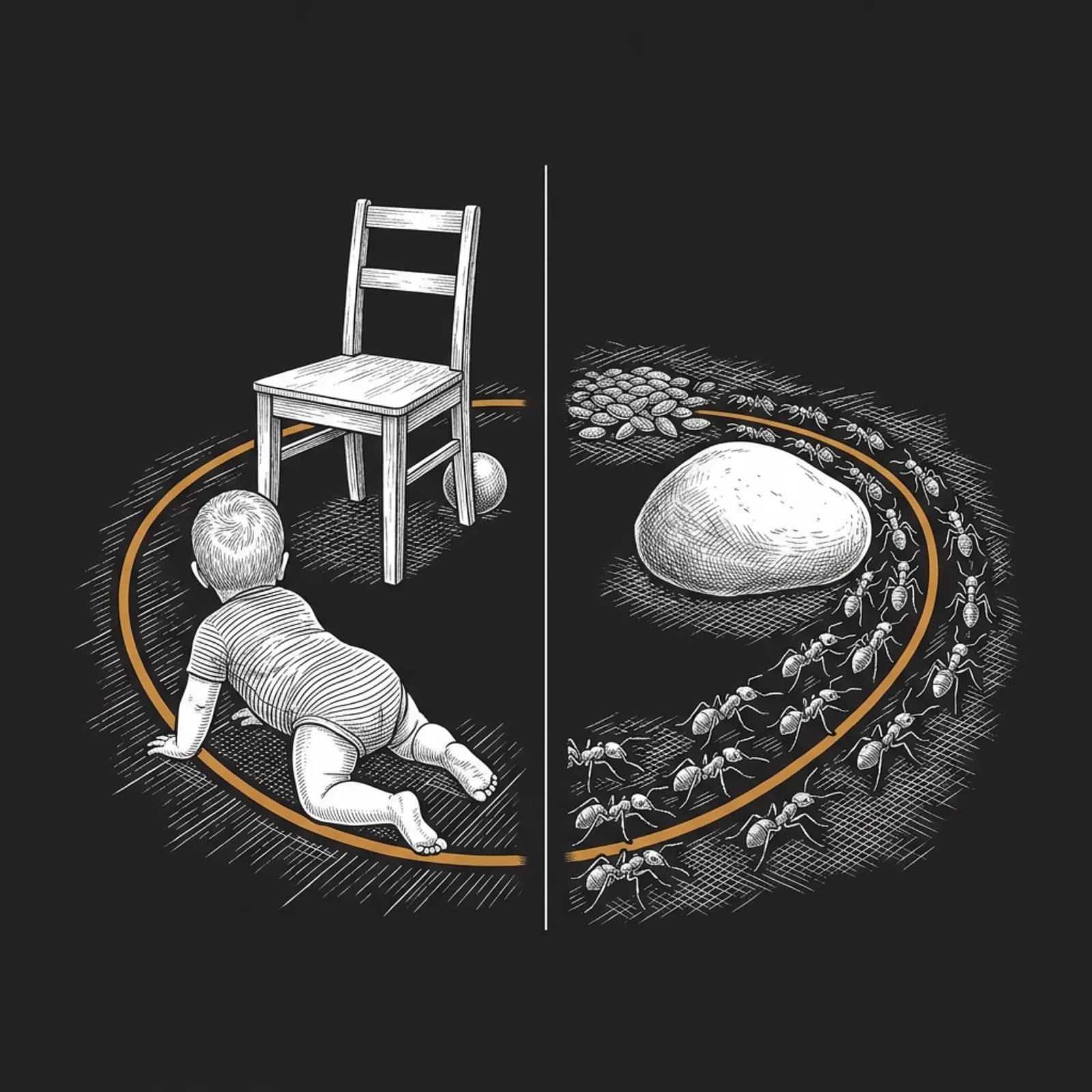 The same answer, written twice Chapter 1
 -
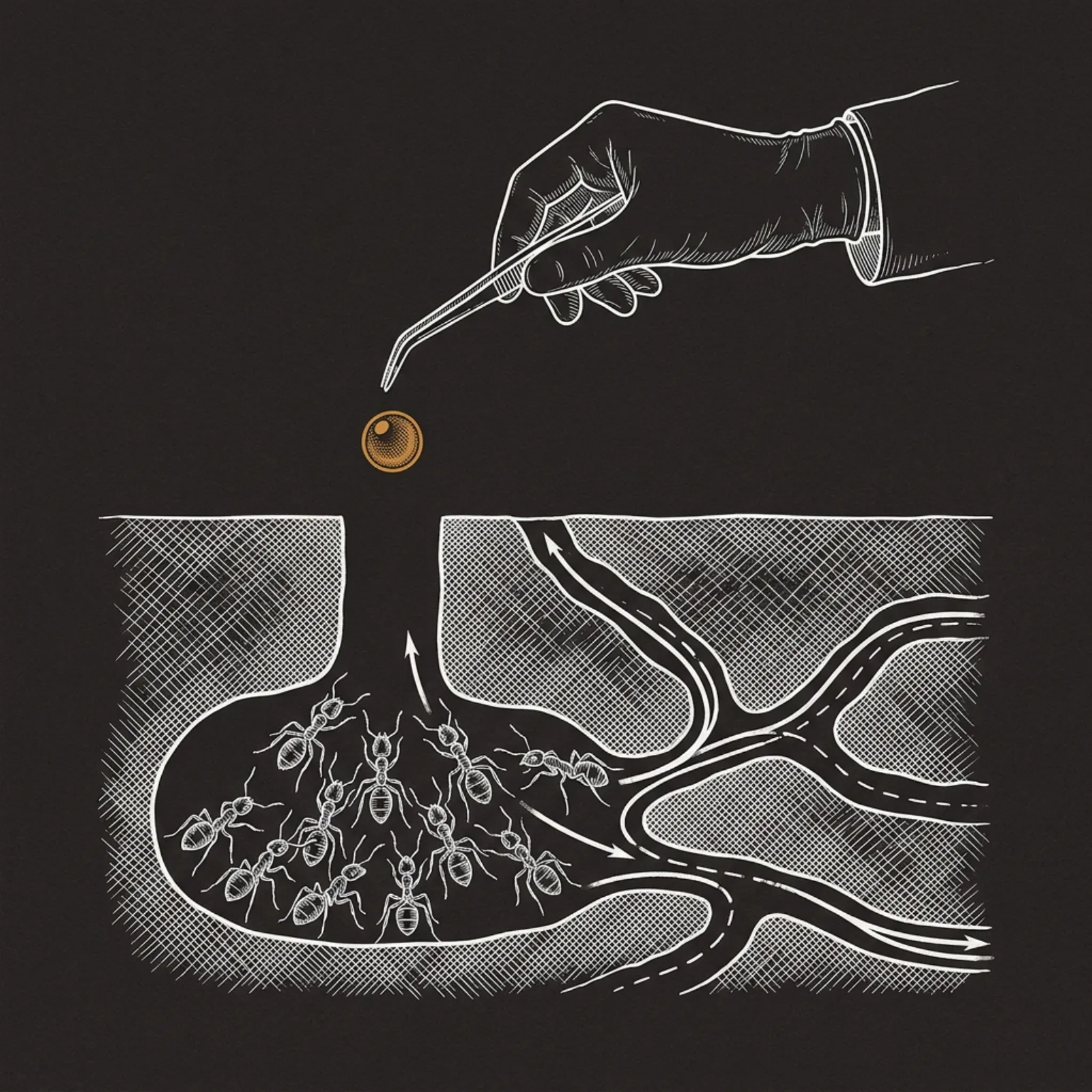 Glass beads at the entrance Chapter 2
 -
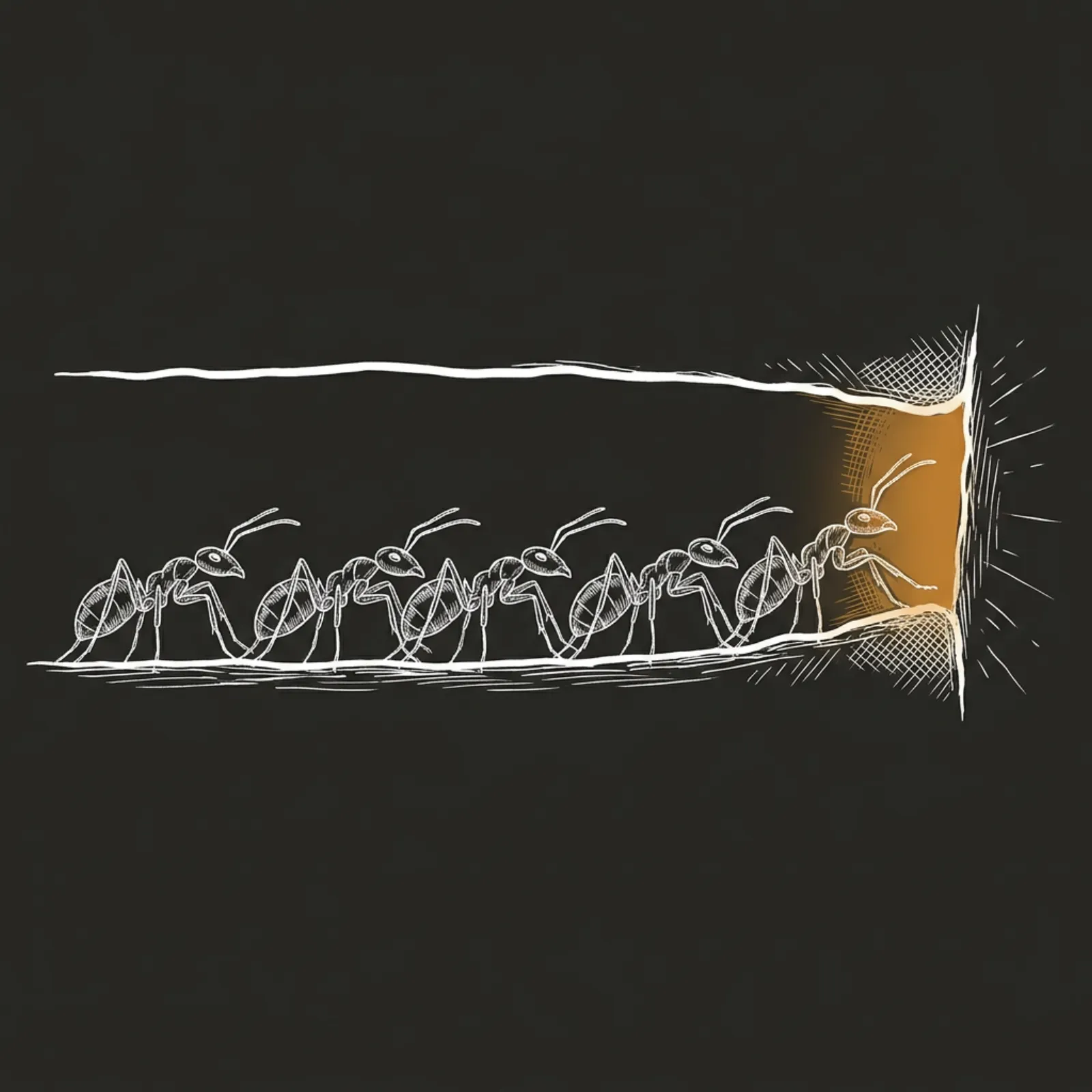 The eager go first Chapter 3
 -
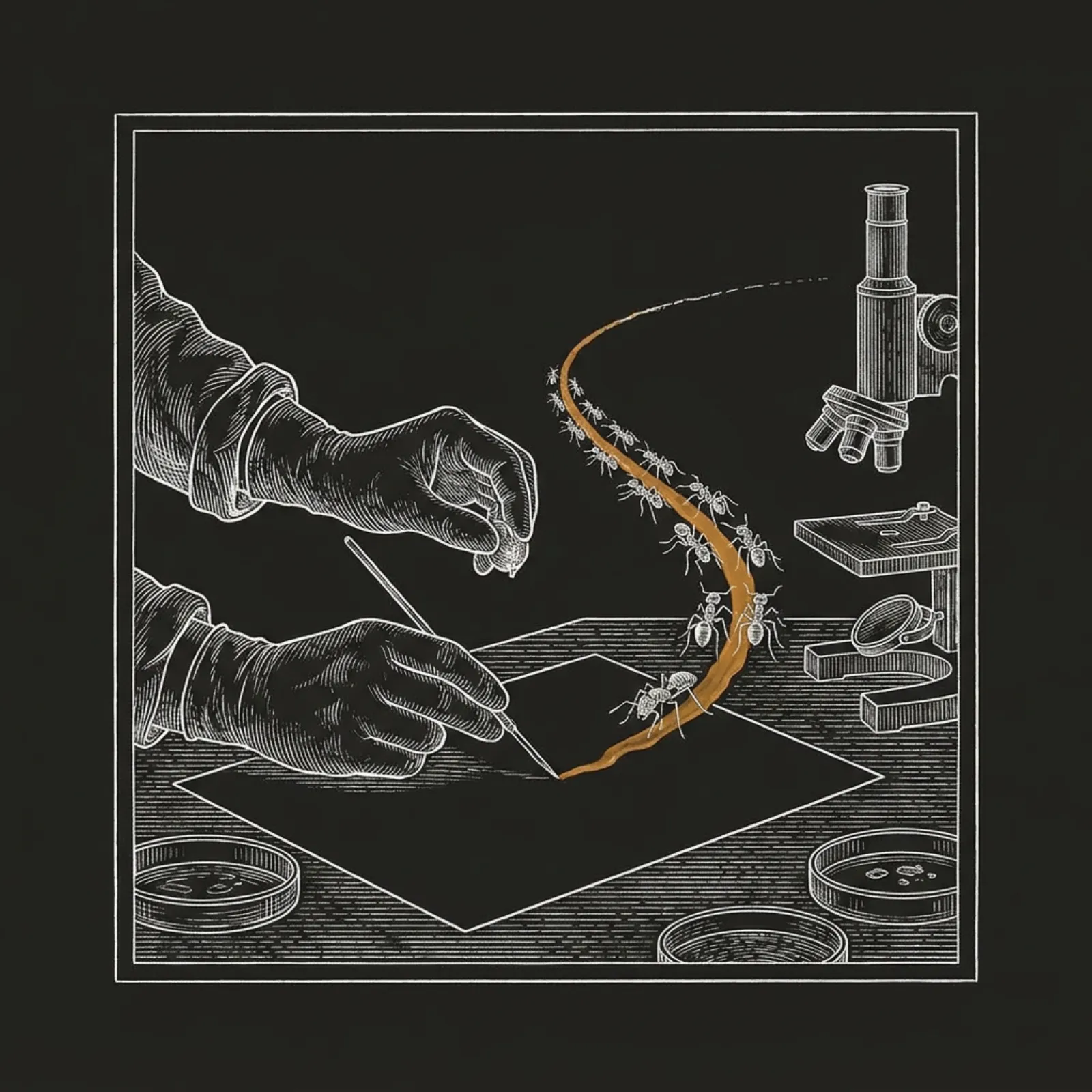 Wilson's smear Chapter 4
 -
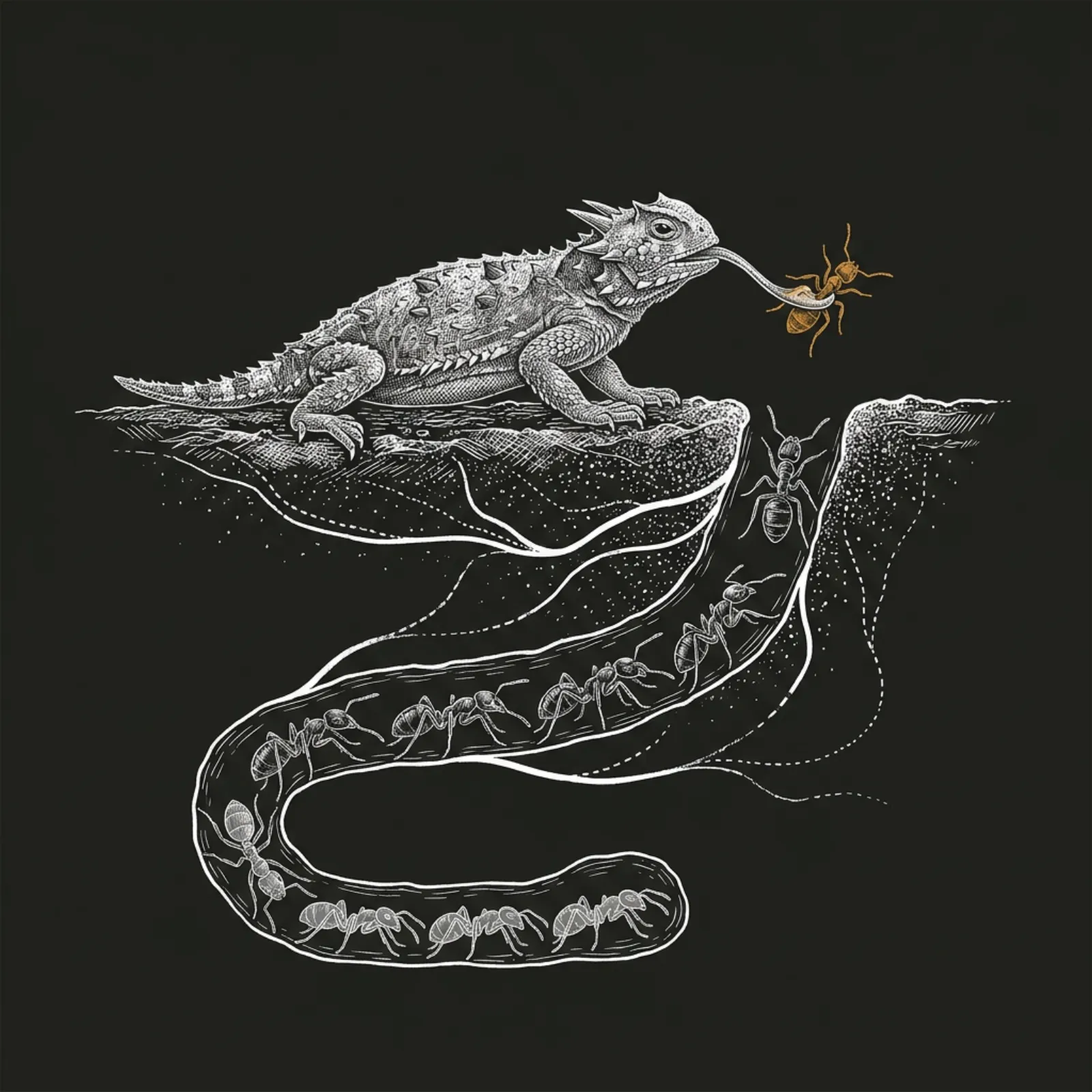 The horned toad at the door Chapter 5
 -
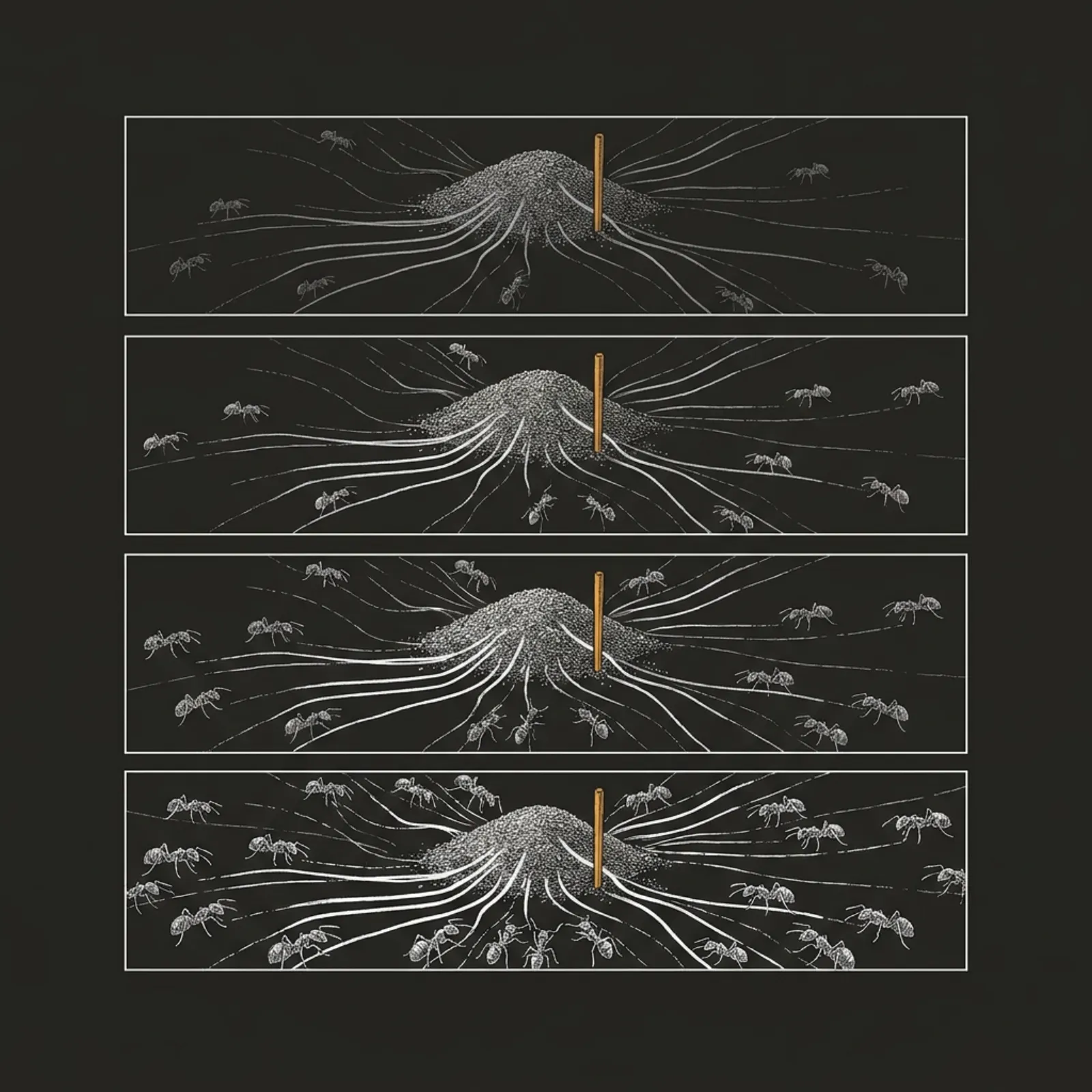 The mound across decades Chapter 6
 -
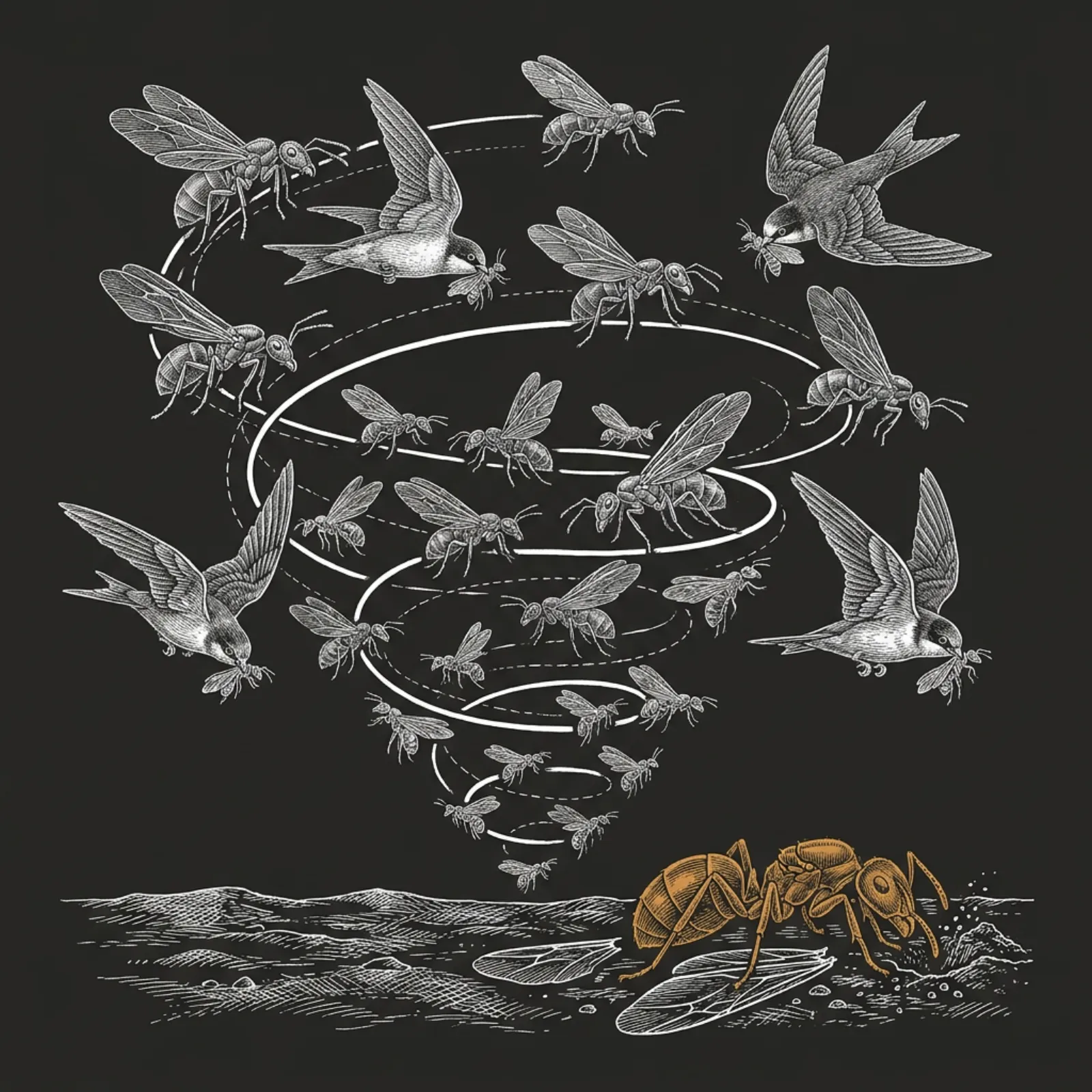 The lottery afternoon Chapter 7
 -
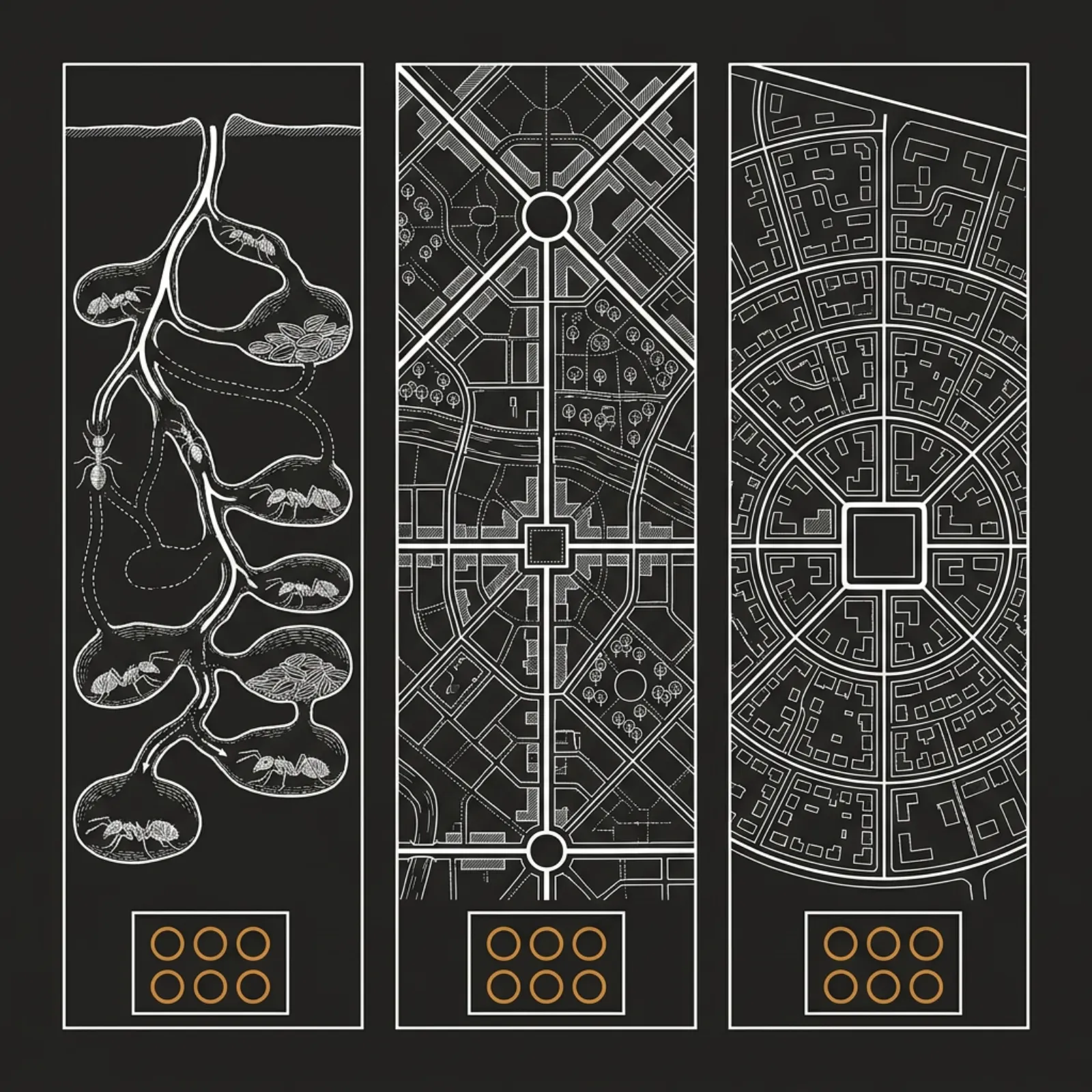 Three systems, one inventory Chapter 8
 - See the whole journey Every plate, and the diagrams that move
Editions
Contents
Movement One
The Colony
biology only; the notation arrives unnamed
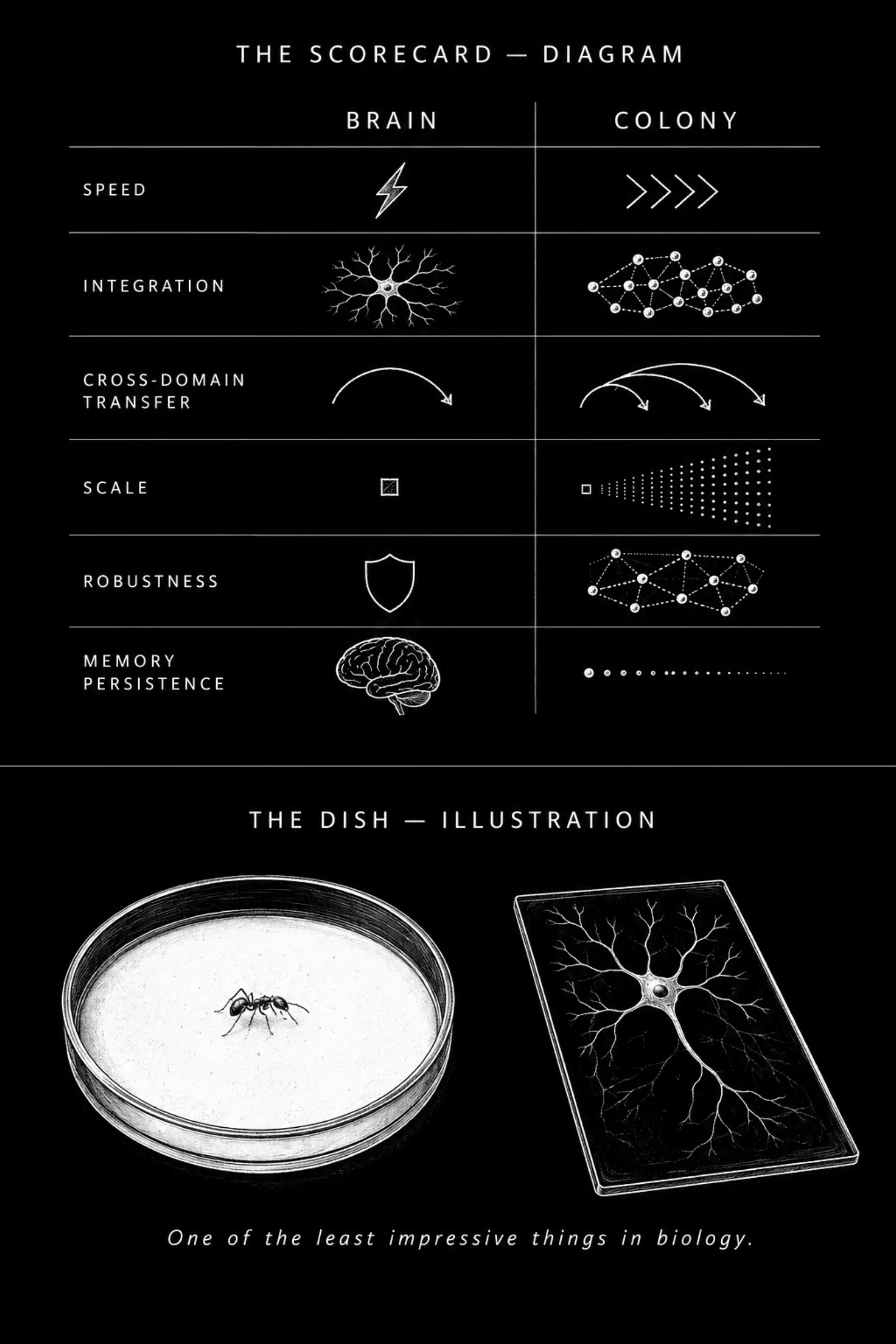
- 1 Brain or Colony? The brain and the colony win and lose on matched axes, speed against scale and a deep mortal memory against a shallow immortal one. The book concludes they are one architecture tuned to two settings, and asks what that architecture is. 16 min
- 2 What the Ants Are Doing Ant colony foraging emerges from patroller thresholds and return rates, without central direction, as a distributed response to environmental conditions. 19 min
- 3 How the Ant Decides An ant decides to leave the nest based solely on the rate of antennal contacts and chemical cues, not internal deliberation or external commands. 16 min
- 4 The Pheromone Trail Pheromone trails act as external memory: the soil holds the history of traffic, and ants follow concentrations without needing to remember. 17 min
- 5 The Castes Roles in a colony are not assigned. They emerge from the conditions each ant senses, persist while those conditions persist, and reorganize on their own when a gap changes what its neighbours sense. 15 min
- 6 How a Colony Survives a Decade Colony survival over decades depends on the persistence of structure and relationships, not on individual ants, which are replaced annually. 15 min
- 7 The Queen Is Not in Charge The queen is not in charge: she is a reproductive specialist, not a decision-maker; colony intelligence emerges from worker interactions. 12 min
Movement Two
The Architecture
the same pattern in eight materials; the six dimensions named
- 8 The Six Things Every Colony Has Every colony must possess six fundamental components—agents, containers, work, paths, events, and knowledge—to function at all. 20 min
- 9 The City A city, like an ant colony, exhibits intelligence without a planner; outcomes emerge from local interactions and feedback on a shared substrate. 16 min
- 10 The Market Markets are colony-like substrates: prices emerge from millions of local trades, aggregating knowledge without any central authority. 17 min
- 11 The Scientific Community Scientific knowledge is a colony product: true findings propagate through replication and acceptance, not through individual authority. 17 min
- 12 The Body The body is a colony of cells: wound healing, immune response, and development arise from local chemical signals, not central control. 14 min
- 13 The Brain The brain, despite its power, uses colony-like mechanisms: eighty-six billion neurons communicate via local signals, producing intelligence without a central conductor. 20 min
- 14 The Language Language changes over centuries through local usage and amplification, resembling pheromone trails: no authority directs drift, only cumulative small shifts. 16 min
- 15 The Ledger A ledger is a substrate that enforces its own rules, with no single party holding it in place. Every earlier substrate, markets and science and law among them, depended on institutions that can decay or be captured. 11 min
- 16 Why the Pattern Holds The six-component pattern reappears across domains because any system facing many agents, limited information, and coordination needs will evolve it. 14 min
Movement Three
The Implications
finally AI, in general terms
- 18 What AGI Actually Is True AGI will not be a single model but a distributed substrate of interacting agents, learning and acting without central control. 25 min
- 19 The Ceiling of the Single Model Models are the most capable agents ever built, yet general intelligence has never been a property of an agent. It belongs to the substrate the agents are placed back into, which the models are still waiting for. 18 min
- 20 Alignment Is a Substrate Property Aligning AI systems requires designing the substrate (rules and feedback) to shape emergent behavior, not merely controlling a single model. 23 min
- 21 What Civilization Already Is Civilization is a substrate built by humans to overcome brain limits—memory, speed, computation—enabling collective intelligence. 16 min
- 22 The Next Hundred Million Years The colony architecture—agents, paths, knowledge—will outlast any particular species or technology, extending into deep time. 11 min